 Guide On Map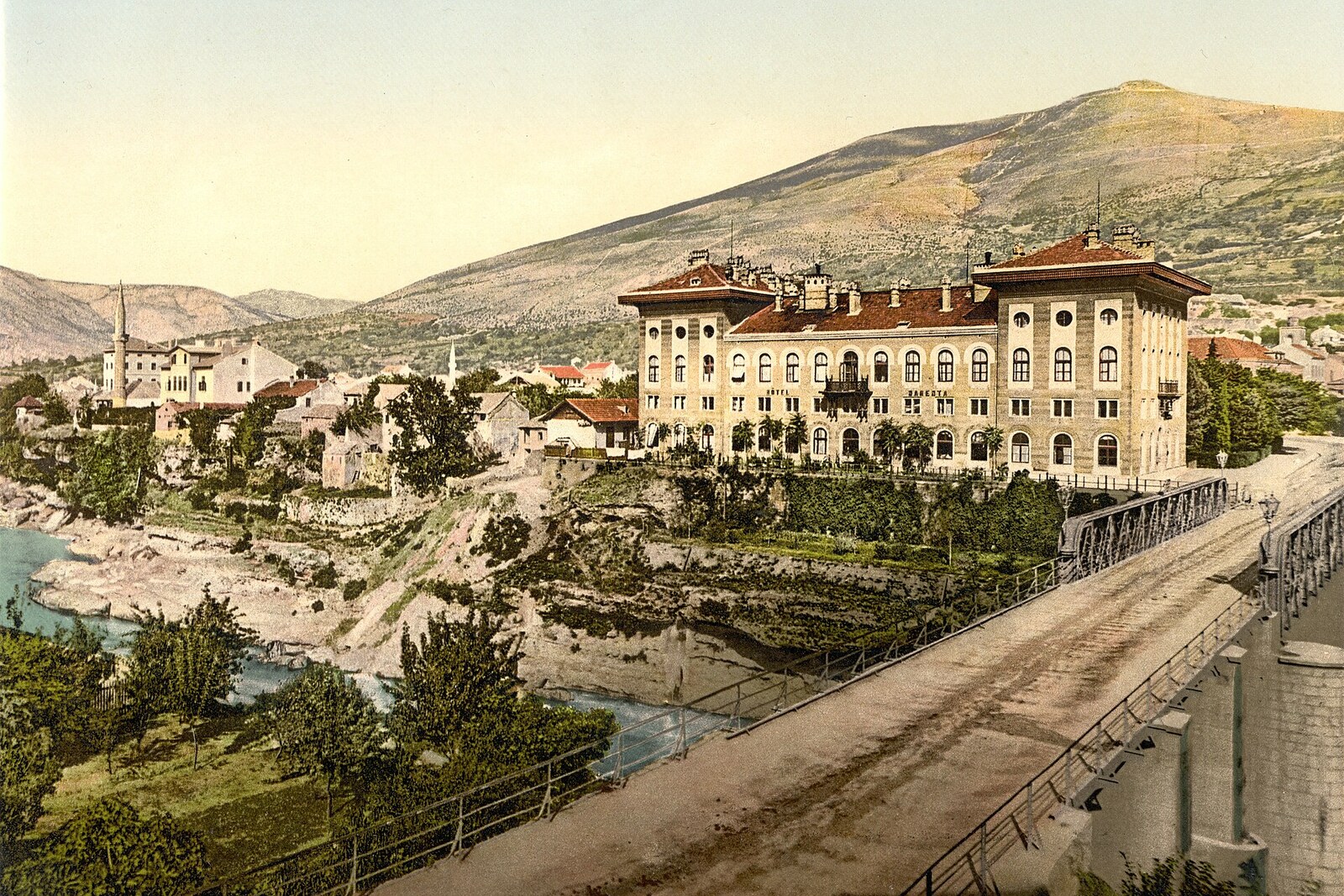
Look around first
What to notice
- Yellow-and-red facade stripes
- Western facade
- Eastern tower
- Cast decorative details
The story of the place
For visitors who had previously had to make do with hans and simple inns, Hotel Neretva was erected by the bridge. The facade's yellow and red stripes, the eastern tower, and Moorish-style ornament can be seen on the large building above the river. The rooms had private bathrooms, while downstairs there were a restaurant, meeting halls, and a reading room with newspapers from European capitals. From here, people went from the railway station to the new business district, and crossed the bridge into the old part of Mostar.
Musala is the old name for an open area used for communal prayer. Until the end of the nineteenth century, there was no ordinary city square here. The land belonged to the religious endowment of the neighboring Ćose Jahja-hodža Mosque, was enclosed by a stone wall, and could be entered only through a small gate from the mosque courtyard. On a rise stood a minbar—a pulpit from which a sermon was delivered before the holiday prayer.
In eighteen seventy-eight, the Austro-Hungarian administration began dismantling Musala. One townsman, whom the documents identify only by the surname Behlilović, decided to obtain building stone from here. He tore down the wall and the minbar and used them for his own house. The stone enclosure did not disappear through the passage of time: it was dismantled by a man who needed the material. With the enclosure, the former life of the enclosed prayer courtyard also came to an end.
Officials needed a route between the old part of Mostar on the left bank and the new business district growing around the railway station on the right bank. In eighteen eighty-two, a bridge was built by the former Musala. The area that had once been entered through the mosque found itself beside one of the city's main crossings.
Ten years later, Hotel Neretva appeared here. The architect Alexander Wittek received a commission for an imposing hotel for visitors, who had previously had mainly hans and simple inns available to them. By the bridge, he erected a building enormous for Mostar at the time, with yellow-and-red stripes and Moorish decoration. Its name was taken from the river, on whose very bank the hotel stood.
The managers hired cooks from Prague, arranged rooms with bathrooms, meeting halls, and a reading room with European newspapers. The restaurant served Wiener schnitzel and Sachertorte, a piano was played over dinner, and later people danced here. The hotel was needed in this location precisely because of the bridge: a visitor could get from the station to the new center, then enter the old town directly from here. The former prayer area became the city's main drawing room.
In nineteen ninety-two, the hotel sustained severe damage, and most of the building collapsed. What stands before you now was assembled while preserving the surviving sections of the western facade and the eastern tower. Craftsmen restored the missing decoration from traces and examples: they took impressions of the original ornaments, made molds, and cast the lost details anew. The walls of the prayer courtyard and the minbar disappeared in Behlilović's time; all that remains of them here is the word “Musala” in the square's name.
Useful on site
The square and exterior viewing are available at all times; entry to the hotel is not included. The hotel's actual operating status as of the verification date has not been confirmed.
Checked: June 24, 2026. Check the official source before visiting.View the hotel only from outside and remain behind the active barriers; the interior grounds and construction zones are not part of the route.