 Guide On Map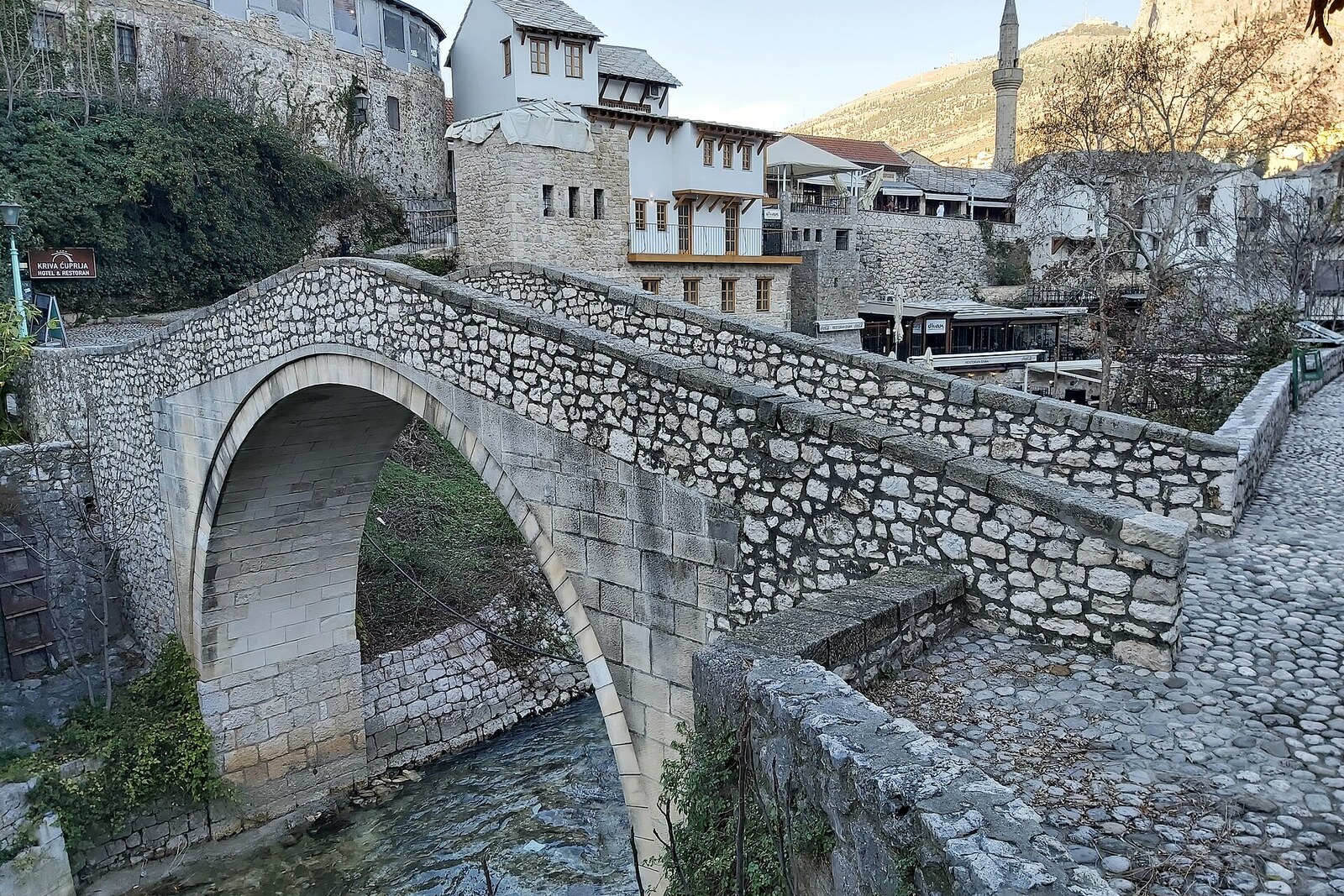
Look around first
What to notice
- Stone arch
- Bridge steps
- Radobolja riverbed
The story of the place
A single stone arch spans the narrow channel of the Radobolja, with steps running across it. In old charters it was called the bridge on the Radobolja, and the name Crooked Bridge took hold later, although its origin has remained unknown. The crossing linked the bazaar part of the city with the western road and the watermills and was among the city’s main thoroughfares until the railway. A flood destroyed the former arch in December two thousand, after which the bridge was returned to its former place, and the current vault has already been rebuilt.
A stone arch across the Radobolja appeared here before the famous crossing over the Neretva. In the middle of the sixteenth century, commercial and craft rows stood on one bank of the little river, while residential quarters, gardens, and watermills grew up on the other. The road from western Herzegovina came out here. Peasants crossed the bridge on their way to market, merchants passed through with pack animals, and workers made their way to the mills.
In fifteen fifty-eight, the Mostar official and benefactor Ćejvan Kethoda made sure that this route would not depend on occasional repairs. He established a waqf—property whose income was permanently intended for public and religious needs—and wrote in its charter that money was to be spent on maintaining “his bridge on the Radobolja River.” The document makes clear that the crossing already existed; it gives neither an exact construction date nor the name of the builder.
Six years later, Nesuh-aga Vučjaković, the owner of the neighboring watermills, left a similar instruction. The mills brought him income, and his workers walked to them across this bridge. Two men independently set aside part of their income for the same stone arch. Funds were to be issued whenever it needed repair. Thanks to this, a reliable crossing remained here between the bazaar, the mills, and the western road. Until the railway was laid through Mostar in eighteen eighty-four, one of the city’s main thoroughfares passed across it.
Its resemblance to the arch of the Old Bridge gave rise to a legend that its smaller model had been tested here in advance. The documents do not confirm this: Crooked Bridge was already mentioned eight years before the Old Bridge was completed, and historians have not been able to establish its builder.
The name also appeared later. In old charters, it is simply “the bridge on the Radobolja”; when and why it came to be called Crooked Bridge is unknown. Yet the stone vault forms a regular semicircle.
In December two thousand, a flood of the Radobolja destroyed the old arch. UNESCO specialists organized the restoration, Luxembourg paid for the work, and in two thousand one the crossing was returned to its former place. Today’s steps once again lead across the very same narrow part of the riverbed used by Nesuh-aga’s mill workers, although the stone vault above them has already been rebuilt.
Useful on site
Open pedestrian crossing without fixed hours; temporary restrictions are possible after bad weather.
Checked: June 24, 2026. Check the official source before visiting.Cross slowly and keep to the more comfortable side; wet smooth stone easily becomes slippery.