 Guide On Map
Moscow Kremlin and Kitay-gorod: the center of power
From Alexander Garden across Red Square and Varvarka Street to the Floating Bridge
Guide On Map on your phone
Open the walk like a regular app
It takes about 10 seconds to install. No app store needed.
The whole path
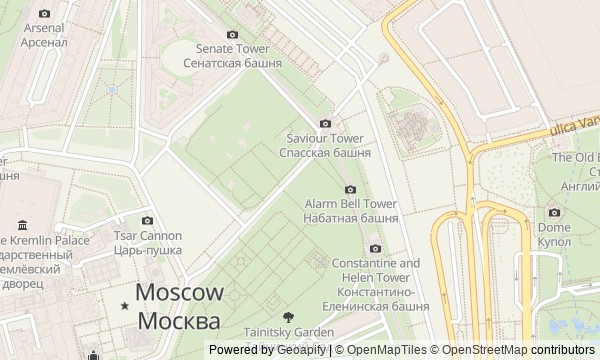
Route map
About the walk
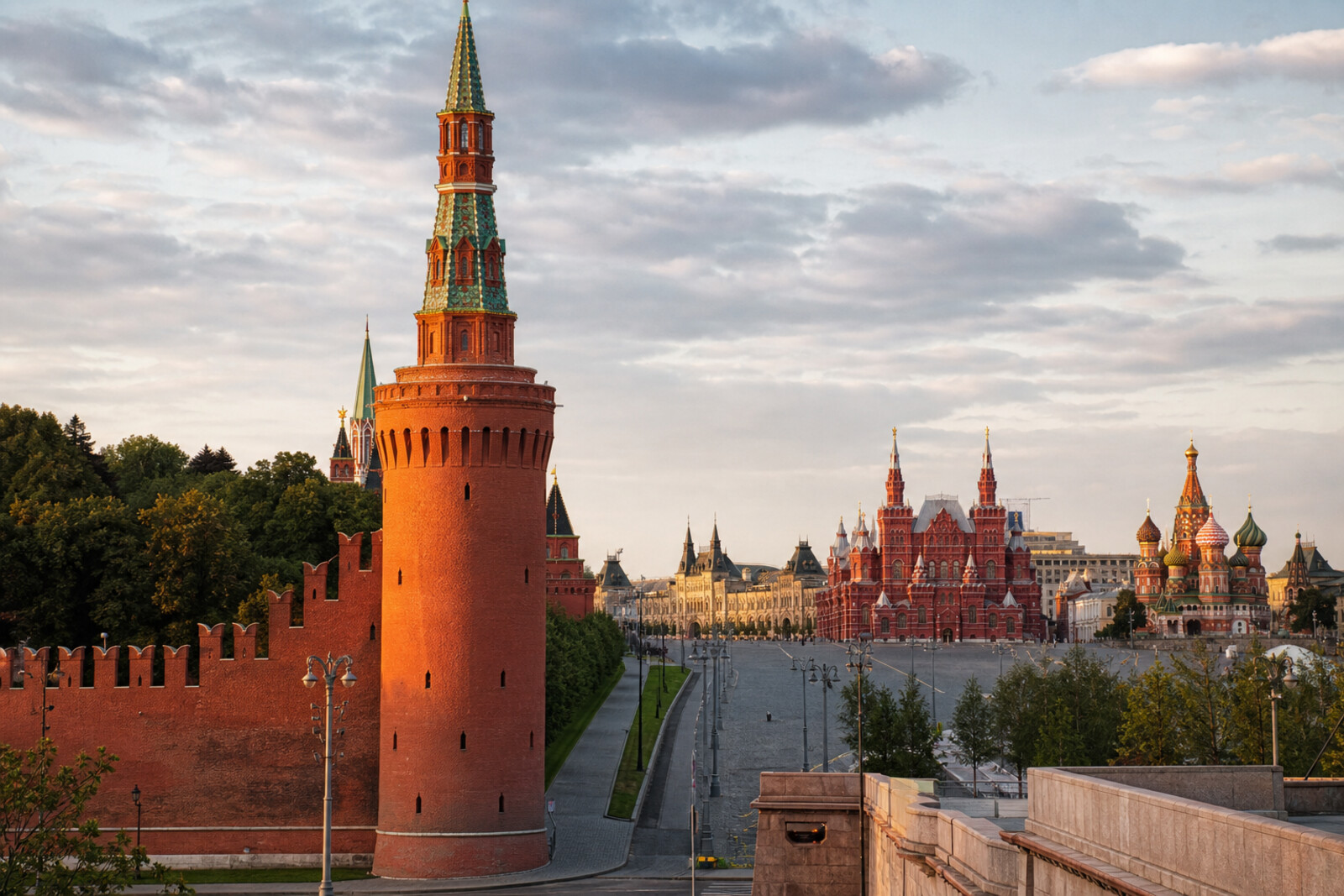
You will walk from Alexander Garden past the Moscow Kremlin gates, cross Red Square, and descend Varvarka Street into Zaryadye. Familiar postcard views will follow one another: a memorial by the wall, a stone platform, trading arcades, cathedral domes, merchants' chambers, a boyar house, and a bridge above the river.
Instead of a broad overview, you will unpack the precise decisions that changed memory, faith, trade, and the cityscape itself here. Why was one pronoun replaced in an inscription? Why was an envoy lavishly fed but kept from leaving his house for months? Why were spectators asked not to disperse while a fire raged nearby?
The account will be calm and concrete. It will separate document from legend and show consequences through the things still before you. By the end, you will be able to explain how the Moscow Kremlin gates, GUM, the cathedral, the chambers of Varvarka Street, and the park on the site of a hotel make up one story of central Moscow.
Why this order
The route begins at the memorial in Alexander Garden, where you can see how official memory changed the very site by the Moscow Kremlin. Next, Trinity Bridge and two towers turn a decision made above into a narrow physical passage where the fate of those leaving was decided. From the towers, the road across Manezhnaya Square leads to Lobnoye Mesto, a platform from which power spoke to the city and where the city tried to answer back. GUM opposite continues this line through state management of everyday trade. From there, the cathedral at the square's southern edge returns the route to an earlier way of fixing victory in place. Beyond the cathedral, Varvarka Street exchanges the ceremonial square for chambers: Old English Court shows power through agreement and restricted freedom, while the neighboring Chambers of the Romanov Boyars show it through the creation of a dynastic past. The final descent into Zaryadye reveals a change on another scale: a park appeared on the site of a hotel, and the Floating Bridge opened a view of the river that had once been closed off.
Those who want to see the center's main places without a general retelling Those interested in people's decisions and the fates of buildings Those who enjoy separating confirmed fact from enduring legend
Those looking only for an overview of architectural styles Those who want a light account without stories of war, executions, and fire Those who want to spend the entire walk inside the Moscow Kremlin
Before you go
The main story can be followed outdoors, so decide in advance whether you want to include one museum interior: the Church of the Intercession on the Moat, Old English Court, and the Chambers of the Romanov Boyars can each easily change the pace of the entire walk. Check their access and visiting rules separately on their official pages; do not expect to enter every site without preparation.
Access to the Moscow Kremlin approaches and Red Square can temporarily change because of ceremonies and large public events. Before you set out, check city updates and bring headphones: near the guard, in the trading arcades, and on the bridge, it is better to listen without blocking the flow of people.
When to go
Without visiting interiors, the walk takes about 3 hours. One chosen museum extends it to 3.5–4 hours, while visiting the Church of the Intercession on the Moat, Old English Court, and the Chambers of the Romanov Boyars takes about 5.5 hours.
Backup plan
If the way through Red Square is closed, do not try to get around the cordons along the Kremlin Wall. From Manezhnaya Square, go to Okhotny Ryad, walk along Nikolskaya Street, and approach GUM from Vetoshny Lane. You can listen to the story of Lobnoye Mesto as a separate chapter without the exact visual setting. Then continue along Ilyinka Street to Kitaygorodsky Passage and emerge onto Varvarka Street: Old English Court, the Chambers of the Romanov Boyars, and Zaryadye will retain the route's sequence. In that case, view the Church of the Intercession on the Moat from the accessible side of Varvarka Street or from the park, without returning to the closed section.
Route conditions
Surface. Paved — 2.5 km (data covers 78% of the route)
Stairs. Flights: 10, 45 m in total
Access. Wheelchair — no; stroller — limited (stairs)
Facilities. Toilets — 15
Elevation. Ascent — 26 m; descent — 43 m
OpenStreetMap extract of July 9, 2026: database data, not a check on the ground. Data © OpenStreetMap contributors, ODbL licence
Walk plan
Open in maps ↗- 1
Alexander Garden
Here the route introduces its main theme: who changed memory in the country’s most public place, and through what decisions. - 2
Kutafya and Trinity Towers
The passage between two fortifications shows how the design of a gate could decide people's fate. - 3
Lobnoye Mesto
The stone platform will provide the setting for an episode in which a religious dispute was turned into a public victory. - 4
GUM
The shopping galleries will link a state decision to a queue for scarce goods. - 5
Church of the Intercession on the Moat
The cathedral's layout shows how a sequence of military events was translated into the language of church dedications. - 6
Old English Court
The merchants' chambers shift the route from a public square to closed negotiations over trade and alliance. - 7
Chambers of the Romanov Boyars
The family museum will show how a convincing image of the dynastic past was created in the nineteenth century. - 8
Zaryadye Park and the Floating Bridge
The final panorama makes it possible to compare the open park with the vanished mass of the hotel.
Route features
Everything you need stays in the browser
Progress, saves and your trip plan are stored on this device.
Add Guide On Map to your home screen so the walk opens outside the browser.
How we handle sources, maps and corrections: our editorial standards