 Guide On Map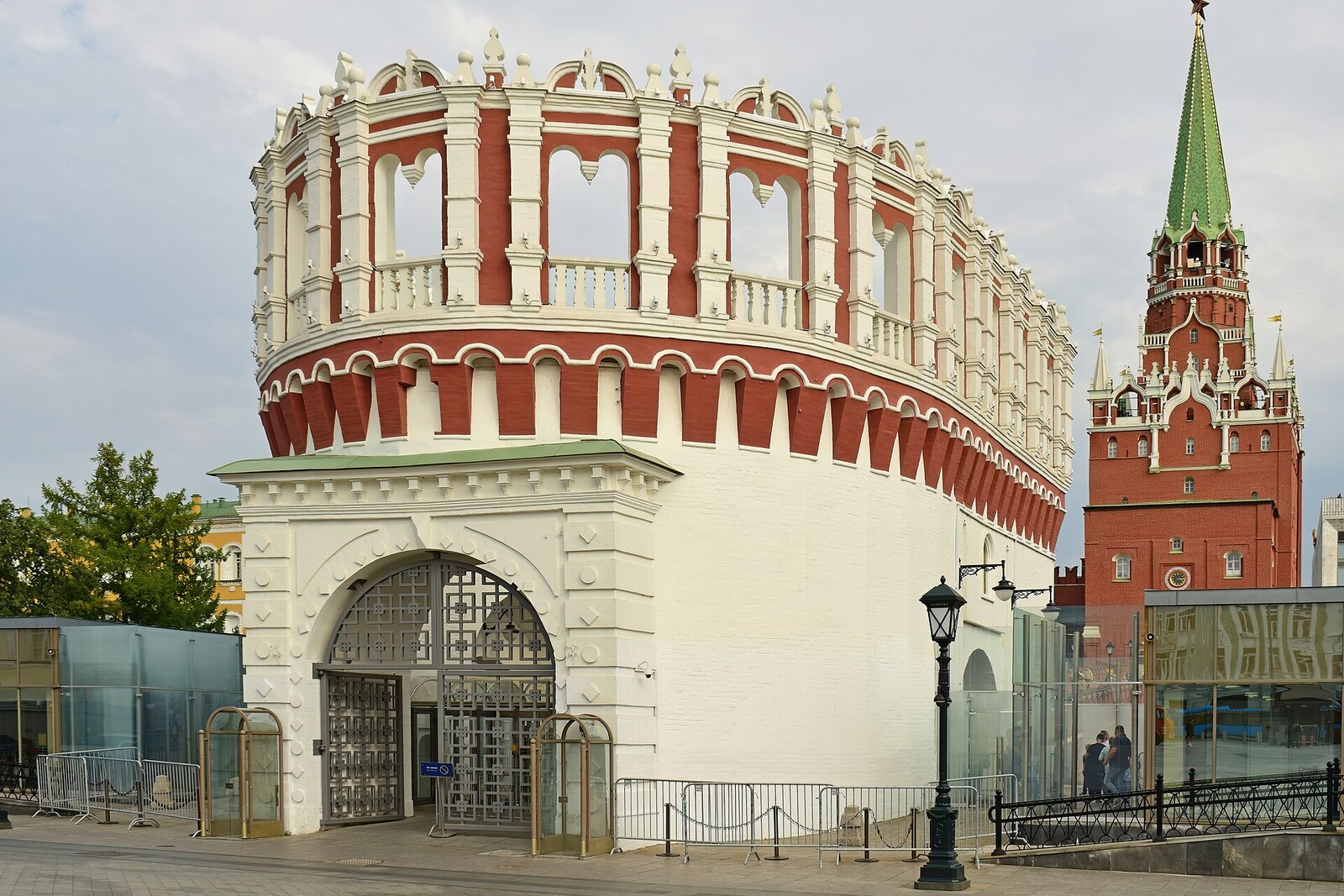
Look around first
What to notice
- Kutafya Tower
- Trinity Bridge
- The arch of Trinity Tower
The story of the place
Kutafya Tower protected the approach to Trinity Tower. At the end of the stone bridge, the low outer fortification remains, while beyond the bridge a tall tower rises in the Kremlin Wall. When the Neglinnaya River flowed here in the open, Kutafya Tower was surrounded by water and a moat, and bridges that could be raised led to its side gates. The stone crossing over the river was built in fifteen sixteen; the Neglinnaya River is now hidden underground, the moat has been filled in, but the tower, bridge, and arch of Trinity Tower remain in place.
At the end of October sixteen twelve, boyar families began to be released from the Moscow Kremlin through the passage now called Trinity Gate. Almost no food remained inside, and the Polish-Lithuanian garrison decided to reduce the number of people eating. For those leaving, this still did not mean safety: outside, people were waiting who considered the boyars traitors.
Two years earlier, several leading boyars—the tsar's highest-ranking advisers—had agreed, after the overthrow of Tsar Vasily Shuysky, to invite the Polish prince Władysław Vasa to the throne. A foreign garrison entered the Moscow Kremlin to support him. Władysław Vasa never appeared in Moscow, a siege began, and the families of those who had invited him remained behind the Kremlin Wall with the soldiers.
The exit was arranged so that it was impossible to bypass those waiting. In fifteen sixteen, a stone bridge was built across the then-open Neglinnaya River. On the far side of the river stood Kutafya Tower, surrounded by water and a moat; drawbridges led to its side gates. The other end of the crossing was closed off by a tall tower in the Kremlin Wall. People leaving the Moscow Kremlin found themselves in a narrow corridor between two fortifications.
At Trinity Bridge, they were met by Dmitry Pozharsky, the military leader of the Second People's Militia, who was seeking the garrison's surrender. Cossacks allied with him tried to rush at the boyars. Pozharsky's troops held them back and led those leaving from the bridge under guard.
Among those rescued were sixteen-year-old Mikhail Fyodorovich Romanov and his mother, Nun Martha. He had not made the decisions that had brought the garrison into the Moscow Kremlin, but he could have died along with his older relatives. A few months later, the Zemsky Sobor elected Mikhail tsar. Soon after the civilians left, the garrison capitulated, and the militiamen entered the Moscow Kremlin.
The tall tower was later called Trinity Tower, in sixteen fifty-eight, after Trinity Metochion—the Moscow representation of a monastery that stood inside the Moscow Kremlin. The origin of the name Kutafya Tower has not been established precisely. Museum researchers cautiously connect it with the old word “kut,” meaning a shelter or a corner; the popular version that it was the nickname of a stout woman remains a supposition.
The Neglinnaya River now flows underground, and the moat has been filled in. Of the former passage, the stone bridge, the arch of Trinity Tower, and Kutafya Tower—the Moscow Kremlin's only surviving bridgehead fortification—remain. Mikhail Fyodorovich Romanov and his mother left by this same route in sixteen twelve.
Useful on site
The Moscow Kremlin museums are generally open from 09:30 to 18:00; Thursday is a day off. Access to the grounds is through Kutafya Tower with a ticket for the appropriate route.
Checked: date not specified. Check the official source before visiting.The purpose of the fortifications is easy to read before the security zone. If you are not going into the Moscow Kremlin, do not join the line: look at the group of towers from the side, without obstructing those entering.