 Guide On Map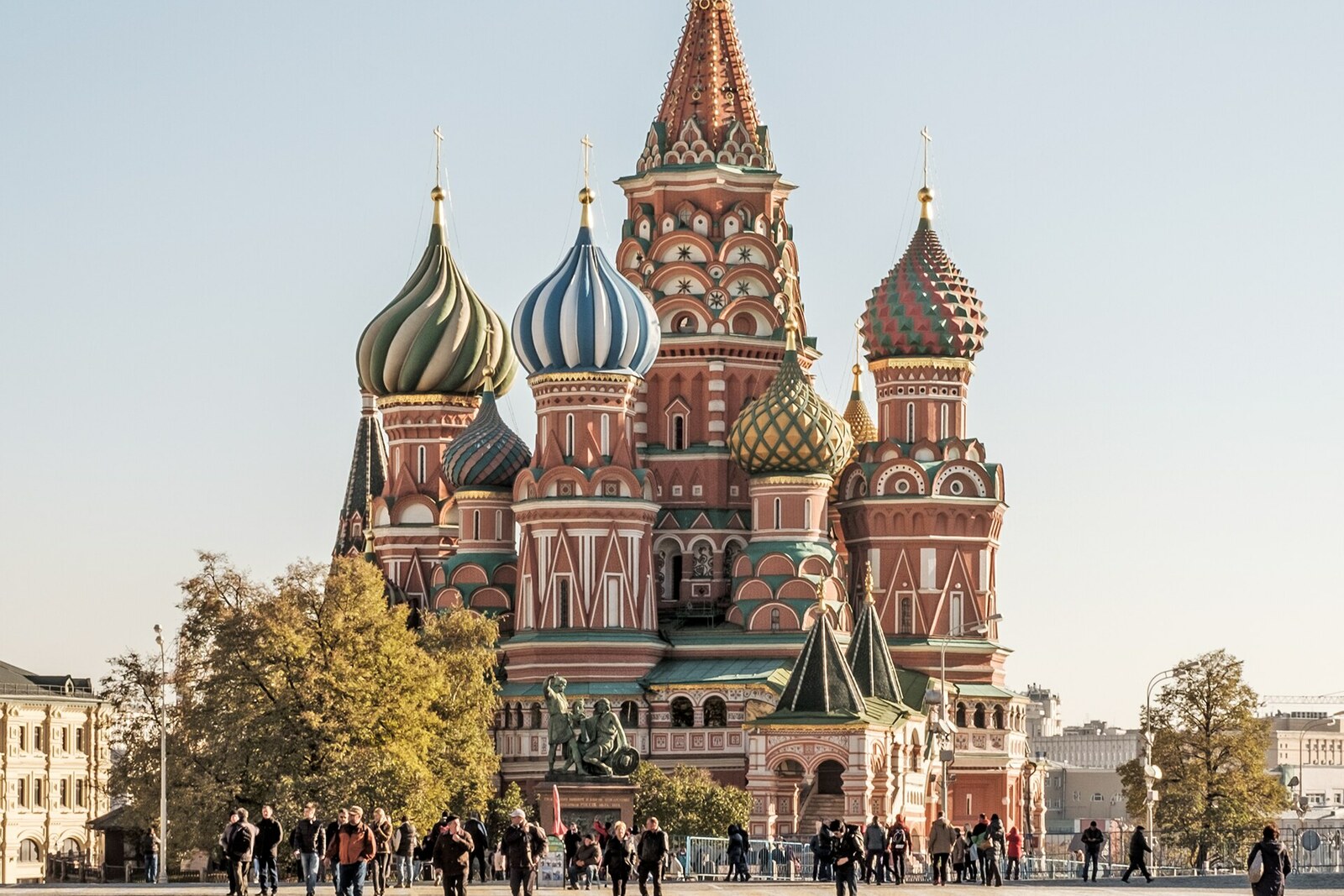
Look around first
What to notice
- Nine domes
- Central tent roof
- Exterior galleries
- Church of Saint Basil the Blessed
The story of the place
The nine domes and the central tent roof belong to the Church of the Intercession on the Moat, while its familiar name came from the small heated church below. The Moscow holy fool Vasily was buried here, beside the old Trinity Church, and a separate side chapel was later built above his grave. Services were held there all year round, so the name of the constantly open church gradually spread to the whole cathedral. The central church beneath the tent roof retained its dedication to the Intercession.
Beneath each large dome is a separate church, with its own altar and dedication. The nine original churches stand on a shared foundation and are linked by galleries. That is why there is no single spacious hall inside corresponding to the exterior volume: passages lead from one small church to another.
This layout was chosen after Tsar Ivan IV's campaign against Kazan. The twenty-two-year-old tsar personally led the army and sought to destroy the independent Kazan Khanate; two earlier campaigns that he commanded did not achieve that aim. The third ended in the autumn of fifteen fifty-two, after a siege lasting more than forty days. The city's defenders attacked the siege works, while the cavalry of the Tatar tsarevich Yapanchi, trying to help Kazan, struck the army from the rear. On August thirtieth, Yapanchi's detachment was routed. The decisive assault began on October first, and Kazan was taken on October second. Khan Yadegar Muhammad was captured, most of the male defenders were killed, and the Kazan Khanate ceased to exist.
For the church, each of these days already had its own name. On August thirtieth, three patriarchs of Constantinople were commemorated: Alexander, John, and Paul the New. On October first, the Feast of the Intercession of the Theotokos was celebrated. On October second, the martyrs Cyprian and Justina were remembered. The saints were not chosen for their participation in the war: Ivan IV and the head of the Russian Church, Metropolitan Macarius, used the church calendar as a system of names for the victory church.
At first, a wooden Church of the Intercession with side chapels was built here; the chronicles differ in their details of this first ensemble. Ivan IV then ordered it to be replaced with a stone one. Construction continued from fifteen fifty-five to fifteen sixty-one. The tallest, central church was dedicated to the Intercession, the feast on which the assault began. The northern church was named for Cyprian and Justina, the day Kazan was taken. The northeastern church was dedicated to the three patriarchs, the day Yapanchi's cavalry was routed. The domes show the arrangement devised by Ivan IV and Macarius: one military campaign divided into several church commemorations.
The familiar name, the Church of Saint Basil the Blessed, appeared later. While the builders were erecting the stone cathedral, Vasily died nearby—a venerated Moscow holy fool, a religious ascetic who had renounced property and lived on alms. He was buried here, beside the old Trinity Church. After Vasily's canonization in fifteen eighty-eight, Ivan IV's son, Fyodor I, ordered a separate church to be added above the grave. It was heated, services were held there all year round, and the name of the constantly open side chapel gradually spread to the whole cathedral. Vasily's tomb is still in this lower church, while the central tent roof still bears the name of the Intercession—the first day of the final assault on Kazan.
Useful on site
June 25–27, 2026 — 10:00–21:00; June 28–30 — 10:00–19:00; July 1 — closed. The ticket office and entrance close an hour before the end of opening hours; the first Wednesday of the month is closed.
Checked: date not specified. Check the official source before visiting.The cathedral's composite form is easy to make out from outside. The interior is visited separately; its narrow passages and stairways require more time than a quick look at the facades.