 Guide On Map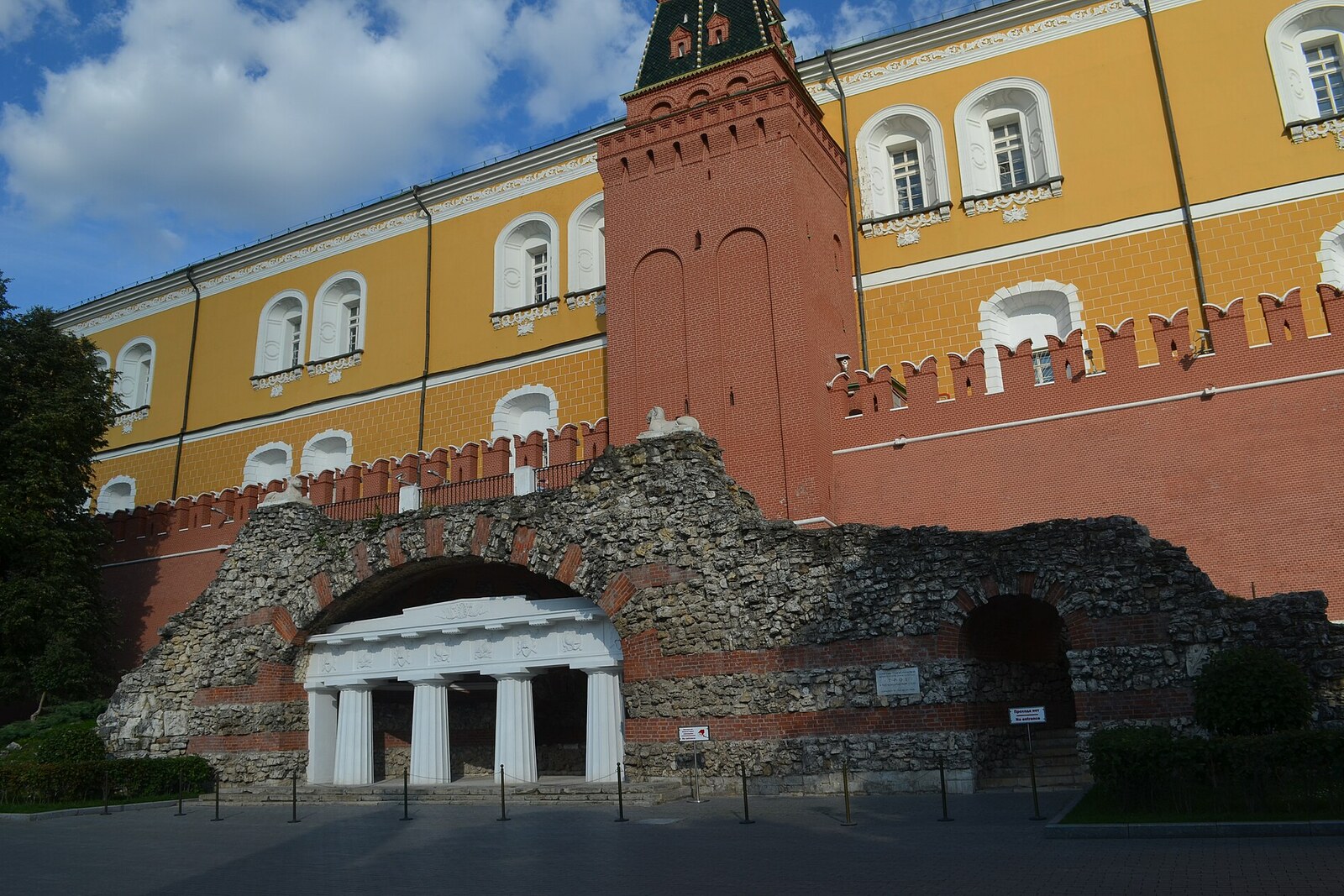
Look around first
What to notice
- Granite slab with an inscription
- Eternal Flame
- Honor guard
- Obelisk by the Ruins Grotto
The story of the place
This strip along the Kremlin Wall became a garden after Moscow’s devastation of eighteen twelve: Alexander I commissioned its improvement, and Osip Bove created a promenade garden here. By Middle Arsenal Tower, he assembled a grotto from stone and the remains of destroyed houses. Beside it stands an obelisk moved here from the entrance; it was first dedicated to the House of Romanov, and after the revolution its inscriptions were changed to honor revolutionary thinkers. The garden’s name preserves that of the emperor who began this work.
The honor guard at the Eternal Flame stands above a real burial. Beneath the granite slab lie the remains of one person who died on the approaches to Moscow. No one knows his name.
In the autumn of nineteen sixty-six, builders discovered a mass grave near Kryukovo, at the forty-first kilometer of Leningradskoye Highway. Here, in December nineteen forty-one, Soviet units stopped the German advance on the capital. From the burial they took the remains of a soldier in preserved uniform without insignia. He had no documents. His name could no longer be established.
Nikolay Yegorychev, head of Moscow’s party organization, proposed moving this soldier to the Moscow Kremlin; he was seeking the creation of a nationwide military memorial. For him, the war was not limited to an official date: in nineteen forty-one, he volunteered for the front, fought near Moscow, and was seriously wounded. Yegorychev insisted on Alexander Garden. A grave in a cemetery would have remained a Moscow monument; a site by the Kremlin Wall made it possible to bury one unnamed soldier on behalf of the whole country.
There was no vacant space here. An obelisk stood at the entrance, erected for the three-hundredth anniversary of the House of Romanov and remade after the revolution into a monument to revolutionary thinkers. No one dared touch it without the highest approval. A note about the new memorial lay without action for half a year, and the proposed site was not approved.
Yegorychev authorized the obelisk’s move deeper into the garden on his own responsibility. Then, on November sixth, nineteen sixty-six, he ordered a model of the grave placed in the room that members of the Politburo—the country’s highest party leadership—were due to enter during a ceremonial meeting. He gathered them before the finished design and asked them to speak. Everyone supported the memorial; the earlier refusal lost force.
On December third, the coffin was brought from Belorussky Railway Station on an artillery gun carriage and buried by the Kremlin Wall. On May eighth, nineteen sixty-seven, the granite ensemble was unveiled and the Eternal Flame was lit.
Four writers were invited to devise the inscription. They proposed: “His name is unknown, his deed is immortal.” Yegorychev imagined a person who had lost a son or father in the war and never learned where he had died. Such a person would speak directly to the buried soldier. The pronoun was changed, and the slab bore the words: “Your name is unknown, your deed is immortal.” That is why one soldier is buried at this grave, but he is addressed as each of the missing.
The obelisk that yielded its site now stands near the Ruins Grotto by Middle Arsenal Tower. The grotto also explains the origin of the garden itself. After Moscow was burned and devastated in eighteen twelve, Emperor Alexander I ordered the land along the Kremlin Wall to be landscaped. The architect Osip Bove created a garden here and, in eighteen twenty-one, assembled the grotto from brick, granite, and fragments of destroyed Moscow houses. Later, the Kremlin Garden was named Alexander Garden in honor of the emperor who began this work.
At the entrance remains the grave of a person without a name. By Middle Arsenal Tower stand the obelisk moved for it and the stones of houses that Bove gathered after another war.
Useful on site
Exterior viewing; access to individual parts of the garden may be temporarily restricted by security and city events.
Checked: date not specified. Check the official source before visiting.Both parts of this stop are outdoors. At the memorial, do not interfere with the changing of the guard, and leave the approach clear for those laying flowers.