 Guide On Map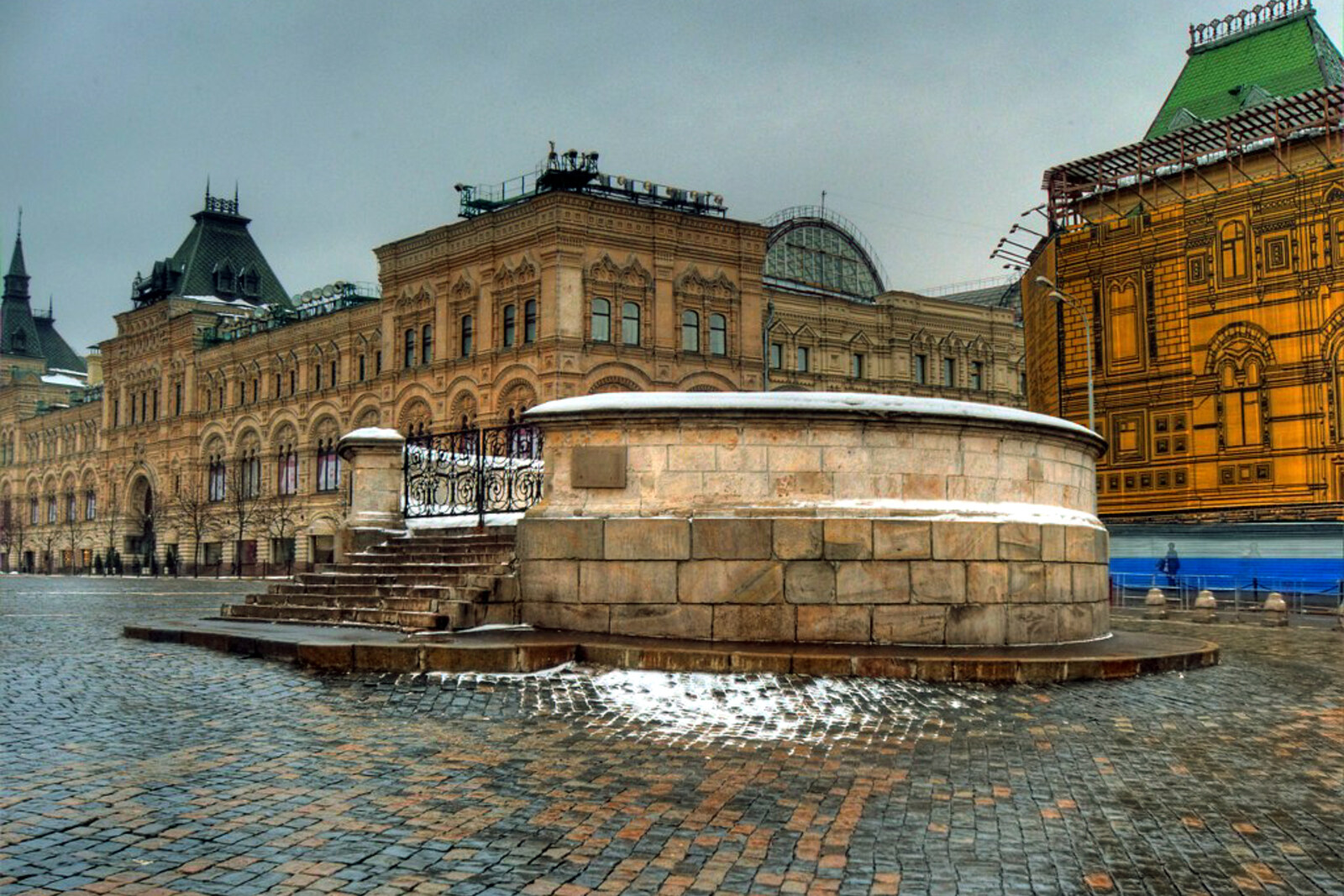
Look around first
What to notice
- White-stone circular platform
- Stone parapet
- Staircase
The story of the place
In the summer of sixteen eighty-two, Nikita Dobrynin, a former priest from Suzdal, climbed onto Lobnoye Mesto and announced to the gathered crowd that he had won the dispute over the true faith. He and his supporters raised their hands with two fingers joined for the sign of the cross and called on Muscovites to cross themselves the same way. A few days later, Dobrynin was executed on Red Square beside that very platform.
He had been working toward this public appearance for more than twenty years. In the middle of the seventeenth century, Patriarch Nikon ordered the correction of service books and changes to familiar rites: the sign of the cross was henceforth to be made with three fingers instead of two, some words were spelled differently, and religious processions proceeded differently. Nikita saw these as distortions of the faith. He served in Suzdal Cathedral, receiving an income in money and bread there, but began filing complaints against his archbishop, a supporter of the reform. Nikita was first forbidden to serve, then defrocked, anathematized, and confined to a monastery.
Fearing a death sentence, he repented. In sixteen sixty-seven, a church council ordered him to publicly denounce himself on the porch of Dormition Cathedral, on Red Square, and here at Lobnoye Mesto. His repentance restored Dobrynin to communion with the church, but he was not permitted to serve as a priest or receive his former income again. In sixteen eighty-one, he once more asked for the ban to be lifted and was refused again.
The following spring, the Moscow streltsy—armed service regiments—rebelled and forced the court to heed their demands. Supporters of the old rites were among them. They needed someone able to debate the bishops using the books, and they chose Nikita. Dobrynin drew up a chelobitnaya, a written petition to the sovereigns, demanding the restoration of the old faith. He wanted the debates to take place at Lobnoye Mesto before a crowd.
This platform was better suited than any other for a public hearing. Lobnoye Mesto served as the city’s pulpit: decrees and sentences were read from here, a new patriarch was named, war and peace were announced, and prayers were spoken before the gathered Muscovites. Words spoken here were intended for the entire city.
Patriarch Joachim, head of the official church and defender of the reformed rites, refused to debate before an armed crowd. Tsarevna Sophia, the elder sister of two underage tsars and the effective authority at court, also insisted that the debates be held inside the Moscow Kremlin, in the Faceted Chamber.
On July fifth, Nikita entered the Faceted Chamber with books and icons. He sought the repeal of the reforms; Joachim defended the order already adopted by the church. The dispute descended into shouting, but the participants reached no decision and agreed to continue the conversation two days later. Dobrynin left the Moscow Kremlin, climbed onto Lobnoye Mesto, and gave the crowd his own version of the outcome: the Old Believers had won and put the bishops to shame.
There was no continuation. The elected representatives of the streltsy went over to Sophia’s side and handed Nikita over. He was tried for insulting the tsar’s majesty and executed on July eleventh; his companions were sent to remote monasteries. The old rites were not restored in Moscow churches.
This execution helped create the impression that heads were constantly chopped off at Lobnoye Mesto. Usually, sentences were only proclaimed here, while the block or a wooden scaffold was set up nearby. Even the origin of the name is unrelated to executions: it is derived either from the old word “lob,” used for a steep descent to the river, or from the church name for Golgotha, the “Place of the Skull.”
The stone circle before us stands east of the platform on which Nikita first renounced his convictions and, fifteen years later, proclaimed their victory. In seventeen eighty-six, the architect Matvey Kazakov moved Lobnoye Mesto and gave it its present white-stone appearance. To the west, an unmarked space remains: that was where the platform stood from which Dobrynin spoke his final public words proclaiming victory.
Useful on site
Open urban space with no ticket required; access may be fully or partially closed for state ceremonies, preparations, and mass events.
Checked: date not specified. Check the official source before visiting.Listen from the edge of the square, where it is easier to stop without crossing the main flow of people. You do not need to climb onto the platform for the narration.