 Guide On Map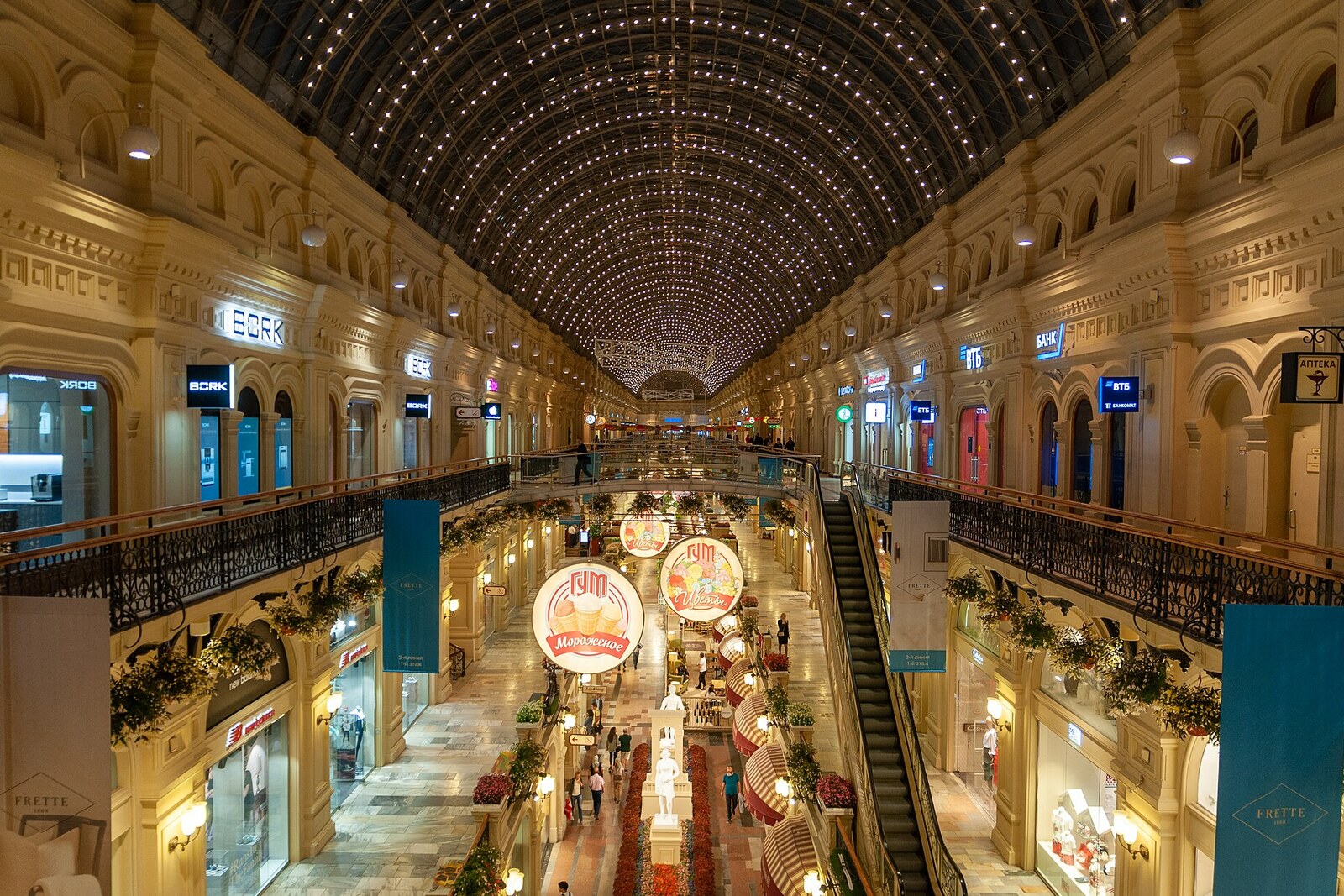
Look around first
What to notice
- Three covered galleries
- The central fountain with an octagonal base
- Glass ceilings
The story of the place
Beneath the glass ceilings stretch three long galleries: merchant shops once stood in each of them, and now separate trading houses once again stand side by side. Trade disappeared here for a long time when the premises were handed over to ministries and departments, and the entrance from Red Square was kept locked. There were plans to remove the building twice for high-rise projects, but both ideas remained on paper. At the central fountain, the octagonal base is noticeable: the round basin appeared before the Revolution, while a later reconstruction gave it its present form.
On December twenty-fourth, nineteen fifty-three, an enormous queue formed at the entrance from Nikolskaya Street. Police detachments held back people who had come for clothing, shoes, fabrics, and tableware. Inside, one hundred forty-seven retail sections opened, offering tens of thousands of types of goods. Just four months earlier, the desks of government institutions had stood here.
Before the Revolution, the building was called the Upper Trading Rows. Merchants traded from separate shops arranged along three covered galleries. The letters “GUM” first appeared in December nineteen twenty-one, when Vladimir Lenin signed the regulation on the State Universal Store. After banning free trade and enduring a severe shortage of goods, the Bolsheviks were introducing the New Economic Policy and once again allowing sellers into the trading rows.
In nineteen thirty, Joseph Stalin closed GUM. Ministries and departments occupied the galleries, and the entrance from Red Square was locked. There were plans to demolish the building twice: first for a high-rise for the People's Commissariat for Heavy Industry, then for one of Moscow's postwar high-rises. Both projects remained on paper.
After Stalin's death, Georgy Malenkov, chairman of the Council of Ministers, pressed for increased production of everyday goods. On August twentieth, nineteen fifty-three, he signed a resolution to bring trade back here. Anastas Mikoyan, minister of domestic and foreign trade, was put in charge. His name appeared in the document alongside an exact deadline: the store had to open no later than November first. The institutions were ordered to vacate the premises within ten days.
Mikoyan conceived of the store very differently from the prerevolutionary shop owners. In nineteen thirty-six, he traveled to the United States to study food production and the organization of trade. American department stores impressed him with their large departments, technical devices, and attention to shoppers' convenience. Now, instead of many independent shops, the old galleries were fitted out with unified departments, checkout counters at the exits, a display hall, and sales exhibitions.
Mikoyan missed the appointed deadline by almost two months. The refitting was completed on December twenty-first, and three days later the doors opened. GUM received the best goods Soviet enterprises could provide. Their very scarcity drew the queue to the Nikolskaya entrance: the fully stocked counters here were ahead of the everyday supply available to most of the country.
Since nineteen ninety-two, the store has no longer been state-owned, though the old abbreviation has been retained as its name. Separate trading houses once again operate in the galleries. What remains of Mikoyan's refitting is the shape of the central fountain: the original round basin appeared before the Revolution, while its octagonal base was made during the reconstruction of nineteen fifty-three.
Useful on site
Daily from 10:00 to 22:00; admission is free.
Checked: date not specified. Check the official source before visiting.The main idea can be understood from the square, but inside the layout of the passage and movement between levels are easier to see. Go in only if you are ready for a crowded space and an extra pause.