 Guide On Map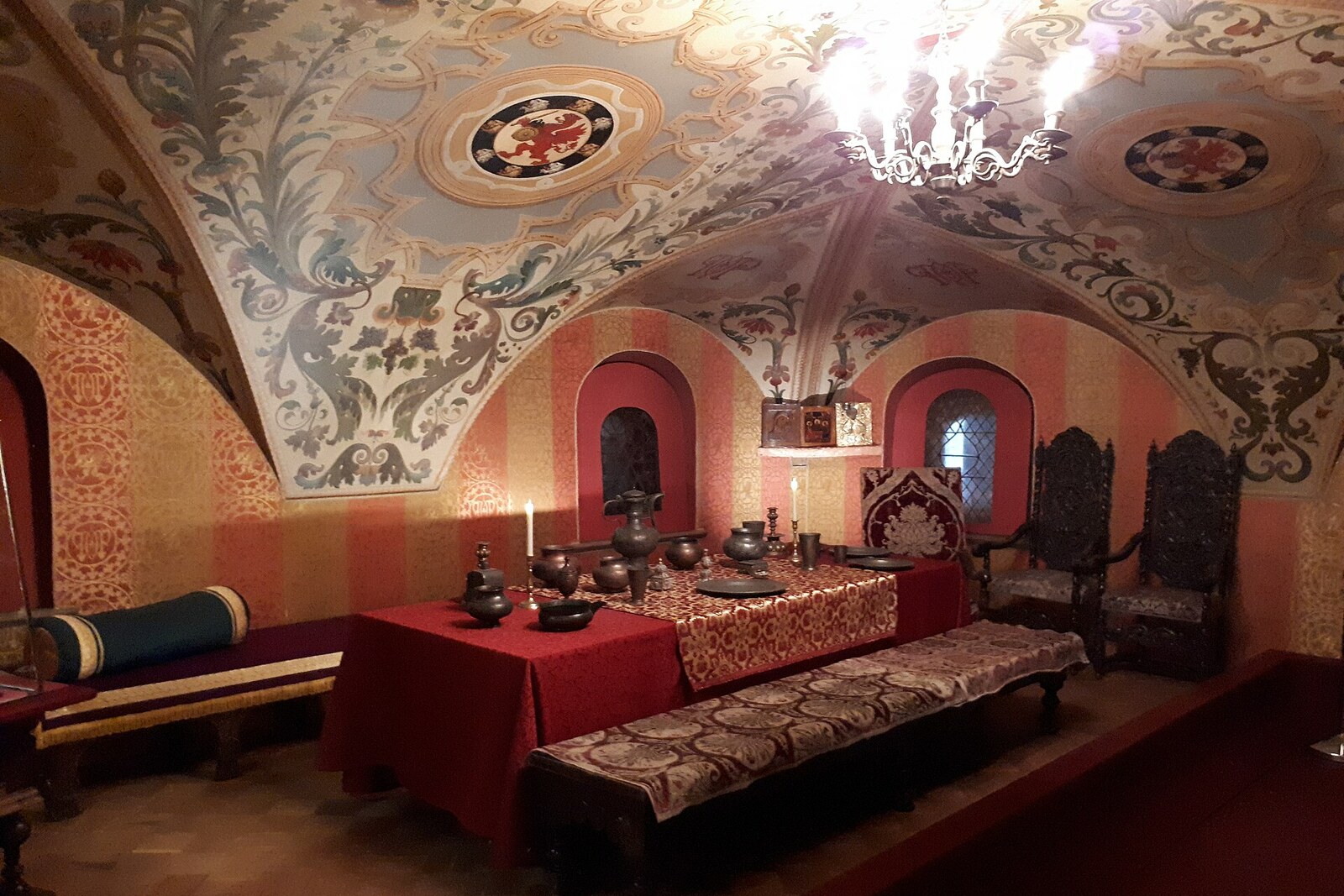
Look around first
What to notice
- White-limestone lower floor
- Wooden terem
- Tiled stoves
- Painting of the Refectory Chamber
The story of the place
The Chambers of the Romanov Boyars grew out of an urban estate belonging to a boyar family: the owners lived here, while the lower level served household needs. The white-limestone first floor and cellars are among the oldest surviving parts of the house; above them stands a wooden terem. As early as the middle of the sixteenth century, the estate belonged to Nikita Romanovich Yuriev, and the name of the House of Romanov derived from the name of his father. Fires, monastic alterations, and tenant-residents changed the building so much that the unified boyar house gradually fell apart.
Immediately after his coronation, in eighteen fifty-six, Emperor Alexander II ordered these chambers restored to their original appearance and opened as a museum of his ancestors. The new sovereign needed to visibly connect his own family with the first tsar of the dynasty. To do this, the old house first had to be turned into a convincing Romanov home.
The site was not chosen at random. From the middle of the sixteenth century, the chambers were part of the estate of the boyar Nikita Romanovich Yuriev. His children took the name of the House of Romanov after their grandfather, Roman Yuryevich. According to tradition, Nikita's grandson, Mikhail Fyodorovich Romanov, was born here; in sixteen thirteen, he was elected the first tsar from this family. No document confirms that he was born in these particular chambers. In the nineteenth century, a scholarly commission established that the building had indeed belonged to the Romanov court, but could not prove Mikhail's birthplace.
By then, the unified boyar house had long ceased to exist. Fires, monastic repairs, and alterations by tenants had changed it beyond recognition. The cellars and part of the lower service floor remained the oldest sections. Alexander II paid Znamensky Monastery twenty thousand rubles, transferred the building to the Moscow Palace Office, and commissioned its restoration from Fyodor Richter, an academician of architecture and chief architect of the Grand Kremlin Palace.
Richter dismantled later walls and searched for bricked-up windows, old doorways, staircases, and hiding places. From these traces, he determined the former arrangement of the rooms. Yet the traces were not sufficient everywhere. The wooden terem, gallery, balcony, and ceremonial staircase had to be built anew to his design. Furniture was made from examples in the Armoury Chamber, the Kremlin Terem Palace, old images, and textiles. The tiled stoves were also made especially for the museum. Authentic objects from the sixteenth and seventeenth centuries were placed inside the newly created rooms: the refectory, the boyar's study, the sons' room, the svetlitsa, and the boyar's wife's quarters.
This approach to the past is especially clear in the Refectory Chamber. When workers cleared its vaults, it turned out that the old walls were smooth and undecorated. Richter nevertheless proposed painting the ceiling. He took the ornament from the charter on the election of Mikhail Fyodorovich Romanov as tsar: stems, leaves, flowers, and fruit. Alexander II insisted that the artists add the Romanov griffin, the double-headed eagle, and Mikhail Fyodorovich Romanov's monogram. These symbols were not found beneath the plaster; they were placed there by the emperor creating a family museum.
In August eighteen fifty-nine, the Chambers of the Romanov Boyars opened. Visitors were admitted twice a week, with no more than eight people at a time. They entered rooms where genuine ancient objects were combined with the nineteenth-century idea of boyar life.
Almost a century later, restorers called Richter's work false. They proposed dismantling the stoves he had made and destroying the painting in the Refectory Chamber. The restorer Alexander Korin argued for preserving it: the smooth seventeenth-century vault had not survived behind it anyway, while the painting itself had already become evidence of early Russian restoration. A compromise was found: the ceiling was covered with paper and painted over. Thus, the eagles, griffins, and monogram spent about twenty-five years beneath a white layer.
In the nineteen eighties, the paper was removed. For two years, detached plaster was strengthened with mortar, injected by syringes into the voids beneath the painting. Today's griffins, double-headed eagle, and the letters of Mikhail Fyodorovich Romanov's name remain where Alexander II ordered them placed: on the ceiling of a boyar room conceived for the first Russian memorial museum.
Useful on site
June 25 – July 1, 2026 — daily from 10:00 to 19:00. Timed entry; the number of tickets is limited; the ticket office and entrance close one hour before closing time.
Checked: date not specified. Check the official source before visiting.The facade reveals the story of the restoration, but the layout of a boyar house can be seen only inside. Keep in mind the stairs, small rooms, and separate museum entrance.