 Guide On Map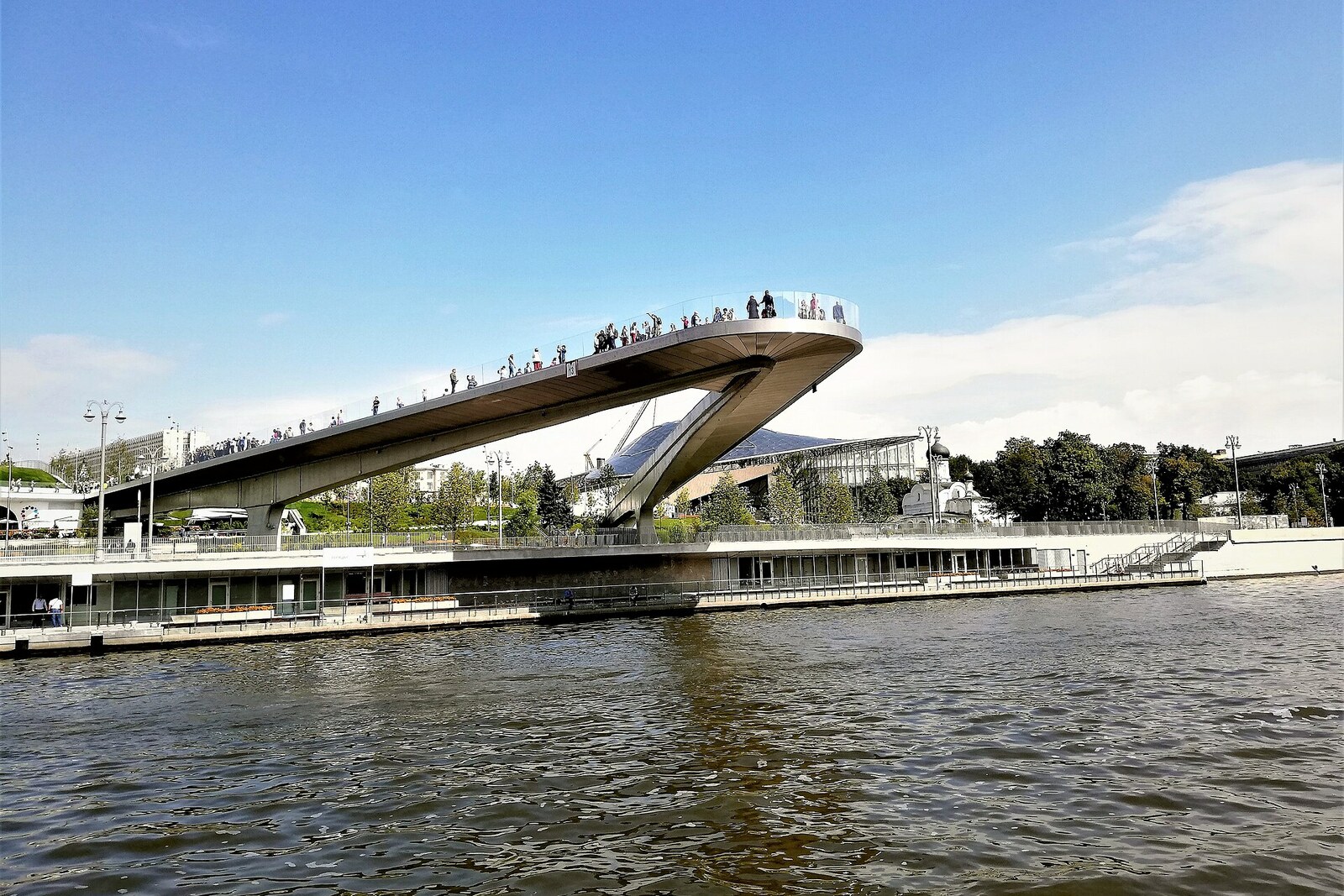
Look around first
What to notice
- Floating Bridge
- Concrete cantilever
- Moscow River
- Lawns and pavilions
The story of the place
The Floating Bridge ends where it begins: both of its paths return to the park. You do not cross the river here. A seventy-meter concrete cantilever projects over the embankment and the water without support; that is where the word “floating” comes from. It was built as a viewing platform. There is a precise reason for this panorama: the huge building that occupied what is now the park for almost forty years no longer blocks the embankment.
The park inherited the name of old Zaryadye, a quarter behind the Lower Trading Rows. In nineteen forty-seven, almost all its houses and lanes were demolished for a high-rise administrative building. Moscow’s chief architect, Dmitry Chechulin, received the largest commission of his career here. By the spring of nineteen fifty-three, builders had completed the foundation and the technical floor, after which construction ceased.
Chechulin was criticized during the move away from costly decorative architecture, yet he retained his profession and influence. After becoming head of the studio responsible for this site, the architect proposed using the completed foundation for a hotel. Thus the lost commission returned to him in another form. In nineteen sixty-seven, Hotel Rossiya opened—the world’s largest hotel at the time, capable of accommodating several thousand guests. At its base were Zaryadye Cinema and a concert hall, while a northern tower with restaurants rose above its wings.
On February twenty-fifth, nineteen seventy-seven, a fire began in the northern wing. An expert commission later concluded that its cause could not be established definitively. Fire and smoke appeared simultaneously on several floors, the interior staircases became deadly dangerous, and firefighters’ aerial ladders reached only the seventh floor.
The firefighters suspended a chain of scaling ladders from the facade, from the seventh to the twelfth floor. They brought forty-three people out by way of it. Guests in the upper restaurant had to be lowered onto the roof of the eleventh floor and led across it to another part of the hotel. In all, more than one thousand people were saved; thirteen firefighters were injured. Forty-two people died, and another fifty-two were injured.
Meanwhile, Arkady Raikin was performing in the concert hall—an artist who made his living on the stage and had gathered about two and a half thousand spectators that evening. The hall was outside the fire, but if the entire audience had left at once, it would have filled the lobby and obstructed the rescuers. Raikin was asked to extend the concert. He continued performing while firefighters worked in the neighboring wing, and the spectators remained in their seats. There was no stampede in the hotel.
After repairs, Hotel Rossiya again accommodated guests and operated until two thousand six. By two thousand ten, it had been dismantled, and in two thousand seventeen the park opened here. The northern wing, the restaurant, the concert hall, and the firefighters’ facade ladder stood on the grounds of today’s lawns and pavilions; nothing of them remains above ground. The Floating Bridge projects over the river precisely as a platform for the view opened up after the demolition.
Useful on site
The park grounds are open around the clock. Pavilions: Monday 12:00–21:00, Tuesday–Sunday 10:00–21:00.
Checked: date not specified. Check the official source before visiting.Walk to the far part of the bridge, but do not linger in the middle of the passage when the flow is heavy. The panorama is accessible without visiting a museum; in bad weather, the open platform is especially exposed to the wind.