 Guide On Map
Old Montreal: city, market, and port
From Place d'Armes through the city's founding site to the Clock Tower
Guide On Map on your phone
Open the walk like a regular app
It takes about 10 seconds to install. No app store needed.
The whole path
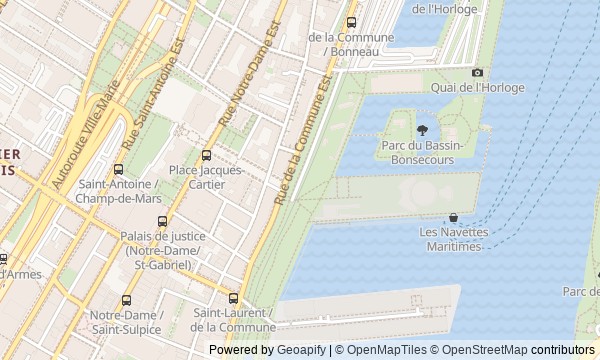
Route map
About the walk
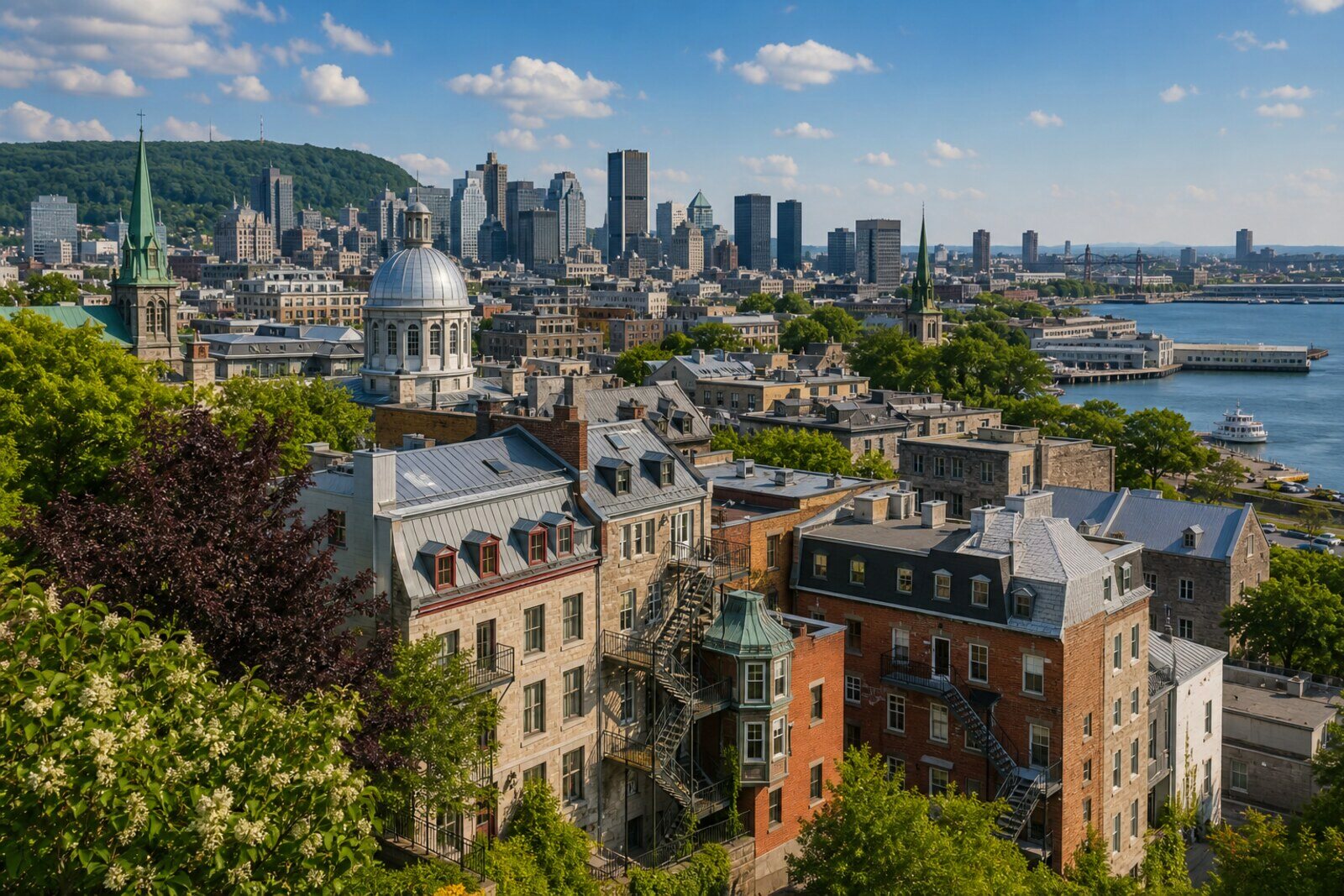
You will cross Old Montreal from Place d'Armes to the river, then continue as far as the white Clock Tower. At first you will find yourself among a church, the old city center, and close-set squares. Then you will descend to the site of the first settlement, pass former markets, and emerge at the quays. This is not a route for sorting facades by style. More important are the things left behind by decisions and disputes: missing flags, a chair carried away, a market stall, a silver ship beneath a vault. Why did they end up here? The answers will come gradually. You will hear a calm, precise account that separates document from city memory and brings a large event down to a human gesture. By the end, you will read Old Montreal not as a row of handsome buildings, but as a city whose main place was moved several times—from fort and parish square to market and port.
Why this order
Place d'Armes and the neighboring Notre-Dame Basilica of Montreal first show two ways of controlling the city's center: military formation and the church pulpit. From the church, the route descends to Place Royale, where the waterfront turned trade into a civic matter. Nearby Pointe-à-Callière takes the route deeper still—to the fort and the settlement's founding site beneath a former market. Then the path along the river leads to Place Jacques-Cartier: this is where trade was moved from Place Royale. The climb through the market square ends at Montreal City Hall, where the commercial center gives way to a municipal and political one. From City Hall, the route continues to the chapel of port workers and sailors, then heads straight out to the former cargo quays. The Clock Tower completes this sequence where the city waterfront became a port and a place of memory.
Those walking through Old Montreal for the first time Those who care about the human decisions behind familiar facades Those who enjoy markets, archaeology, and port history
Those looking only for an overview of architectural styles Those who do not want to enter museums and churches Those who want a short walk without historical storytelling
Before you go
The main account is available from the street, so the walk does not depend on visiting interiors. If you want to enter the basilica, the archaeological museum, Montreal City Hall, or the chapel, check access for your chosen date in advance: services, events, and temporary restrictions can alter the usual arrangements. Choose shoes comfortable for cobblestones and long periods of standing, and keep the wind by the river in mind. In the squares, it is worth walking around the monuments, and at Bonsecours Market, look at the chapel not only from the street but from the port side as well.
When to go
About 2 hours for the full route, with unhurried walks between stops and time to examine details; visiting any interior will require additional time.
Backup plan
If individual buildings are closed, keep the order of the stops: at the basilica, the facade and towers are enough; at Pointe-à-Callière, use the square, the museum volume, and the signs of the Great Peace; at Montreal City Hall, the balcony; and at the chapel, an exterior circuit and the figure above the roof. In rain or strong wind, take shorter pauses in open squares and allow more time for sheltered stretches among the blocks. If walking to the port tower immediately feels uncomfortable, pause at Bonsecours Market and continue later: the final stretch matters as a self-contained passage from the dense city to open water.
Route conditions
Surface. Paved — 2.5 km; unpaved — 22 m (data covers 94% of the route)
Access. Wheelchair — limited; stroller — limited
Facilities. Toilets — 4; drinking water — 9
Elevation. Ascent — 8 m; descent — 20 m
OpenStreetMap extract of June 25, 2026: database data, not a check on the ground. Data © OpenStreetMap contributors, ODbL licence
Walk plan
Open in maps ↗- 1
Place d'Armes
Here, the square's military name will coincide with a ceremony at which weapons had to be laid down without the main trophy. - 2
Notre-Dame Basilica of Montreal
This stop will explain why the city's largest parish church never regained its bishop's cathedra. - 3
Place Royale
The former market will show how customs officials took the place of direct trade between city residents and farmers. - 4
Pointe-à-Callière
Beneath the modern museum lie traces of the first fort, the governor's residence, and a river that was hidden underground. - 5
Place Jacques-Cartier
The last market stall will recall the condition that two merchants built into a land deal. - 6
Montreal City Hall
An ordinary balcony outside the council chamber became the place where a city reception disrupted the plans for a state visit. - 7
Notre-Dame-de-Bon-Secours Chapel
Here, a vow made at sea will remain not only a story, but also a silver model of a ship beneath the vault. - 8
Old Port and Clock Tower Quay
The finale shows how a working cargo pier was turned into a waterfront for walks while preserving a port memorial.
Route features
Everything you need stays in the browser
Progress, saves and your trip plan are stored on this device.
Add Guide On Map to your home screen so the walk opens outside the browser.
How we handle sources, maps and corrections: our editorial standards