 Guide On Map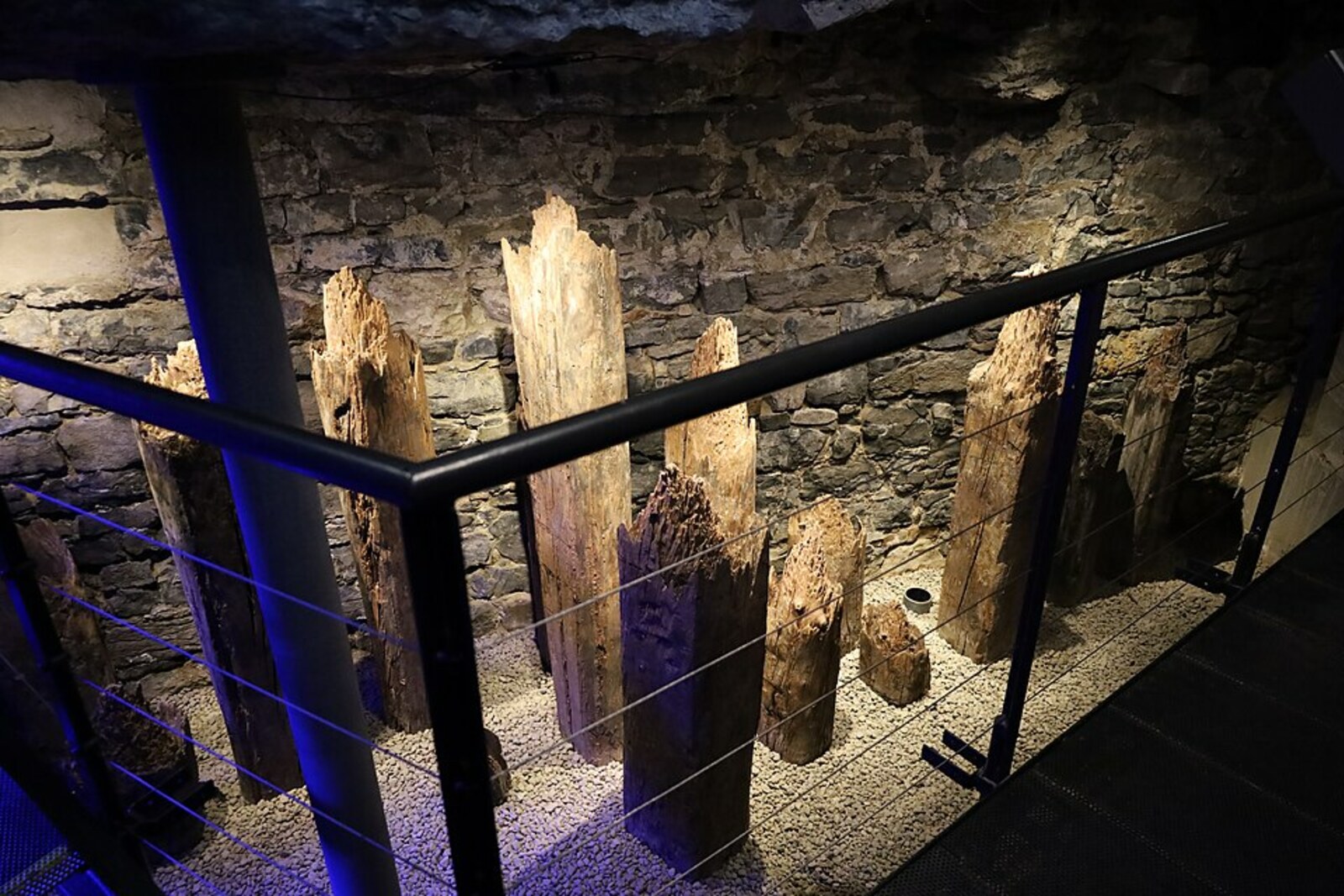
Look around first
What to notice
- Bastion trenches
- Stone foundations of the residence
- Vaulted collector
- Museum complex
The story of the place
On the low strip of land at the mouth of the small Saint-Pierre River, boats were pulled ashore before the Lachine Rapids; Indigenous peoples used this place long before the French settlers. Later, residents left the dangerous bank, but the museum complex preserved traces of the early development. Archaeological trenches and stone masonry can be seen among the galleries, and part of the route passes by the vaulted tunnel into which the river was hidden in the nineteenth century.
At the end of December sixteen forty-two, Paul de Chomedey de Maisonneuve placed a wooden cross by the water and laid his written vow beneath it. He was responsible for the settlement of Ville-Marie and for about fifty people surviving their first winter here. Water had already filled the ditch in front of the palisade and reached the gates.
Maisonneuve had chosen this point a few months earlier. Here, the small Saint-Pierre River flowed into the Saint Lawrence River, and boats could be pulled ashore before the Lachine Rapids. Indigenous peoples had used this convenient place long before the French. In spring, the settlers put up wooden houses, a storehouse, and the fort's enclosure. Jeanne Mance, who had arrived to found a hospital, was meanwhile managing the colony's supplies and daily life.
The convenient landing place was a low strip of land between two rivers. By Christmas, an ice jam had raised the water of the Saint-Pierre River. If it had entered beyond the palisade, the settlers would have lost their homes and storehouse in the middle of winter. According to an old Montreal chronicle, Maisonneuve ordered his vow to be read publicly: if the water receded, he himself would carry the heavy cross to Mount Royal and set it up on the mountain.
The water stopped at the gate threshold and then began to fall. On January sixth, sixteen forty-three, Maisonneuve kept his promise: he carried the cross on his shoulders at the head of a procession and set it up on Mount Royal. That wooden cross did not survive. The present illuminated structure on the mountain was erected almost three centuries later as a reminder of that vow.
The flood did not remain an isolated warning. After Maisonneuve's departure, the residents gradually abandoned the fort and moved to the other bank of the Saint-Pierre River, where floods threatened them less. The wooden structures disappeared, but archaeologists found the bastion trenches and reconstructed the position of the palisade. The small river also vanished from view: in the nineteenth century, it was enclosed in a vaulted collector, through which part of the museum route now runs.
The point did not yet have its modern name in Maisonneuve's time. In the late seventeenth century, Montreal governor Louis-Hector de Callière received the abandoned plot and built a residence directly on the remains of the first fort. Because of his house, the point came to be called Pointe-à-Callière—Callière's Point. The residence burned down in seventeen sixty-five. Beneath the museum complex, its stone foundations lie beside the fort trenches, and below them runs the collector on the site of the river that nearly flooded the first settlement.
Useful on site
The archaeological remains are inside the museum complex and require a separate visit; from outside, focus on the position of the site and the markings in the pavement.