 Guide On Map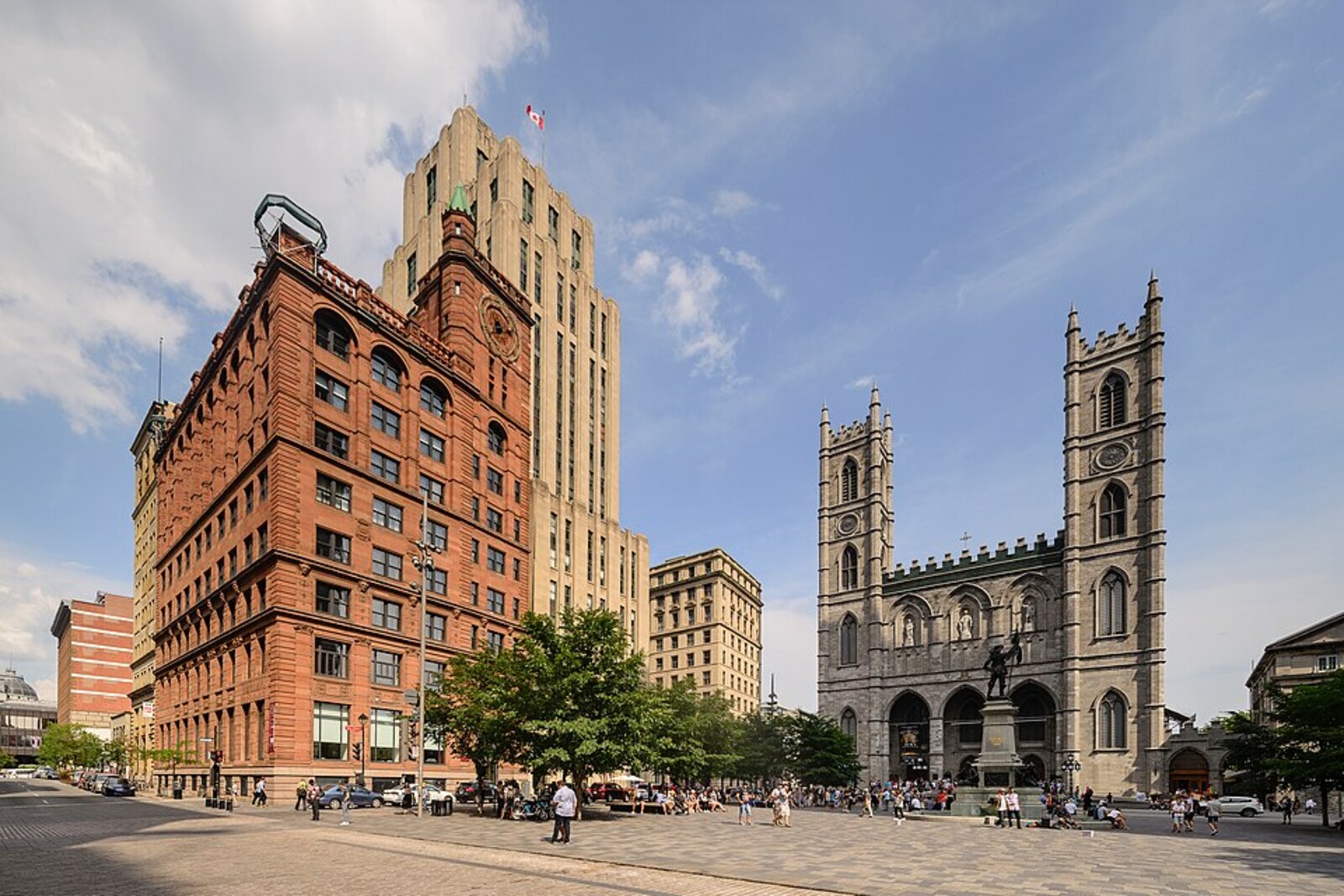
Look around first
What to notice
- Maisonneuve Monument
- Bronze flag in Maisonneuve's hand
- The square's open space
The story of the place
In the heart of Old Montreal, military formations were assembled for several decades. At first, this site was called the church parish square, and after the fire of seventeen twenty-one, drills were moved here from Place Royale and the open space was enlarged. That is how the square acquired a name connected with formation and weapons. Maisonneuve stands above it with a bronze royal flag in his hand, erected here in eighteen ninety-five.
On September ninth, seventeen sixty, French battalions came out onto this square one after another. British grenadiers with artillery were already standing here. The French laid their muskets down before them and returned to their camp on the city rampart. The regiments had no flags with them.
The day before, the governor of New France, Pierre de Rigaud de Vaudreuil, had signed the capitulation of Montreal. Three British armies had converged on the city, their guns trained on its walls. Montreal itself had almost no defenses and was full of refugees. Vaudreuil sought terms that would preserve the inhabitants' property and Catholic faith, and he wanted to withdraw the soldiers to France.
François-Gaston de Lévis, commander of the French regular forces, demanded that the fighting continue. British General Jeffery Amherst refused the French military honors—the right to leave the city in formation, with flags, weapons, and drums. Moreover, the soldiers were forbidden to serve again until the end of the Seven Years' War. For Lévis, who lived for military service and was responsible for the future of ten battalions, this meant defeat with a stain on his career.
He proposed one final sortie. When Vaudreuil refused to risk the city, Lévis asked permission to take the regiments to Saint Helen's Island and continue the resistance there, although without provisions they would soon have been in a hopeless position. The governor refused again and ordered the weapons to be laid down.
Then the standard-bearers burned the regimental flags. Amherst expected to take them as trophies; Lévis replied that by the time of the capitulation, the flags no longer existed. So the next day the battalions came here with muskets but without flags. The regular soldiers were then sent to France and barred from further participation in the war. Canadian militiamen were allowed to return home. British military rule began in Montreal, and three years later France ceded Canada to Great Britain under a peace treaty.
This spot was chosen for the ceremony because townspeople had assembled military formations here for several decades. At first, the site was called Place de la Fabrique—the church parish square. After the fire of seventeen twenty-one, drills were moved here from Place Royale, and the cleared space was enlarged. That was when the name Place d'Armes appeared—a place for formation and weapons.
The regimental flags Amherst had expected are not here. Raised above the square is another flag of the French king—a bronze one in the hand of Paul de Chomedey de Maisonneuve, the first governor of Ville-Marie, as Montreal was once called. The monument was erected in eighteen ninety-five. And the name remains from the parade ground where soldiers first practiced with weapons and then laid them down.
Useful on site
Walk all the way around the monument: its meaning unfolds on each side, and the main scenes are below the central figure.