 Guide On Map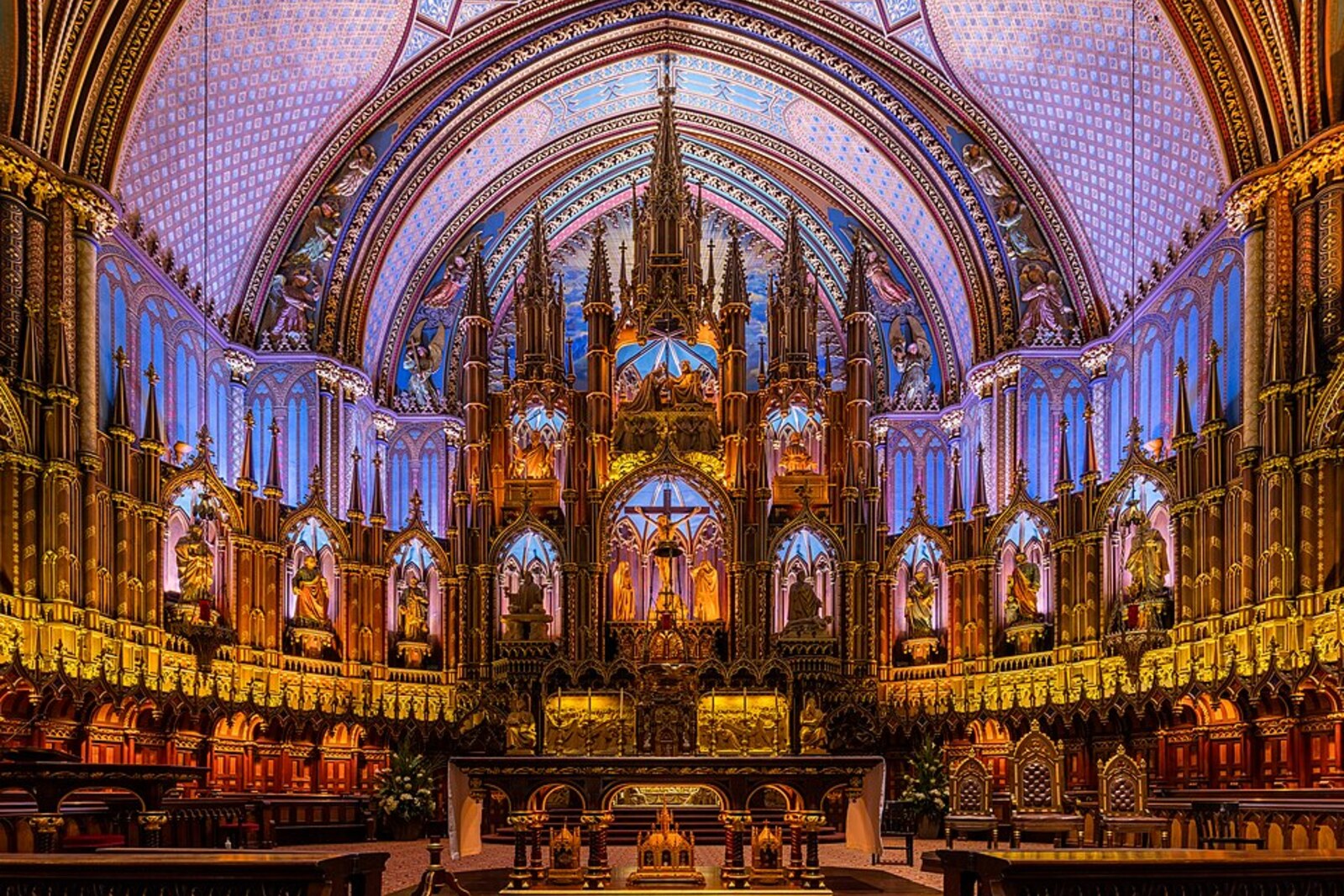
Look around first
What to notice
- Two towers
- Pointed arches
- Facade crenellations
- The outline of the earlier church in the paving
The story of the place
In July of eighteen twenty-one, the churchwardens carried a chair out of Notre-Dame. The present basilica did not yet exist: the earlier church stood closer to the square, and its site is now marked in the paving in front of the facade. The chair they carried out served as the bishop's cathedra. While it was in the church, the church was considered a cathedral, from which the bishop governed his diocese.
The cathedra belonged to Jean-Jacques Lartigue, a Montreal priest whom the bishop of Quebec appointed as his assistant in the vast Montreal District. Lartigue wanted to establish a permanent episcopal center here. He himself belonged to the Sulpicians, a community of Catholic priests that governed the Notre-Dame parish and directed almost all of the city's church life.
For Lartigue, the appointment meant a break with the people among whom he had lived and served. The Sulpicians' superior, Jacques-Henri-Auguste Roux, feared that a local bishop would begin assigning priests without the seminary's leaders. Lartigue hoped that a papal directive requiring him to accept ordination, as well as his former membership in the community, would protect him. In February, he was evicted from the seminary. He moved into the convent hospital Hôtel-Dieu de Montréal. In summer, while Lartigue was away from Notre-Dame, the churchwardens removed his cathedra.
Lartigue did not give up his post. He collected donations and began building his own St. James Church, completed in eighteen twenty-five. His cathedra was installed there, and in eighteen thirty-six Lartigue became the first bishop of the new Diocese of Montreal.
The Sulpicians responded by building the church that now stands in front of the square. They had a reason to expand even without the dispute: the old Notre-Dame held about three thousand people, while the parish had fifteen thousand parishioners, and people remained outside during Sunday masses. But their rivalry with Lartigue made them think bigger. The building committee demanded a church with eight thousand seats, capable of overshadowing the bishop's new cathedral.
For this, they invited James O'Donnell, an Irish Protestant architect from New York. Instead of the classical style customary for local churches, he proposed Neo-Gothic architecture with towers, pointed arches, and crenellations. In eighteen twenty-nine, North America's largest house of worship opened here. The Sulpicians retained the city's main parish, but the bishop's cathedra never returned here.
Notre-Dame means “Our Lady”—the name Catholics use for the Virgin Mary, the mother of Jesus Christ, to whom the parish is dedicated. Masses are still celebrated here today; major city ceremonies and public funerals are also held here. The church received the title of minor basilica from Pope John Paul II in nineteen eighty-two. It is an honorary status, not an indication of a bishop's residence.
The Montreal cathedra is now in Mary, Queen of the World Cathedral, in another part of the city. In the paving before the facade of Notre-Dame, the site of the earlier church remains—the very church from which the churchwardens carried out the bishop's chair.
Useful on site
You can understand the building's history from outside; plan a visit to the nave, crypt, and Sacred Heart Chapel separately, after checking the access conditions.