 Guide On Map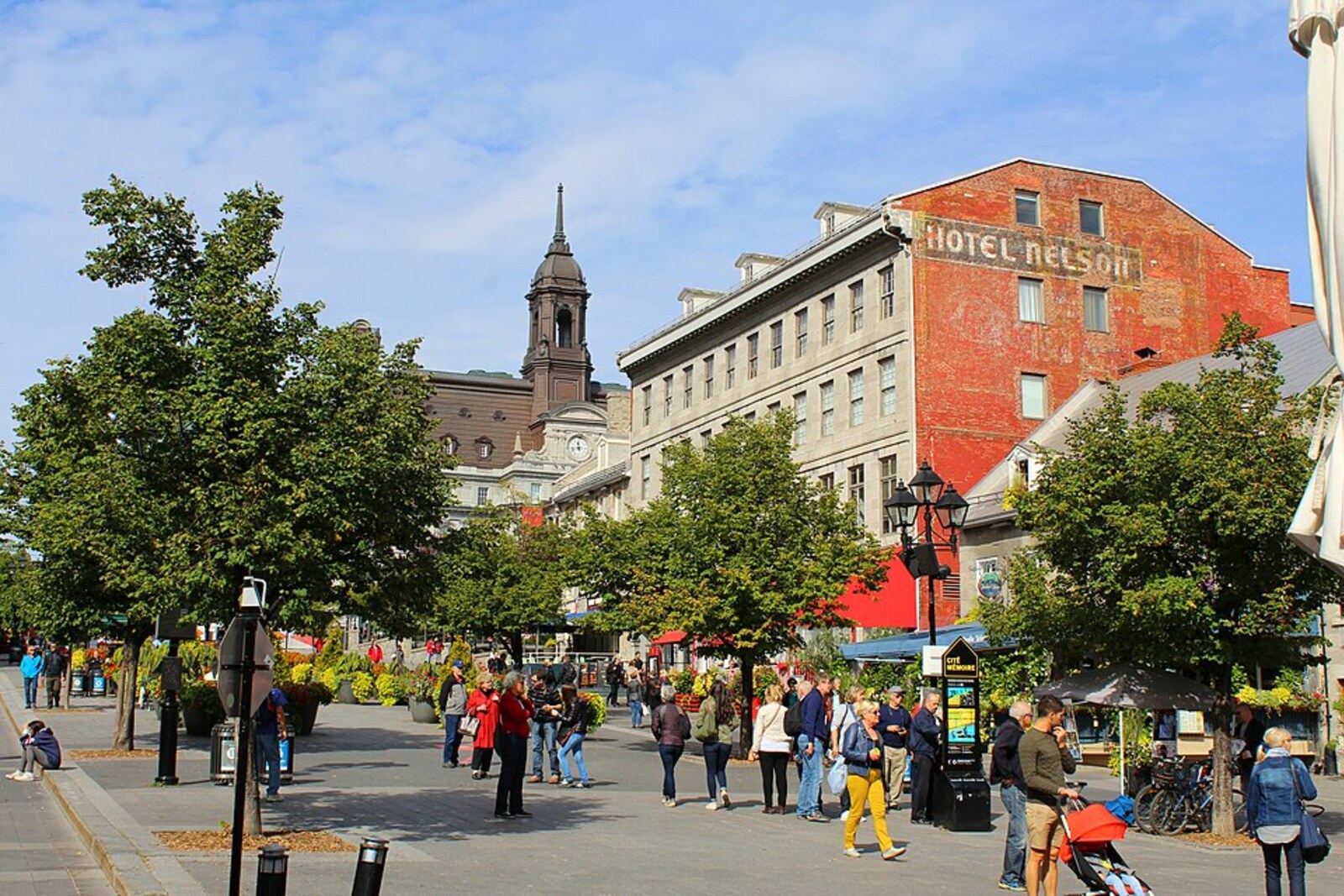
Look around first
What to notice
- Market kiosk
- Restaurant terraces
- Open strip of the square
The story of the place
The open strip between Notre-Dame Street and Saint Paul Street was left to the city for a public market forever. There was no money for a stone market hall at the time, so wooden market rows were the first to stand here; vendors of vegetables, meat, and other provisions moved here from cramped Place Royale. Later, the merchants moved under the roof of Bonsecours Market, the structures were dismantled, but open-air trade lasted until the middle of the twentieth century. The present kiosk at the top of the square keeps this function in operation.
Today the square is occupied by restaurant terraces, stalls, and street artists. A small market kiosk operates at the upper end. Its selection may change; the reason it exists is recorded in a document drawn up more than two hundred years ago.
On June sixth, eighteen oh three, a fire destroyed the college that stood here, housed in the former Château Vaudreuil. Half a year later, Joseph Périnault and Jean-Baptiste-Amable Durocher bought the burned site, with its gardens and ruins. Both were Montreal merchants: they invested money in the fur trade and in land. Now they risked capital on the ashes.
At that time, the city's affairs were handled by justices of the peace. They needed a site for a new market to replace cramped Place Royale. Périnault and Durocher offered to transfer, free of charge, a strip of land from Notre-Dame Street to Saint Paul Street—roughly the one occupied by the present square. There was one condition: a public market had to be established here, and this function had to be maintained forever.
The merchants' generosity had been calculated in advance. They divided the remaining land into lots facing the future market. On December fourteenth, they acquired the entire property; on the twenty-sixth and twenty-seventh, they sold building lots; and on the twenty-ninth, they signed the deed of gift to the city. The purchase, division, sale, and transfer of the market strip took fifteen days. Not a single stall yet existed, but proximity to the market had already been factored into the price of the land.
The magistrates intended to build a stone market hall, but there was not enough money. In eighteen oh eight, they opened wooden market rows here and named them the New Market. Merchants moved vegetables, meat, and other foodstuffs here from the former Place Royale. When vendors were moved under the roof of Bonsecours Market in eighteen forty-seven, the wooden structures were dismantled. Open-air trade continued anyway until the middle of the twentieth century: the condition in the deed of gift had not disappeared.
Also in eighteen forty-seven, the former New Market received the name of Jacques Cartier. He was a French navigator who, in fifteen thirty-five, became the first European to travel up the Saint Lawrence River as far as the Iroquoian village of Hochelaga on the Island of Montreal. Cartier had no connection to this site; his name marked the early European route to Montreal itself.
The small market kiosk allows the city administration to fulfill the condition set by Périnault and Durocher even today. It remains the last market stall in the deal that the two merchants completed over fifteen days in December eighteen oh three.
Useful on site
The square can be noisy and crowded; step to the edge to see it as a whole and understand the connection between its upper section and the port.