 Guide On Map
Milan: Leonardo da Vinci and Sforza
From The Last Supper through Sempione Park and Sforza Castle to Santa Maria presso San Satiro
Guide On Map on your phone
Open the walk like a regular app
It takes about 10 seconds to install. No app store needed.
The whole path
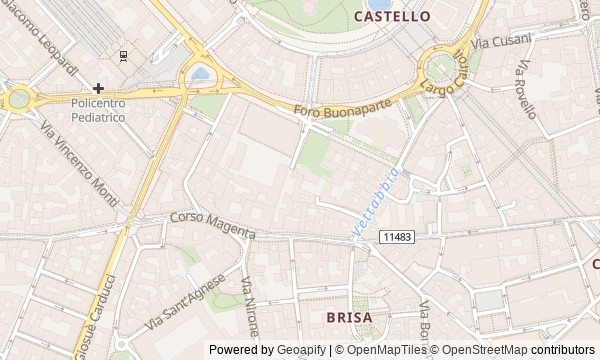
Route map
About the walk
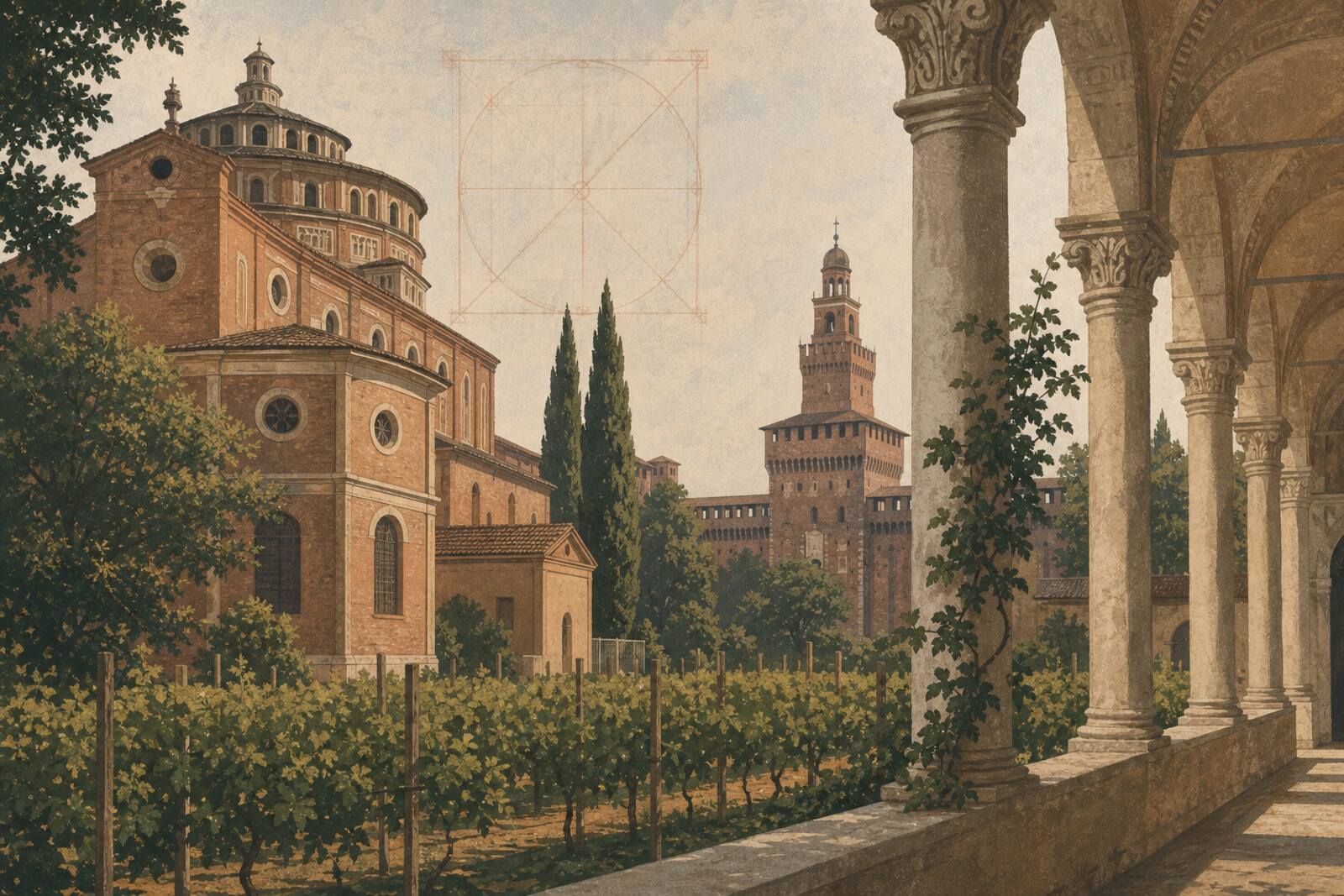
You will begin at the convent refectory with The Last Supper. Casa degli Atellani across the street will continue Leonardo da Vinci's story, not through a painting but through a plot of land. The route then leads to the lawns of Sempione Park, passes through Sforza Castle, and returns to the center through the former convent quarter. It ends in a small church near Milan Cathedral.
This is a walk through Renaissance Milan without a parade of great names. You will see a city of commissioners, owners, and people who had to work with an awkward wall, a cramped plot, or someone else's power. Why would an artist linger over one painting, only for its paint to begin disappearing? What remains of a vineyard after several centuries? How can a garden path become the trace of a political dispute?
The story will be calm and concrete. Documents will be separated from legends, what survives from what has been restored. After the walk, you will be able to explain how, between Santa Maria delle Grazie and Santa Maria presso San Satiro, land, walls, and images became tools of the Milanese Renaissance.
Why this order
Santa Maria delle Grazie introduces the courtly world of Sforza through Leonardo da Vinci's commission; the house opposite turns the artist's service into the story of his own land. From an intimate garden, the route reaches Sempione Park: after ducal grants, you will see how civic Milan defended this land from private development. The open perspective of the park leads directly to Sforza Castle, around which open space was preserved; at its towers, the cost of Sforza power becomes clear. The route then returns to Monastero Maggiore: the Civic Archaeological Museum of Milan reveals a Roman tower that the nuns adapted, and in doing so preserved. Nearby, San Maurizio al Monastero Maggiore continues the story of the same convent inside the wall that divided townspeople from nuns. The final walk to Santa Maria presso San Satiro shifts from ducal and convent commissions to a parish one: after great estates and a fortress, a cramped plot shows how a lack of land shaped the architecture.
Those interested in Leonardo da Vinci as a working master, not only as a famous name Those who enjoy stories of commissions, holdings, and urban transformations Those willing to alternate between churches, a museum, a park, and a fortress
Those looking for a short walk only around Milan Cathedral Those who want an overview of the main sights without detailed stories Those who do not want to enter churches and museum spaces
Before you go
Plan your visit to The Last Supper separately and well in advance: it is not the same as ordinary admission to the basilica, and arriving late for your reserved time may mean losing your visit. Do not expect to enter Casa degli Atellani and Leonardo's Vineyard without confirmed access—the story of this stop still works from behind closed gates. Before your walk, check announcements from the churches and museums themselves: services, restoration work, or temporary restrictions may close individual rooms. In churches, keep quiet and choose clothing appropriate for an active place of worship. Allow extra time for the museum collections at Sforza Castle and the Civic Archaeological Museum of Milan.
When to go
Allow 3,5–4,5 hours if you enter one or two interiors and stop for the key details. An outdoor version without museums and The Last Supper can take 1,5–2 hours, but the walk from the park to Santa Maria presso San Satiro will still take time.
Backup plan
Without a place to view The Last Supper, take in the basilica, apse, and convent complex from the square, keeping Leonardo da Vinci's story as the context for an inaccessible refectory. Read the closed Casa degli Atellani through its gates and the story of the land behind them. If the museum spaces are closed, focus on the Roman tower near San Maurizio al Monastero Maggiore, the exterior parts of the archaeological complex, the facades, and the publicly accessible courtyards of Sforza Castle. In the park, walk at least the main axis between Filarete Tower and the Arch of Peace. If Santa Maria presso San Satiro is closed, do not replace its optical choir with a random interior: end the route outside with the story of how the street forced Donato Bramante to build depth without free land.
Route conditions
Surface. Paved — 2.4 km; unpaved — 419 m (data covers 81% of the route)
Stairs. Flights: 1, 6 m in total
Access. Wheelchair — no; stroller — limited (stairs)
Facilities. Toilets — 9; drinking water — 5
Elevation. Ascent — 28 m; descent — 20 m
OpenStreetMap extract of June 18, 2026: database data, not a check on the ground. Data © OpenStreetMap contributors, ODbL licence
Walk plan
Open in maps ↗- 1
Santa Maria delle Grazie and The Last Supper
Here Leonardo’s free approach will meet what a monastic wall could withstand. - 2
Casa degli Atellani and Leonardo's Vineyard
The garden will add land to Leonardo's court commissions—land he would have to fight for after the exile of Sforza. - 3
Sempione Park
The park will show you which part of Milan its residents would not allow to be cut through with straight streets and built over. - 4
Sforza Castle
The fortress will show how the new duke answered the city that had recently destroyed the residence of the previous dynasty. - 5
Civic Archaeological Museum of Milan
This stop connects the Roman fortifications with the monastery thanks to which the defensive tower was not dismantled. - 6
San Maurizio al Monastero Maggiore
The divided church will show how a family’s rise could come to a halt at the wall of a nuns’ hall. - 7
Santa Maria presso San Satiro
The final stop brings together a private commission, parish donations, and a lack of space before a single altar.
Route features
Everything you need stays in the browser
Progress, saves and your trip plan are stored on this device.
Add Guide On Map to your home screen so the walk opens outside the browser.
How we handle sources, maps and corrections: our editorial standards