 Guide On Map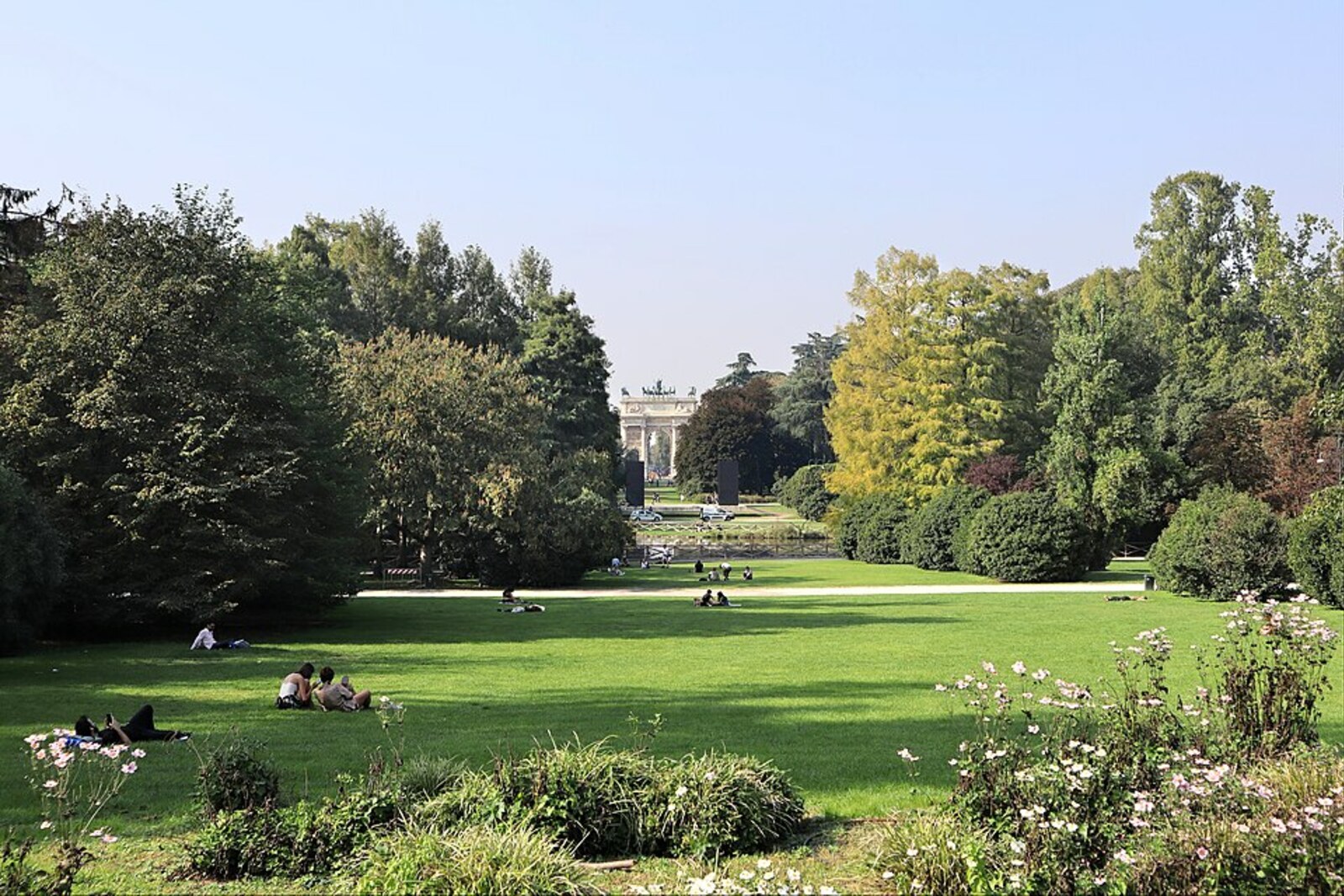
Look around first
What to notice
- Winding paths
- Low hills
- A pond and channels
- An open view between the arch and the castle
The story of the place
Between Sforza Castle and the Arch of Peace lies a large urban garden with water, low hills, and paths that wind gently among groups of trees. At the end of the nineteenth century, landscape architect Emilio Alemagna conceived this entire landscape: he built up the terrain, laid out channels, and created broad routes for carriages. Their curves deliberately diverge from the rectangular grid of neighboring streets, and a long open view has been left along the line between the arch and the castle. The name Sempione recalls Simplon Pass: through the Arch of Peace runs the route of the old road to the Alps.
Before the trees and lawns, this was Piazza d'Armi—the garrison’s military parade ground. After the unification of Italy, soldiers and barracks began to be moved farther from the center. A huge plot was freed up, and in rapidly growing Milan it was immediately assessed in terms of residential buildings.
The Milan Land Society—a company that made money from buying and developing plots—proposed running straight streets through the former parade ground and dividing the land into blocks. Mayor Giulio Belinzaghi supported the project. He stood on both sides of the future deal: he headed the municipality while also being one of the society’s major shareholders. If the plan went through, the company would receive expensive land right next to the center.
In eighteen eighty-four, Giuseppe Murnigotti, a design engineer, inventor, and one of the founders of the Milan College of Engineers and Architects, spoke out against it. He proposed moving the new parade ground and barracks beyond Porta Magenta, building houses along the edges of the freed-up territory, and preserving the middle between the castle and the Arch of Peace as a large public park. Murnigotti persuaded his colleagues and pressed to have his project discussed in the municipal council, putting his professional reputation up against the city administration and the land company.
In April, the dispute took three days of meetings. Opponents of development accused the administration of being too closely tied to the society. Belinzaghi and his cabinet resigned. Blocks along the edges of the former parade ground were built after all, but the central plot was left open after several revisions of the plan.
In the plan of eighteen eighty-nine, municipal engineer Cesare Beruto established the park here. Its creation was entrusted to architect Emilio Alemagna, a master of garden design. Between eighteen ninety and eighteen ninety-three, he built up low hills, created a pond and channels, grouped the trees, and laid out broad winding roads for carriages. Their curves deliberately diverged from the rectangular grid of neighboring streets. The hills and water here were made to Alemagna’s drawings; they are not remnants of an old country forest.
Sempione is the Italian name for Simplon Pass in the Alps. The park received its name because it lies on the route from the center of Milan through the Arch of Peace to the road to the pass, laid on Napoleon’s orders. Alemagna preserved an open view along this line between the arch and the castle.
By then, Belinzaghi had lost his office, Murnigotti’s main demand had entered the city plan, and Alemagna’s roads remained in the ground. Now their gentle curves run across the former drill ground; the straight streets planned by the land society are not here.
Useful on site
The park is open daily: from April through September until midnight, and from October through March until twenty-two hundred. At night, choose illuminated exits and do not go deep into empty areas.
Checked: June 30, 2026. Check the official source before visiting.To understand this stop, it is enough to walk along part of the main axis and then turn onto a side path. Treat the aquarium and the climb up Branca Tower as separate visits, not as a required part of the walk.