 Guide On Map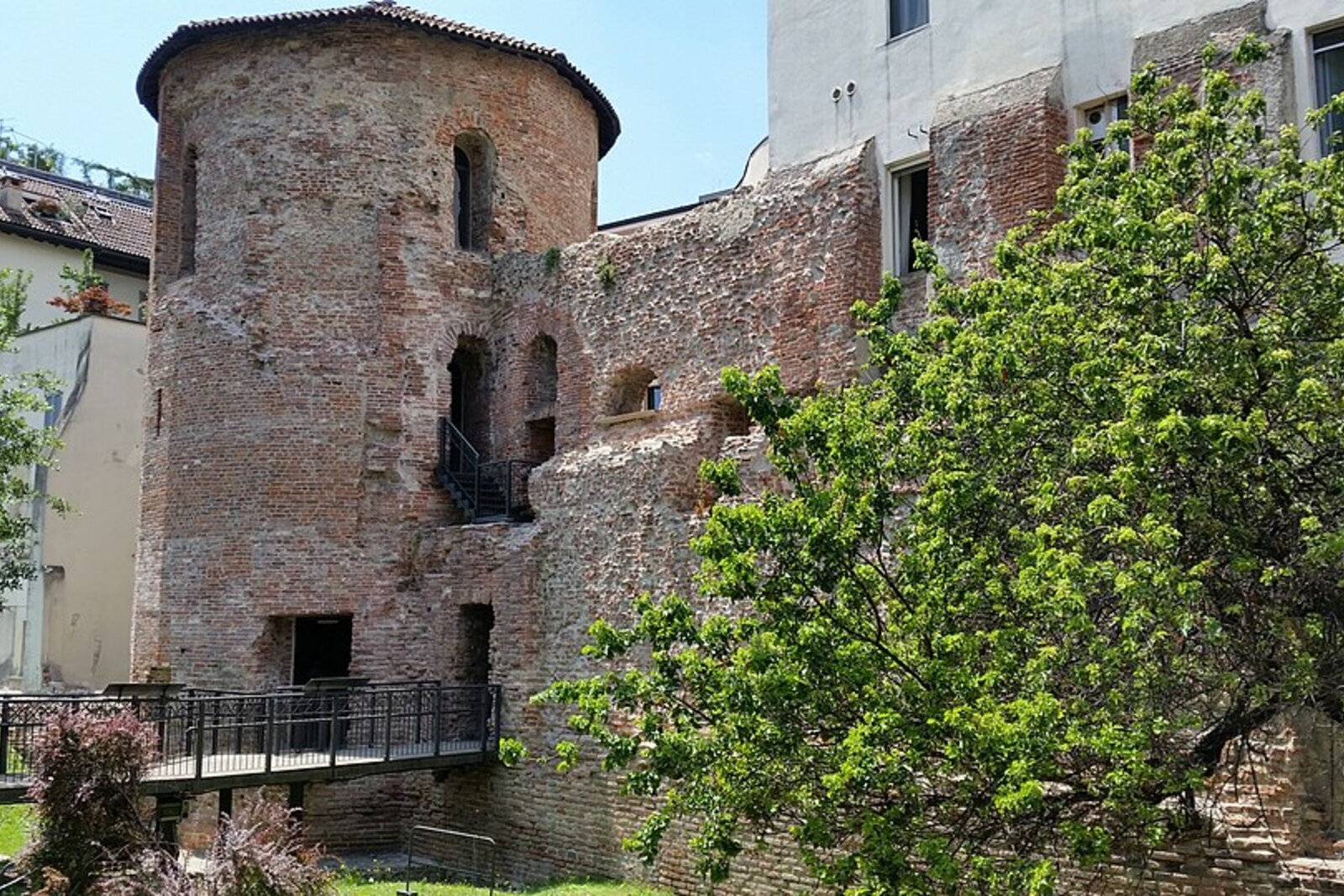
Look around first
What to notice
- The brick polygonal tower
- The round room inside the tower
- Three figures of prisoners
- Two figures of nuns
The story of the place
A brick tower stands in the courtyard of the archaeological museum: it has twenty-four sides on the outside and a round room inside. Medieval frescoes can still be made out on its walls: the Crucifixion, Saint Francis, and three saints in captivity. Two nuns are depicted in the lower part of the painting. Researchers believe that they were the ones who commissioned this work from the artist.
The tower was built for entirely different people. In two eighty-six, Emperor Maximian, one of the four co-rulers of the Roman Empire, made Milan the residence of his court. He needed an imperial quarter with a palace, a hippodrome for chariot races, and a new line of fortifications. Here, the wall joined the structures of the hippodrome; nearby stood the starting gates from which teams were released onto the arena. The polygonal tower protected this junction from the side of the city boundary.
Several centuries later, the Roman guards were gone, and Benedictine nuns settled among the former fortifications. They established Monastero Maggiore here—the largest and one of the wealthiest women's monasteries in Milan. Daughters of influential families joined the community; the nuns lived on income from land and real estate managed by the monastery.
They incorporated the old towers into their daily life. The square structure by the starting gates became a bell tower, while the nuns turned the polygonal defensive tower into a chapel. In the late thirteenth and early fourteenth centuries, two patrons had its interior painted. The identities of the three captive saints remain disputed: they have been seen either as Milanese martyrs or as soldiers of the Theban Legion. One thing can be said with confidence: for the nuns, this Roman room was already a place of prayer, and they left their own figures on its wall beside the saints.
Such use required the room to be preserved. Later monastic buildings closely surrounded the tower and covered sections of the ancient wall. When the government of the Cisalpine Republic abolished the monastery in seventeen ninety-eight, the community lost its home, and its buildings and lands were transferred to other uses. In the nineteenth century, the city laid two streets through the site and dismantled a substantial part of the buildings. After the bombing of nineteen forty-three, another damaged courtyard was demolished. The polygonal tower, which the nuns had used as a chapel for centuries, was not dismantled.
After the war, the city's museum staff were looking for a separate building for the archaeological collections and chose the former monastery beside the most important surviving section of the Roman wall. During construction, from nineteen fifty-nine to nineteen sixty-one, archaeologists discovered the remains of a Roman house beneath the courtyard. In nineteen sixty-five, the Greek, Etruscan, and Roman collections were moved here from Sforza Castle.
The word “civic” in the name conveys the Italian “civico”: this is a city museum, and its collections are administered by the municipality of Milan. In the basement, the monastic walls still rest on Roman masonry, while the lower level of the defensive tower still contains the three painted prisoners and the two nuns who paid for the prisoners' images.
Useful on site
The museum is open Tuesday through Sunday; the ticket office closes one hour before closing time. Individual visitors usually do not need to book; groups book in advance.
Checked: June 30, 2026. Check the official source before visiting.Even without going inside, examine the tower from the outside and note the difference between its lower and upper sections. The collection requires a separate museum visit; it is best to check the accessibility of specific rooms in advance.