 Guide On Map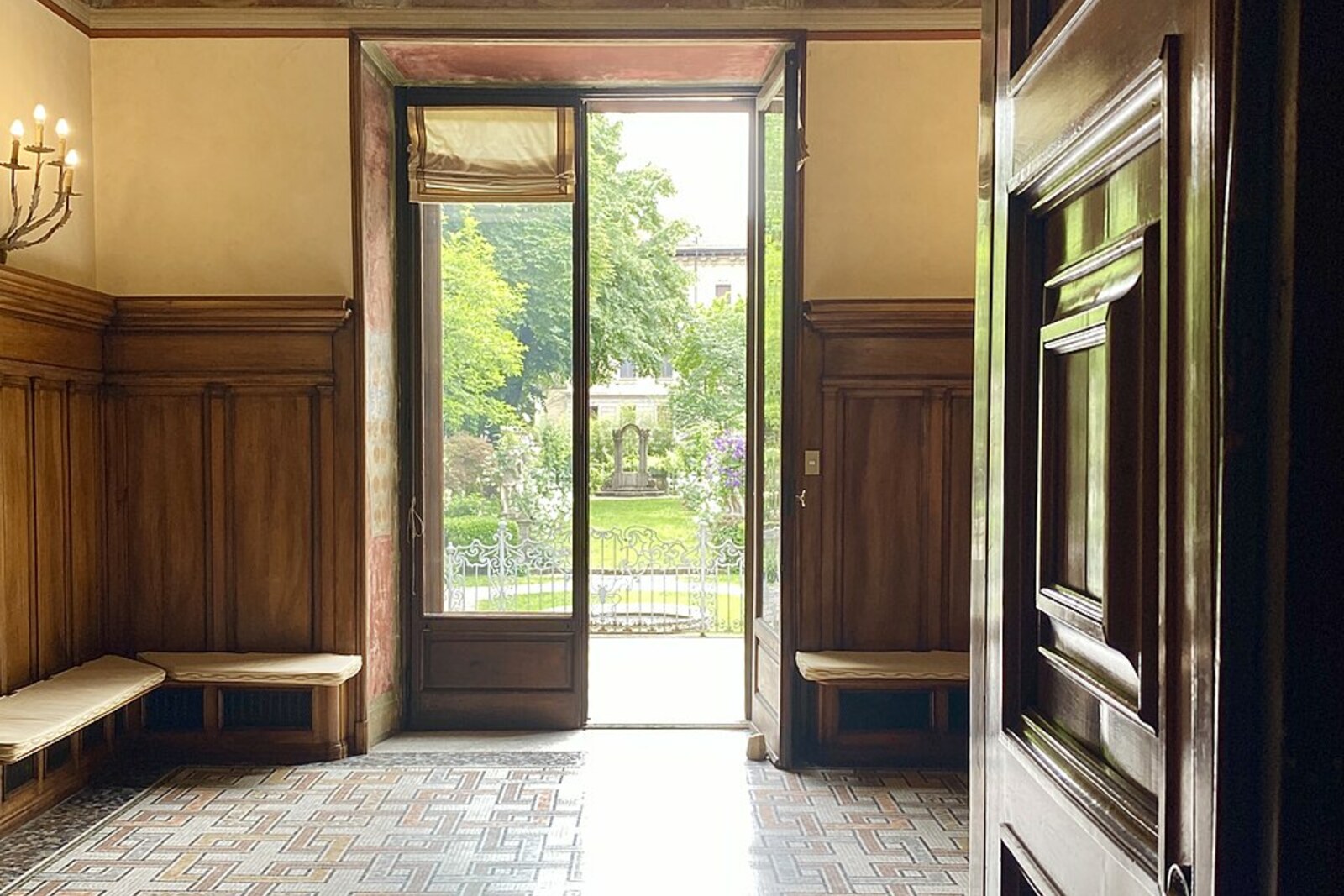
Look around first
What to notice
- The facade of Casa degli Atellani
- The garden behind the house
- Rows of grapevines
The story of the place
Behind the house's facade lies a garden with straight rows of vines: they mark almost a hectare of land that once belonged to Leonardo da Vinci. The present vineyard grew after excavations, when researchers found traces of old plantings and root remains. From them, they identified the grape variety and replanted it according to the historic pattern of rows; beneath your feet is not the surviving garden, but a carefully reconstructed part of it.
The name Atellani remained from a family of Sforza courtiers. In fourteen ninety, the Milanese duke Ludovico Sforza, known as il Moro, bought two neighboring houses here with a garden and gave them to his loyal knight Giacometto della Tela. His descendants came to be called Atellani. The family settled in the houses, joined them together, and held receptions here for the ducal court.
Ludovico Sforza gathered around the church of Santa Maria delle Grazie the people he wanted to reward and keep close by. Fields remained beyond the Atellani garden. In fourteen ninety-eight, the duke gave one plot to Leonardo da Vinci—his painter and engineer, who had already been carrying out court commissions for many years. Leonardo da Vinci's work in the neighboring monastic refectory was only one of these commissions.
The vineyard covered about a hectare and became Leonardo da Vinci's only known real estate. The plot brought in income: when leaving Milan, the artist leased it to the father of his pupil Salaì. This had to be arranged quickly. French troops occupied the city, Ludovico Sforza fled, and the new officials stopped recognizing his grants. Leonardo da Vinci was stripped of the vineyard.
A few years later, the French governor of Milan, Charles d'Amboise, wanted to bring the celebrated master back to the city and commission new works from him. Leonardo da Vinci used the invitation: first, he demanded the return of the land. In fifteen oh seven, the governor ordered his rights restored and specifically instructed that not a single soldo in expenses be taken from the owner.
Leonardo da Vinci kept the plot even after his final departure from Milan. In a will drawn up in France in fifteen nineteen, he divided the vineyard equally. One half went to Salaì, the artist's pupil and longtime companion, who had already built a house here. The other went to the servant Giovan Battista Villani, who followed Leonardo da Vinci to France and remained with him in his final years. The duke's gift outlived the duke himself, confiscation, and its owner's exile, and in the end provided land for two people from his household.
Later, the connection between the plot and Leonardo da Vinci was forgotten. In nineteen twenty, the architect and historian Luca Beltrami compared old records, established the vineyard's location, and managed to photograph the last vines. In nineteen forty-three, bombing destroyed them, and rubble covered the land.
During excavations, researchers found the directions of the old rows and organic remains of roots. Analysis made it possible to identify the grape variety—Malvasia di Candia Aromatica. In twenty fifteen, new vines of this variety were planted here following the layout of the historic rows. The plants that Leonardo da Vinci managed did not survive: beyond the Atellani garden grows a scientifically reconstructed section of his vineyard.
Useful on site
Regular public access to the house and vineyard has not been confirmed since they closed to visitors in October 2023 and changed owners. Treat this stop as an exterior visit unless an officially announced special visit is available.
Checked: June 30, 2026. Check the official source before visiting.Do not take the gate as a promise of free entry. You can enter the house or garden only through a separately confirmed visiting arrangement; from the street, the stop remains meaningful but does not reveal the vineyard.