 Guide On Map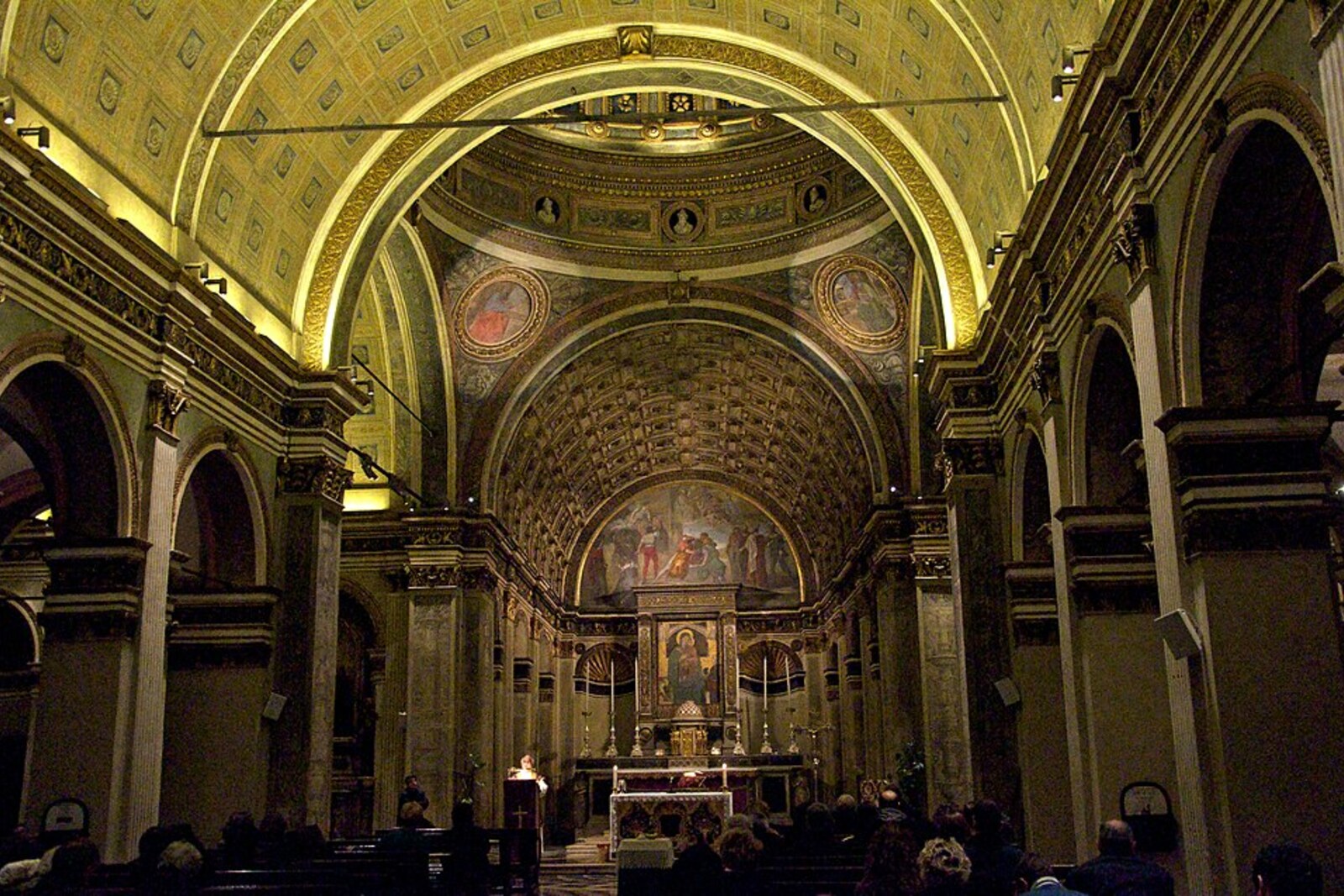
Look around first
What to notice
- Medieval fresco in the high altar
- Perspective choir behind the altar
- Diminishing coffers and columns
- Ancient Chapel of San Satiro
The story of the place
On September twenty-sixth, fourteen seventy-seven, the innkeeper Vincenzo Gallina filed a complaint with the ducal court against the people who guarded Santa Maria presso San Satiro at night. Gallina ran the nearby Falcone Inn and, at his own expense, commissioned a fresco for the church: a scene of a miracle of the Virgin, with himself and members of his family beside it. Someone had slashed precisely their faces with a knife. The innkeeper directly accused the church guards and the rector appointed by the duke. He had spent his own money on the painting; he had to argue with people on whom the life of his parish depended.
Gallina's fresco depicted another image—the one now in the high altar. In the thirteenth century, this Virgin and Child was painted on the outer wall of a small church. Tradition claims that in twelve forty-two the gambler Massazio da Vigolzone, having lost money, struck the painted Child's throat with a knife. The image supposedly bled, and Massazio repented. This is a church legend, but documents confirm the image's subsequent veneration: people came to pray before it and left donations.
The surviving papers do not make it possible to prove that Gallina's complaint itself set construction in motion. Yet the documented history of the new church begins almost immediately afterward. In the autumn of fourteen seventy-eight, three wealthy members of the future confraternity bought, as private individuals, the plot of the neighboring Lupa Tavern. They undertook to pay the price and an annual rent so that the buildings could be demolished and construction of a chapel for the venerated fresco could continue.
In the summer of the following year, parishioners and churchwardens collected alms for construction. In fourteen eighty, they established a confraternity—an association of laypeople that was to build, decorate, and then maintain the church. The amount of each contribution was left to each member's conscience, but the elected leaders were obliged to continue the work already begun and pay their predecessors' debts. On September eighth, the confraternity gathered to take its oath in Vincenzo Gallina's house. The innkeeper, who had begun with a complaint about his family's damaged faces, became one of the commissioners of the new church.
The parishioners invited several masters. Not every part of the building can confidently be attributed to Donato Bramante, but the false choir behind the high altar is among his certain works. The architect needed to place the venerated image in the depth of a solemn church space. A real choir almost ten meters long could not fit here: Via Falcone ran immediately behind the altar wall.
Bramante had only ninety-seven centimeters. In this space, he arranged painted reliefs and stucco: the coffers of the vault, cornices, columns, and niches diminish toward the center as if they receded far beyond the altar. From the middle of the nave, the ninety-seven centimeters seem to be a continuation of the church; from the side, the relief compresses into almost flat decoration. In this way, the architect created a frame for the very image for which parishioners collected money and demolished neighboring buildings. Already in the spring of fourteen eighty-three, the confraternity hired a priest for daily Masses.
San Satiro was here before the Virgin. In the ninth century, the Milanese archbishop Anspert ordered a small church built in honor of Saint Satyrus—the brother of Saint Ambrose. The fifteenth-century builders incorporated it into the new complex. Hence the full name: Santa Maria presso San Satiro—“Saint Mary at Saint Satyrus.” The old Chapel of San Satiro is connected to the left transept of the present church, and its ancient bell tower is visible from outside.
The medieval fresco still stands in the high altar. Above it, a nineteenth-century painting shows Massazio's legendary blow. Behind the altar, the perspective choir ends after ninety-seven centimeters, and Via Falcone still runs immediately beyond the wall.
Useful on site
Free admission, but this is an active church. During services and prayer, tourist viewing and photography may be restricted.
Checked: June 30, 2026. Check the official source before visiting.First look at the choir strictly from the central axis, then slowly move to the side—otherwise, the main effect will remain only a beautiful backdrop. Keep quiet and bear in mind that some parts of the church may be inaccessible.