 Guide On Map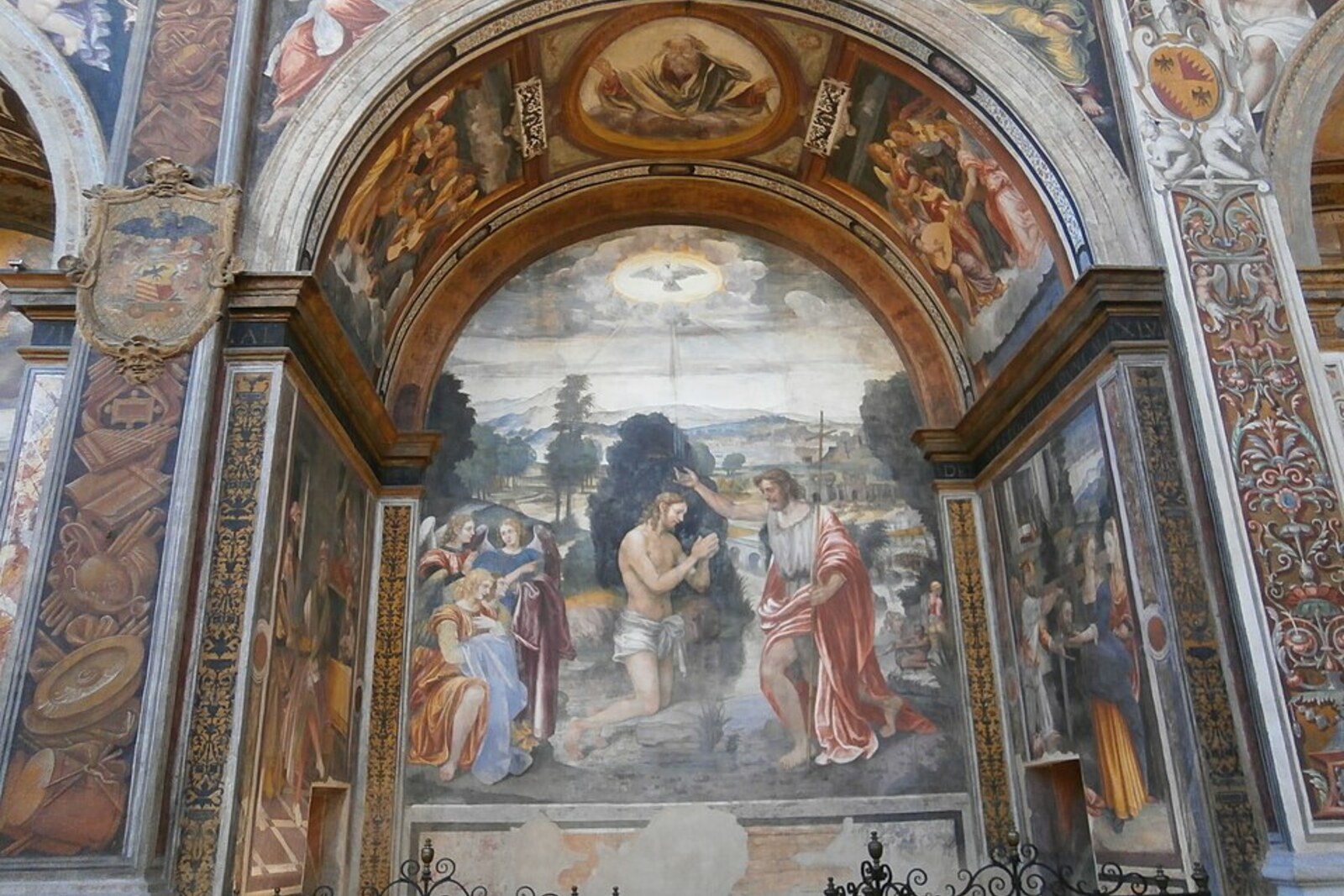
Look around first
What to notice
- The wall between the two church halls
- The grille above the altar
- The raised floor of the nuns’ hall
- The kneeling figures of the couple
The story of the place
It was called the “Great Monastery” as Milan’s leading women’s convent: it owned land and had its own income, while daughters of the wealthiest families lived in its cells. The church stands on the site of a late Roman circus beside the imperial palace; one of the towers from which chariots were released later became the monastery’s bell tower. The gray façade is built of Ornavasso stone, and the interior is covered with sixteenth-century frescoes. Among the paintings are a kneeling man and woman in court dress.
Behind the restrained façade, the builders placed two church halls one behind the other. The front one was set aside for the townspeople, the rear one, more spacious, for the Benedictine nuns. A wall with an altar was built between them. The floor in the nuns’ section was raised by about half a meter: during Mass, the sisters could see the priest through a grille above the altar, and they received Communion through small openings. They were forbidden to cross to the parishioners’ side.
In the upper panels of this wall, Bernardino Luini depicted the martyrdom of the saint who gave the church its name. Maurice is Saint Maurice, an officer of the Theban Legion who, according to church tradition, died with his companions for the Christian faith. At first, the monastery was dedicated to the Virgin Mary. In the tenth century, Emperor Otto I, whose sister lived here as a nun, gave the community a relic containing Maurice’s blood. The saint’s name appeared in documents in ten seventy-eight, and from eleven forty-eight onward the former dedication was no longer mentioned. It was called Monastero Maggiore, the Great Monastery, because it ranked first among Milan’s women’s convents: daughters of the wealthiest families lived here, and the monastery owned land and had its own income.
One such family came to Milan after a catastrophe. Alessandro Bentivoglio was the son of the ruler of Bologna and earned his living through military and court service. In fifteen oh six, his family was expelled from the city. An attempt to retake Bologna gave the Bentivoglios only a few months of their former position, and Alessandro entered the service of the Milanese Sforzas. His wife, Ippolita Sforza, was herself from that family.
At the end of fifteen fifteen, their daughter Bianca, who was about eleven years old, entered here as a novice and received the monastic name Alessandra. For a noble girl, her support in the convent depended on the money and possessions transferred by her family. In her will of fifteen twenty-one, Ippolita left her daughter eleven hundred seventy-three ducats—a large fortune that provided for her life behind the wall. By the following year, Sister Alessandra had become abbess; she was later elected head of the monastery six times.
No document bearing the name of the person who commissioned the paintings has survived, but scholars connect Luini’s arrival specifically with Alessandra’s inheritance and the family’s standing in the convent. On the parishioners’ side, the artist painted the kneeling Bentivoglio couple in expensive court dress. Ippolita did not live to see either these frescoes or her daughter’s rise: she died in fifteen twenty-one, before Luini began the main work. Alessandro continued his career under the Sforzas, became the duke’s governor, and after his death was buried in this church.
Doors were cut into the dividing wall only in the nineteenth century, when the monastery no longer existed. Now you can pass through them to the place Sister Alessandra was forbidden to go: her mother remains painted on the townspeople’s side, while the hall her daughter governed as abbess lies behind the same wall.
Useful on site
Open Tuesday through Sunday, admission is free. The church is kept open by volunteers; unplanned closures are possible, and groups must book in advance.
Checked: June 30, 2026. Check the official source before visiting.This is an active church space: speak quietly and do not disturb the service. If the convent half is accessible, be sure to compare its scale and decoration with the section for the townspeople.