 Guide On Map
Noailles and Cours Julien: Markets and Urban Change
From La Canebière through Noailles and Cours Julien to Place Jean-Jaurès (La Plaine; formerly Plaine Saint-Michel)
Guide On Map on your phone
Open the walk like a regular app
It takes about 10 seconds to install. No app store needed.
The whole path
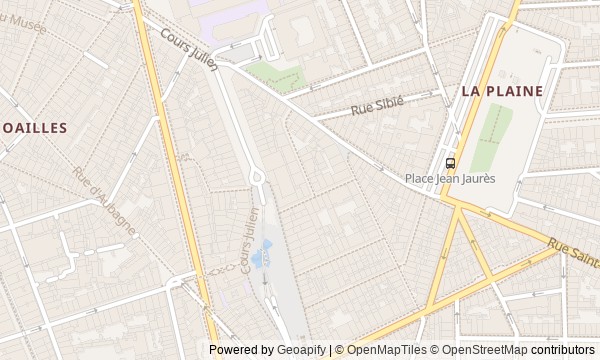
Route map
About the walk
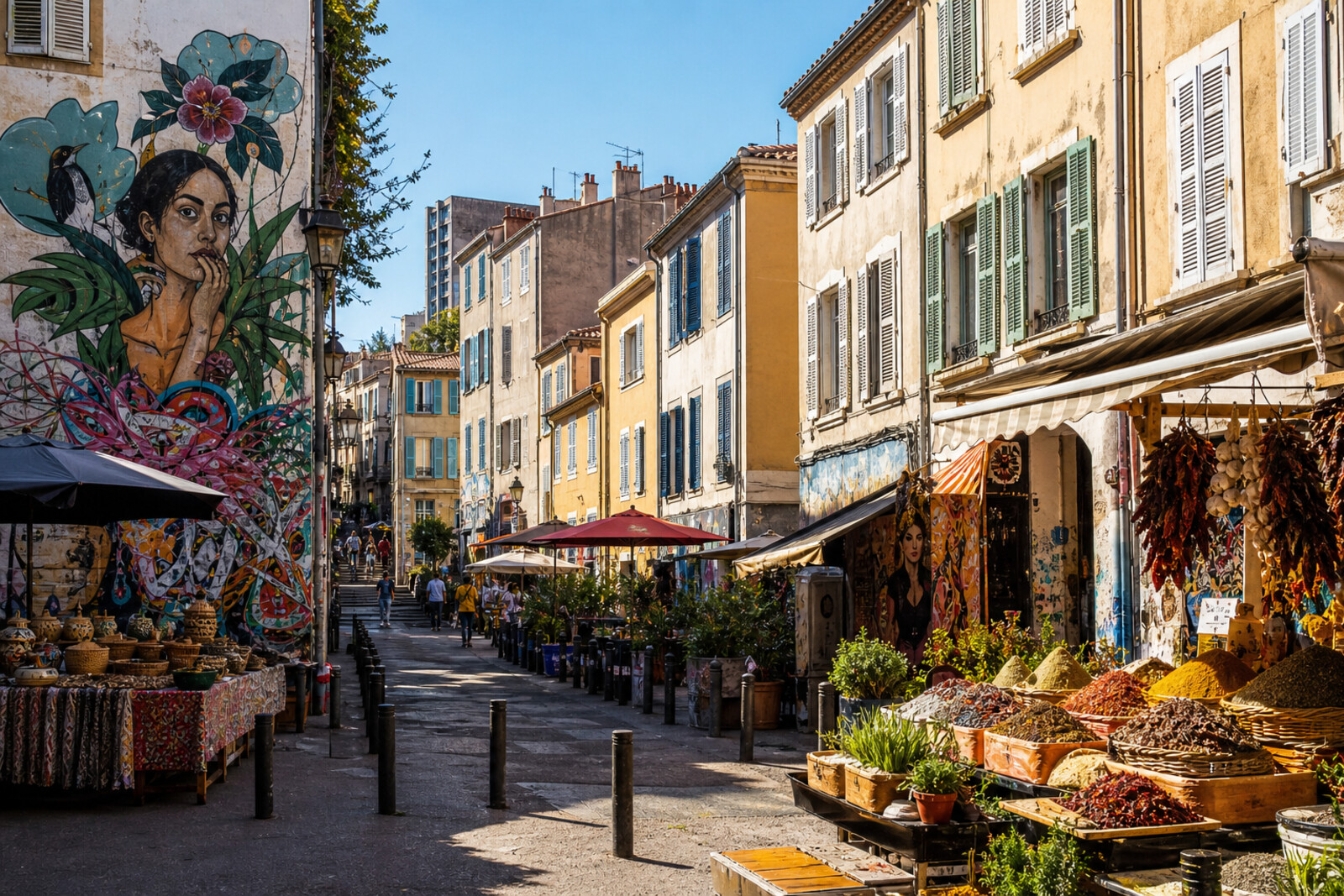
You will begin on La Canebière, among tram tracks and stern façades, then turn into cramped Noailles: toward the vegetable market, an old flower stall, and Rue d'Aubagne. The road then climbs to Cours Julien, follows the painted staircase, and emerges through Notre-Dame-du-Mont Church onto the broad Place Jean-Jaurès (La Plaine; formerly Plaine Saint-Michel).
This is a walk through places the city has repeatedly remade for new needs. Of one monastery, only the name will remain. One stall will keep the florist's familiar nickname. At the memorial, you will hear a nighttime call made a few hours before the collapse, yet you will not learn in advance why a resident was allowed to stay.
The story rests on documents, human decisions, and the things before you. No portside romance, no heroic poses. After the walk, you will read this slope as a chain of urban transformations: from wholesale crates and vanished homes to concert halls, fresh paint, and the small outline of a ball on a wall.
Why this order
The order follows the different fates of urban places. From ceremonial La Canebière, the route immediately turns toward Marché des Capucins: behind the main street, you will find an area where only names remain of a large monastery. After the vanished complex, you will return to Cours Saint-Louis for the opposite case—the single surviving flower stall. Rue d'Aubagne begins there, so the memorial comes next: commercial memory gives way to a precise address and the consequences of a city decision. A short climb brings you to Cours Julien, where another way of dealing with vacated buildings becomes clear—former wholesale premises take on new functions. Then the staircase explains how residents linked the market on the plateau with the lower city. Back at the top, you will walk to Notre-Dame-du-Mont Church: after the story of a shared passage comes an intimate account of one farewell. From the church, the route reaches Place Jean-Jaurès (La Plaine; formerly Plaine Saint-Michel). The openness of the upper square completes the climb and explains why a dangerous flight across the sea was prepared here.
Those who want to understand Marseille's everyday center through markets and city decisions Those who enjoy dense documentary stories with human details Those interested in vanished buildings and new uses for old places
Those looking for a walk focused only on grand monuments Those who find climbs and staircases difficult Those who do not want to stop at the site of a recent urban disaster
Before you go
Wear shoes with good grip: the second half of the route includes climbs and a staircase, especially awkward after rain. Markets change depending on the day and time, so do not expect to see every row at once. Keep an eye on your belongings in the narrow shopping streets, and do not get in shoppers' and vendors' way for a photograph. Speak more quietly in the memorial square and do not occupy the space in front of the commemorative plaque for long. Enter the church only when its doors are open, keeping services and private prayer in mind; the route does not include special access inside.
When to go
Allow 2–3 hours: the route itself is fairly short, but the markets, memorial, church, and wall paintings call for unhurried stops.
Backup plan
If the market is closed, walk its streets as a neighborhood of everyday trade: old shop signs, narrow façades, and the mix of stores still carry the story forward. If the church is closed, limit yourself to the façade and commemorative inscription rather than reshaping the walk around getting inside. If the staircase is wet, closed off, or uncomfortable, take an accessible pedestrian detour shown on the map and rejoin the story at the top, on Cours Julien. In heavy rain, shorten your stops at the painted walls, but do not take slippery steps just to follow the original line.
Route conditions
Surface. Paved — 1 km (data covers 49% of the route)
Facilities. Toilets — 2; drinking water — 1
Elevation. Ascent — 35 m; descent — 14 m
OpenStreetMap extract of June 18, 2026: database data, not a check on the ground. Data © OpenStreetMap contributors, ODbL licence
Walk plan
Open in maps ↗- 1
La Canebière
This stop will show how one urban catastrophe changed the organization of the emergency service. - 2
Marché des Capucins (Noailles)
The market helps reveal a vanished monastery in two surviving city names. - 3
Cours Saint-Louis
A single kiosk links the square’s history to one flower seller and theatrical Marseille. - 4
Rue d'Aubagne Memorial
The plaque will bring eight names back into the conversation about unsafe housing and responsibility. - 5
Cours Julien
The square will explain why today’s cultural institutions inherited spacious trading halls. - 6
Cours Julien Staircase
The staircase will show how residents secured a direct route between the plateau and the lower city. - 7
Notre-Dame-du-Mont Church
A plaque on the facade leads to a quiet musical farewell and the fate of an old organ. - 8
Place Jean-Jaurès (La Plaine; formerly Plaine Saint-Michel)
The relief at the edge of the square marks the starting point of a flight that began before a crowd's eyes.
Route features
Everything you need stays in the browser
Progress, saves and your trip plan are stored on this device.
Add Guide On Map to your home screen so the walk opens outside the browser.
How we handle sources, maps and corrections: our editorial standards