 Guide On Map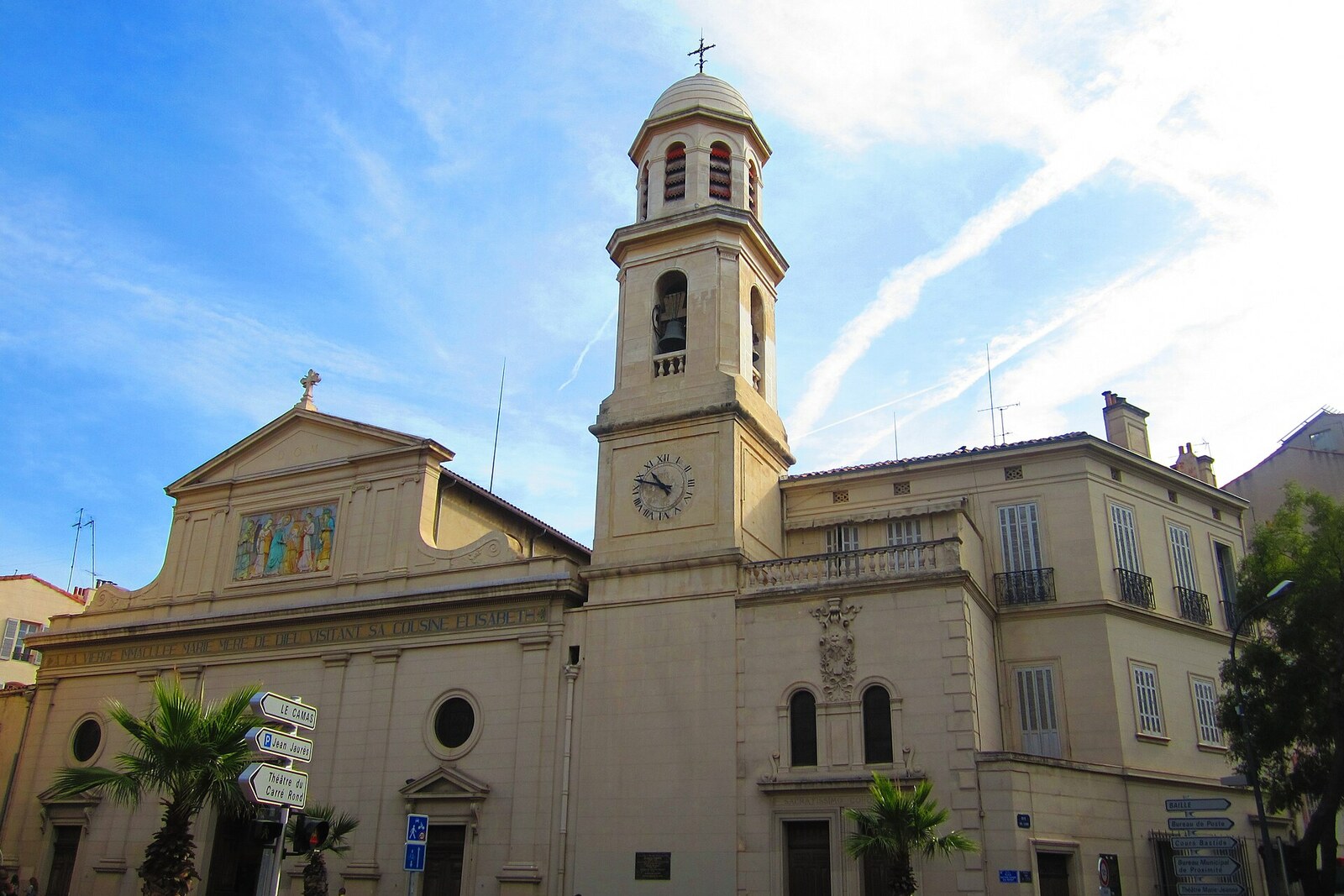
Look around first
What to notice
- Church facade
- Chopin memorial plaque
- Organ above the entrance
- Place Notre-Dame-du-Mont
The story of the place
The name Notre-Dame-du-Mont appeared here long before the present church. In the sixth century, beyond the city walls, there stood the country Chapel of Saint Stephen, belonging to the monks of the Abbey of Saint-Victor. When it fell into disrepair, the monk Balthazar Cappelle obtained permission to restore it. In fifteen eighty-eight, an altar to Notre-Dame-de-Mont-de-Rome—the Our Lady of the Hills of Rome—was installed in the new chapel. This was the name given to the Virgin Mary, the mother of Christ, at a Roman sanctuary. Gradually, this dedication displaced the name of Saint Stephen and was shortened to Notre-Dame-du-Mont.
Sailors who had survived shipwrecks came up here. They brought offerings to the altar in gratitude for their rescue. Later, the sailors transferred this custom to Notre-Dame-de-la-Garde Chapel, built on a higher, more conspicuous hill along the sea route. Here their offerings disappeared, and then the old chapel was demolished, but its name was passed on to the present church, the square, the neighborhood, and the metro station.
There is a memorial plaque to Frédéric Chopin on the church facade. It marks one day—April twenty-fourth, eighteen thirty-nine. On that day, a Requiem Mass was celebrated here for Adolphe Nourrit, the first tenor of the Paris Opera, who lived by his voice and wanted to keep the leading roles for himself.
When the opera management invited another first tenor, Gilbert Duprez, Nourrit first agreed to share the stage with him, then resigned. He left for Italy to change his singing technique and regain his former position. In Naples, Nourrit performed successfully, but his health was deteriorating. In March eighteen thirty-nine, he took his own life by throwing himself from a hotel window.
His widow took his body through Marseille to Paris. Chopin was recovering here at the time from a pulmonary hemorrhage suffered on the way from Mallorca. Nourrit was his friend and one of the first performers to introduce the French public to Schubert’s songs. During the Mass, Chopin played Schubert’s The Stars on the church organ, the dead man’s favorite song. George Sand recalled that people from Marseille paid fifty centimes for a chair and expected a loud concert from the famous pianist. Chopin played quietly; the service remained a farewell between friends, although many had come to hear a celebrity.
According to parish tradition, after the Mass Chopin told the parish priest that the organ was no good at all and should be sold. There was no documented sale immediately after those words. Something else is known: eight years later, a new organ made by Alexandre Ducroquet was installed in the church, while the old instrument was later taken to the town of Eyguières. There, almost all its pipes were sold to pay for repairs to the church floor. The mechanism and the blackwood-covered keys that Chopin had touched were preserved and incorporated into the restored instrument.
The organ above the entrance of Notre-Dame-du-Mont Church is younger than that Requiem Mass. The date remained on the plaque in Marseille, and the keys in Eyguières.
Useful on site
Mass and visiting hours vary; the church is usually open in the morning and evening. The schedule is posted at the entrance.
Checked: June 19, 2026. Check the official source before visiting.The interior is not guaranteed: if the doors are closed, look at the exterior details, and during a service pause the audio and do not walk around the church as though it were an exhibition hall.