 Guide On Map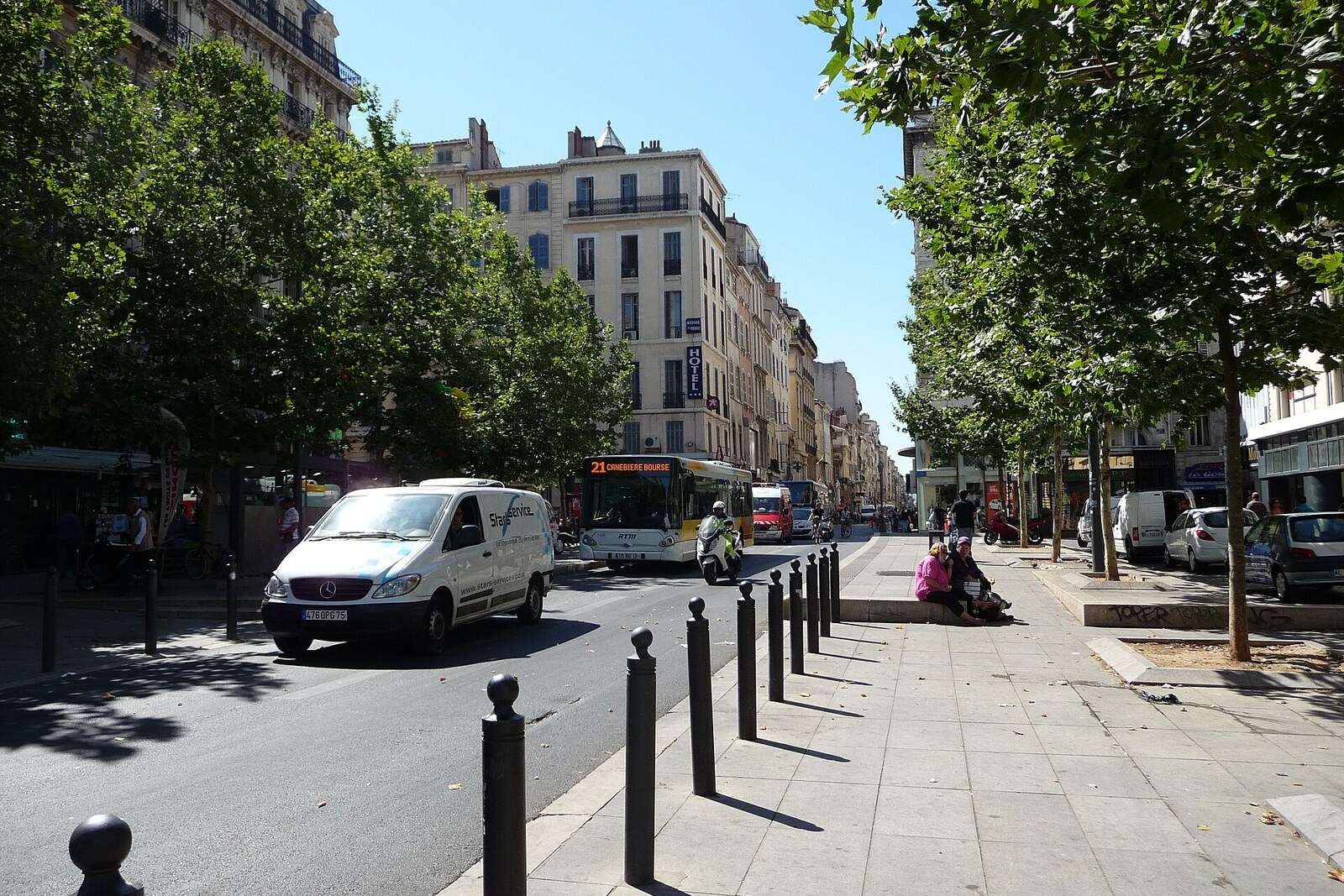
Look around first
What to notice
- The cast-iron kiosk “La Quique”
- The pavilion’s hexagonal plan
- The zinc roof
- Tram tracks
The story of the place
A tram runs along the short square of Cours Saint-Louis today. It received its present name in eighteen sixty, when the widened Rue Noailles cut the former Grand Cours into two parts. The northern part was named Cours Belsunce, and the southern part Cours Saint-Louis.
The Saint Louis here is not the French king Louis IX. He is Louis of Anjou, heir to the Kingdom of Naples, who decided to become a Franciscan. After his older brother’s death, he surrendered his rights to the crown to his younger brother, Robert of Anjou, took monastic vows, and became bishop of Toulouse. In twelve ninety-seven, Louis died at the age of twenty-three; he was buried in Marseille’s Franciscan church. Healings began to be attributed to him at his tomb, Louis was later canonized, and the people of Marseille called him Saint Louis of Marseille. This local veneration explains the square’s name.
Flower sellers had occupied it even before the renaming. Previously, they had traded on the Grand Cours, now Cours Belsunce, laying out flowers on boards placed across trestles. When municipal officials decided to move the market here, the women secured payment from the city for permanent stalls. In October eighteen forty-five, Marseille City Council approved hexagonal cast-iron pavilions with zinc roofs. For this improvement, the councilors immediately raised the fee for a pitch from three to four and a half francs per square meter.
In eighteen forty-seven, eighteen pavilions were built—nine on each side. One of them later acquired a name that can still be read by La Canebière.
Joséphine Nicoli (née Roux) sold flowers from childhood. For her family, it was their only income: her mother raised the children alone and supported them through the same trade. By nineteen hundred, the city directory already listed Joséphine as the owner of the thirteenth pavilion.
In nineteen eighteen, Gaby Deslys, Marseille’s music-hall star, hired Joséphine to sell flowers during her program at the Grand Casino and gave her a new name—La Quique. In Marseille, that was an affectionate way of calling out to a female customer or a child. From the lips of a famous performer, a family form of address became a sign. Performers arriving on Marseille stages began stopping by La Quique before a performance to buy a rose from her for good luck.
Orders extended far beyond the theaters. Joséphine supplied flowers to the prefecture, prepared bouquets for official visits, and in nineteen thirty received the Order of Agricultural Merit. The thirteenth pavilion then passed to her daughter Henriette, who kept it until nineteen seventy-eight.
The other cast-iron pavilions were gradually removed. One kiosk bearing the name “La Quique” remains at the intersection with La Canebière—the last reminder of the eighteen sales pitches that the flower sellers once negotiated from the city.
Useful on site
The open square is accessible around the clock; the flower kiosks usually operate from morning until early afternoon.
Checked: June 19, 2026. Check the official source before visiting.At the busy intersection, choose a spot where you do not block the flow of pedestrians; there is no need to visit any buildings separately.