 Guide On Map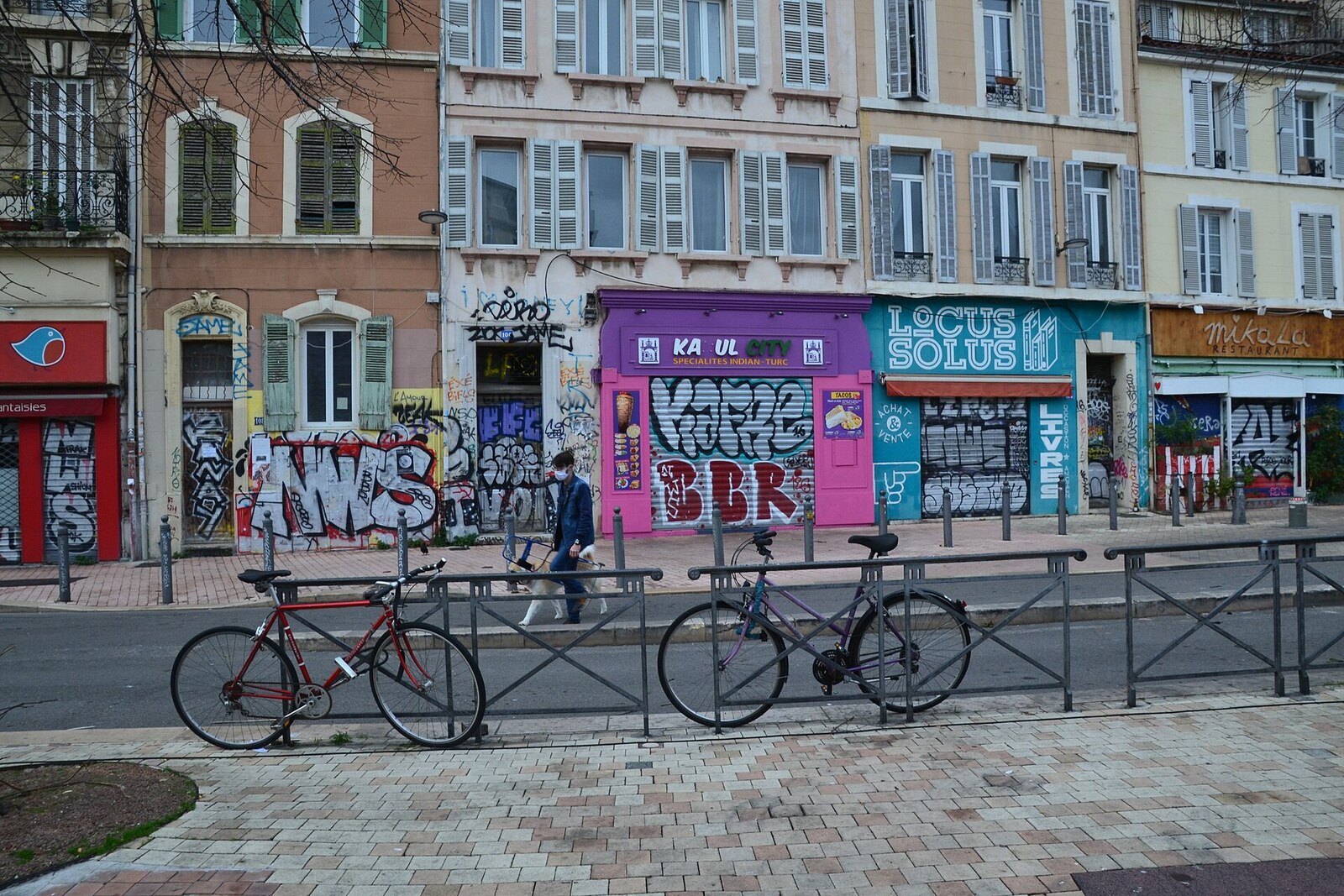
Look around first
What to notice
- The facade of Espace Julien
- Spacious ground floors of former warehouses
- The open square
- Farmers’ market stalls on Wednesdays
The story of the place
In eighteen sixty, Marseille officials concentrated the wholesale trade in fruit and vegetables on Cours Julien. Warehouses and cold-storage rooms occupied the ground floors of the houses, while open stalls stood in the square itself. Farmers from the surrounding area brought their harvest here, and oranges, artichokes, tomatoes, and bananas unloaded at the port also arrived here.
Between wholesalers and buyers stood women traders known in Marseille as “partisans,” meaning distributors. This local market term had nothing to do with political fighters. The women bought goods from wholesalers, split large lots, and resold them in small quantities. Their income was the difference between the two prices, while unsold perishable products remained with them. In the first decades, about two-thirds of the market’s trade passed through these intermediaries.
On April twelfth, eighteen seventy-one, municipal employees introduced public auctions of local produce here. Buyers raised the price aloud; before long, twenty-one auction sites operated on Cours Julien. Some goods now bypassed the “partisans,” and their income fell.
Then the producers themselves opposed the old arrangement. They believed that the intermediaries and auction organizers kept too large a share of the proceeds, and they demanded a separate market on neighboring Place Jean-Jaurès (La Plaine; formerly Plaine Saint-Michel). There, the farmers’ union allocated one hundred forty-one places among its two thousand members. In nineteen oh five, two hundred twenty-five “partisans” were still working on Cours Julien, but most of them lost their status as semi-wholesale intermediaries and became ordinary retail sellers.
By the middle of the twentieth century, trade had outgrown the square itself. In nineteen sixty-four, about two hundred thousand tonnes of vegetables, fruit, and potatoes passed through the market here; roughly half came from abroad. The goods covered the final leg from the port and railway station along city streets. To move this flow out of the center, the municipality instructed SOMIMAR to build a new wholesale market in Arnavaux. In March nineteen seventy-two, trade was moved there.
Spacious warehouses were left vacant. In the former vegetable gallery of Omer Decugis’s company at Cours Julien, thirty-nine, the city opened the Léo Lagrange Community Centre. Ten years later, it was divided into a social center and the Espace Julien concert hall. Theater companies, antique dealers, gallery owners, and restaurants moved into neighboring premises formerly used by wholesalers. That is why the cultural quarter inherited large trading halls rather than purpose-built studios.
The square’s name itself has no connection with the market. “Cours” means a broad urban promenade, while “Julien,” according to the most cautious version, preserved the name of a former landowner. This person’s exact identity has not been established.
On Wednesdays, about thirty local producers return to Cours Julien. They sell their own goods in the square where, at the beginning of the twentieth century, most “partisans” lost their former role as intermediaries.
Useful on site
The open square is accessible around the clock; the farmers’ market is on Wednesdays from 08:00 to 13:00.
Checked: June 19, 2026. Check the official source before visiting.Do not look for a single “main” mural: the quarter’s surface is constantly changing. Concerts and entry to venues are planned separately from the walk.