 Guide On Map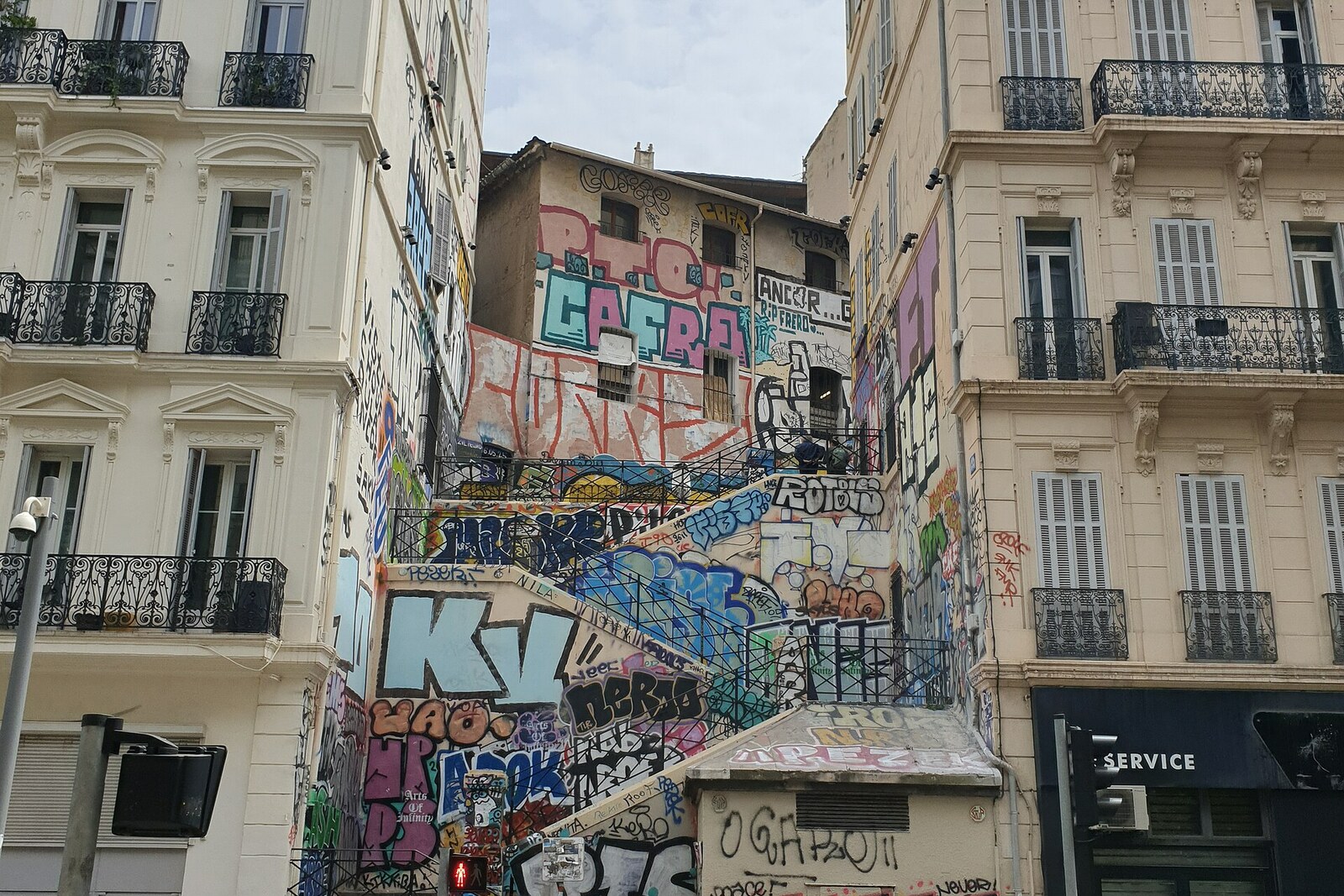
Look around first
What to notice
- Single flights
- Split flights
- Pedestrian bridge
- Layers of murals
The story of the place
The steps narrow into a single run, then split into two; above Cours Lieutaud, cut into the slope, a narrow crossing links them. From the lower neighborhoods, people climbed here to the wholesale market on the plateau. A metro entrance cut through one branch, but the overall pattern of the ascent, street, and bridge remains visible. The paint on the steps changes with the artists: each new mural covers the previous one, so old photographs show images that have already disappeared.
In eighteen oh nine, residents of the Saint-Michel Plateau—an area near what is now La Plaine—demanded a direct route to Marseille’s lower center from municipal councilors. A short but steep slope lay between their homes and Rue Jean-Baptiste-Estelle: over eighty meters of distance, they had to descend about fourteen meters.
Costs and disputes with the owners of neighboring houses delayed the project. Under the rules then in force in Marseille, property owners contributed to the cost of new streets; here, they too were expected to invest their own money. The council discussed the route, but an approved plan did not appear until eighteen fifty-nine. For half a century, residents sought the staircase, which they later paid for together with the city.
The builders alternated single and split flights, and spanned Cours Lieutaud, laid out in a cutting, with a pedestrian bridge. The plateau’s residents got the descent they had demanded. Almost simultaneously, the wholesale market already familiar from the route opened above: the staircase led directly to it from the lower part of the city. Now a metro entrance cuts through one of its flights, but the original line remains—the street, the bridge, the climb to the plateau.
In twenty fourteen, the organizers of Marseille’s first street-art festival chose the staircase for a huge mural. The artists Julien Reynaud and Aset spread one composition across the treads and risers. Later invited artists covered it with their own works. In twenty eighteen, the artist Man Cloua assembled two faces across the flights: separate strips of paint came together into an image when viewed from the bottom of the staircase. Later, an association of local merchants and the municipality continued to commission new murals.
The current paint lies over earlier compositions. Here, the very practice of replacement is preserved, so a photograph of the staircase from several years ago shows a work that has already disappeared. The name Cours Julien is older than all these murals: the Marseille historian Adrien Blès linked it to the surname of a former landowner about whom no reliable biographical information has survived.
Useful on site
Accessible around the clock; the staircase is open to pedestrians.
Checked: June 19, 2026. Check the official source before visiting.Watch your step and stop only where people can get around you; after rain, the paint and steps may be slippery.