 Guide On Map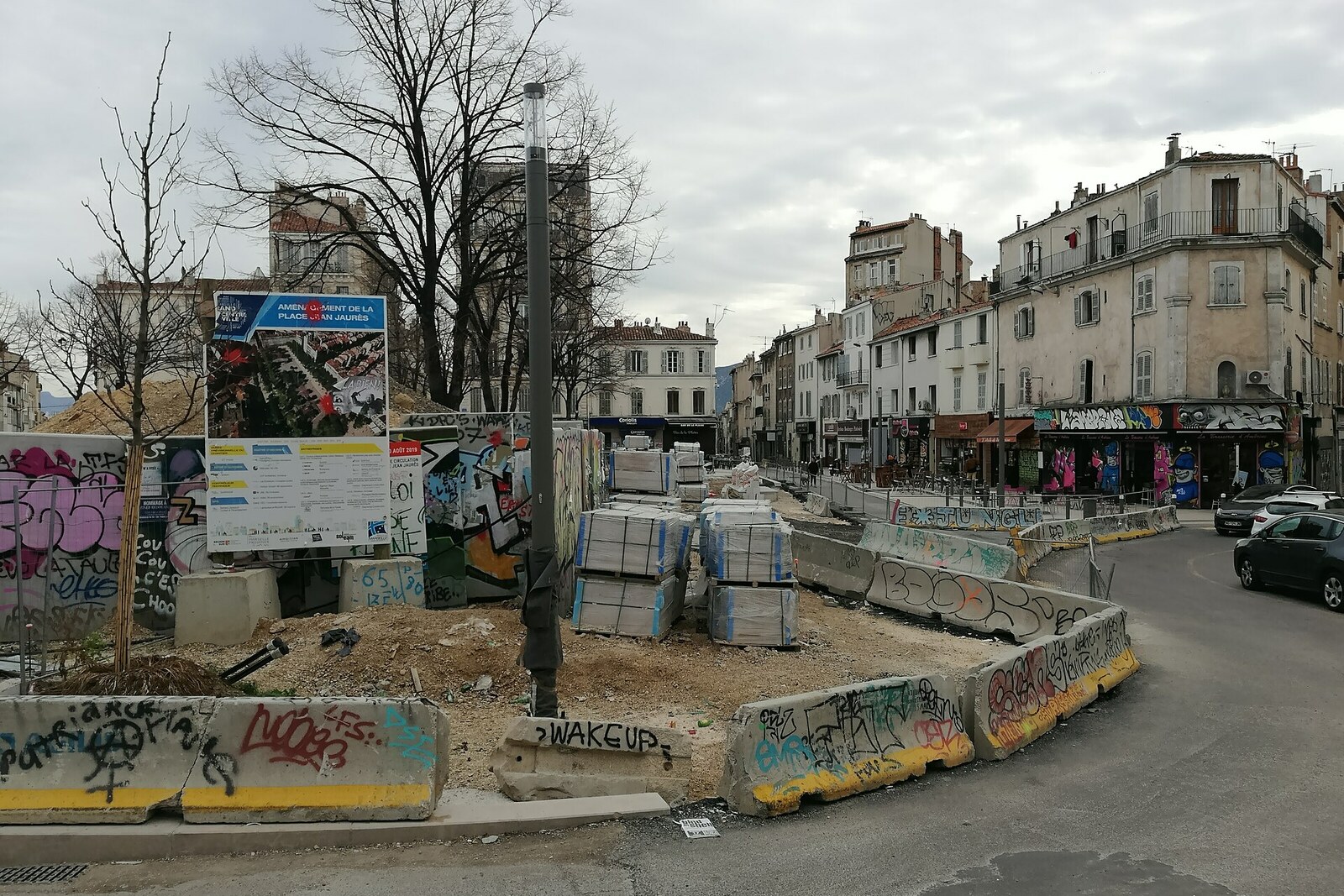
Look around first
What to notice
- Memorial relief at Rue Cibié
- Two profile portraits
- Silhouette of the “Gabizos” balloon
- Place Jean-Jaurès signs
The story of the place
The signs say “Place Jean-Jaurès,” but people in Marseille more often say “La Plaine.” The colloquial name remained from the former Plaine Saint-Michel—Saint Michael's Square. The official name appeared in nineteen nineteen: Marseille City Council dedicated the square to the socialist deputy Jean Jaurès, who sought a peaceful resolution to the European crisis and was killed by a nationalist on July thirty-first, nineteen fourteen, on the eve of French mobilization. Jaurès had no connection to the square itself; his name here is a posthumous dedication.
On Tuesdays, Thursdays, and Saturdays, a large clothing and food market is set up at La Plaine; on Fridays, local producers come. The very shape of the place is convenient for trading: a broad area at the top of a hill, where hundreds of stalls can be set up. Before the market existed, military units assembled here, fairs were held, and balloons were launched.
On November fourteenth, eighteen eighty-six, twenty-four-year-old Louis Capazza was preparing the spherical gas balloon “Gabizos” for flight here. He earned his living as an engineer in the Roads and Bridges administration, while spending his free time and money on experiments with balloons. Capazza wanted to fly from Marseille to his native Corsica. An attempt to make the journey in the opposite direction had already failed.
Twenty-one-year-old Alphonse Fondère, a man from Marseille and an employee of Pierre Savorgnan de Brazza's African expedition, was the second to get into the basket. A strong mistral forced them to postpone the start several times, while a crowd pressed around the basket. At about half past four, Capazza finally gave the order to release the balloon. “Gabizos” barely missed the roof of a neighboring house. They managed to regain altitude with the help of a parachute-ballast invented by Capazza: the device made it possible to lighten the balloon quickly without losing the load altogether.
An hour later, they passed Cassis, then the Hyères Islands. A change in the wind carried the balloon out to open sea after darkness had already fallen. When it became impossible to control the descent, Capazza and Fondère threw off the basket and continued the flight, holding onto the net around the envelope. For several hours, they saw no land, until a lighthouse near Ajaccio appeared ahead.
Five and a half hours after takeoff, “Gabizos” came down near the Corsican village of Appietto. To keep the wind from dragging the balloon and the men along the ground, both aeronauts slit the envelope with knives. A local shepherd gave them shelter for the night, and in the morning they reached Ajaccio and sent a telegram to Marseille. Capazza and Fondère became the first people to cross the Mediterranean Sea in a balloon.
Capazza did not live to see the Marseille memorial to this flight. After his death, Zabet Capazza, the aeronaut's daughter, assembled a committee and found support from cities and aviation organizations, and in nineteen thirty the sculptor Louis Botinelly and the architect Gaston Castel installed a relief at the corner of Rue Cibié. It is on the wall of the Armenian Catholic parish center, exactly at the starting point. The original coloring has disappeared, but a small silhouette of “Gabizos” is still visible beneath the two profile portraits.
Useful on site
On Tuesdays, Thursdays, and Saturdays, the market operates from 06:00 to 13:00; on other days, the square is open around the clock.
Checked: June 19, 2026. Check the official source before visiting.During market hours, do not stand in the walkways, and be mindful of the movement of carts and shoppers; on other days, the square remains accessible but looks noticeably quieter.