 Guide On Map
Northern Medina: Palaces, Gardens, and Madrasa
From Dar El Bacha through Mouassine to Maison de la Photographie de Marrakech
Guide On Map on your phone
Open the walk like a regular app
It takes about 10 seconds to install. No app store needed.
The whole path
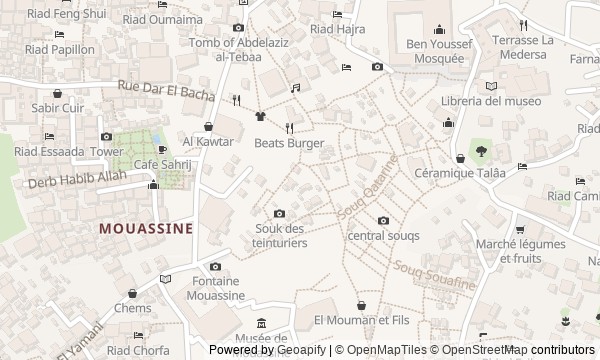
Route map
About the walk
You will walk through the northern Medina from a pasha's palace, through Mouassine, to the Ben Youssef quarter. The route will dip from trading alleys into gardens, guest rooms, a teaching courtyard, and an old domed pavilion. At the end, you will find two private houses that became museums.
What matters here is not a catalog of ornaments, but the fate of enclosed spaces. You will see how a family garden was reassembled from divided plots, and why water links several neighboring stops. The answers stay inside the stories: why a former palace owner went down on his knees, what was found beneath the white plaster, and why an ancient pavilion ended up below street level.
The story will be calm and grounded in things: an inscription, a pool, a student's room, a glass plate. By the end, you will be able to recognize a Saadian dynasty reconstruction, an old water system, and the later transformation of private houses into public places in the northern Medina.
Why this order
Dar El Bacha sets the theme of an enclosed residence where private life met state power. The neighboring garden continues it with a different outcome: a former family property was divided into plots, then brought back together. Restored channels lead to Mouassine Fountain and show that water served not one house but a reshaped quarter. Beside the fountain, Musée de la Musique – Mouassine Douiria takes that reconstruction inside a home, to sixteenth-century guest rooms. After them, Ben Youssef Madrasa offers the necessary contrast: private rooms give way to a large residence hall for visiting students. The next koubba explains where the water came from for the early capital and its religious center. The neighboring Museum of Marrakech returns the route to a private palace adapted for the public. Maison de la Photographie de Marrakech completes this thread with a former funduq, where it is not the courtyard but an archive assembled by private individuals that becomes public.
Those interested in domestic interiors and how the Medina works Those who want to connect architecture with water, power, and everyday life Those who prefer specific human stories to an overview of sights
Those looking for a route only through open squares and streets Those uninterested in museums and restored interiors Those expecting a quick walk without long stops indoors
Before you go
Before setting out, check whether all museums are open and whether there are temporary closures: this route has many interior stops, and the condition of each one shapes the experience. Decide in advance whether you want to visit everything or choose a few main places. Allow more time for full visits than the short distance between stops suggests. A concert at Musée de la Musique – Mouassine Douiria should not be treated as part of a regular museum visit; check the program and entry conditions for a performance separately.
When to go
3–4 hours
Backup plan
If some interiors are closed, keep the sequence of themes: look from the street at the restrained entrances of Dar El Bacha and the douiria, pause at Mouassine Fountain, which can be seen from outside, then continue to the Ben Youssef ensemble. Choose one open palace or teaching interior instead of trying to take in everything. If time is short, keep Maison de la Photographie de Marrakech as the final stop: its archive of photographs is the best way to bring the route together. If you are tired of museums, shorten the indoor visits, but do not rush the walks between them—the contrast between a narrow street and a hidden space is an essential part of this walk.
Route conditions
Surface. Paved — 1.5 km (data covers 75% of the route)
Facilities. Toilets — 8
Elevation. Ascent — 10 m; descent — 3 m
OpenStreetMap extract of June 18, 2026: database data, not a check on the ground. Data © OpenStreetMap contributors, ODbL licence
Walk plan
Open in maps ↗- 1
Dar El Bacha
This is where the thread begins of how a private residence became a place of political calculation—and its failure. - 2
Le Jardin Secret
The garden shows how inheritance fragmented the riad, and how restorers assembled it again parcel by parcel. - 3
Mouassine Fountain
Here, water connects the Saadian remaking of the neighborhood with the everyday life of its new residents. - 4
Musée de la Musique – Mouassine Douiria
This stop will show that later plaster can not only hide old decoration, but also preserve it. - 5
Ben Youssef Madrasa
The student rooms explain why the new dynasty needed an educational center of its own. - 6
Almoravid Koubba
Here you will see how engineers brought water to a new capital and how a useful structure became a dynastic monument. - 7
Museum of Marrakech
The fate of Dar Menebhi shows how a ministerial residence became a school and then a museum. - 8
Maison de la Photographie de Marrakech
The finale will explain how a private collection became a public archive and how to read old photographs critically.
Route features
Everything you need stays in the browser
Progress, saves and your trip plan are stored on this device.
Add Guide On Map to your home screen so the walk opens outside the browser.
How we handle sources, maps and corrections: our editorial standards