 Guide On Map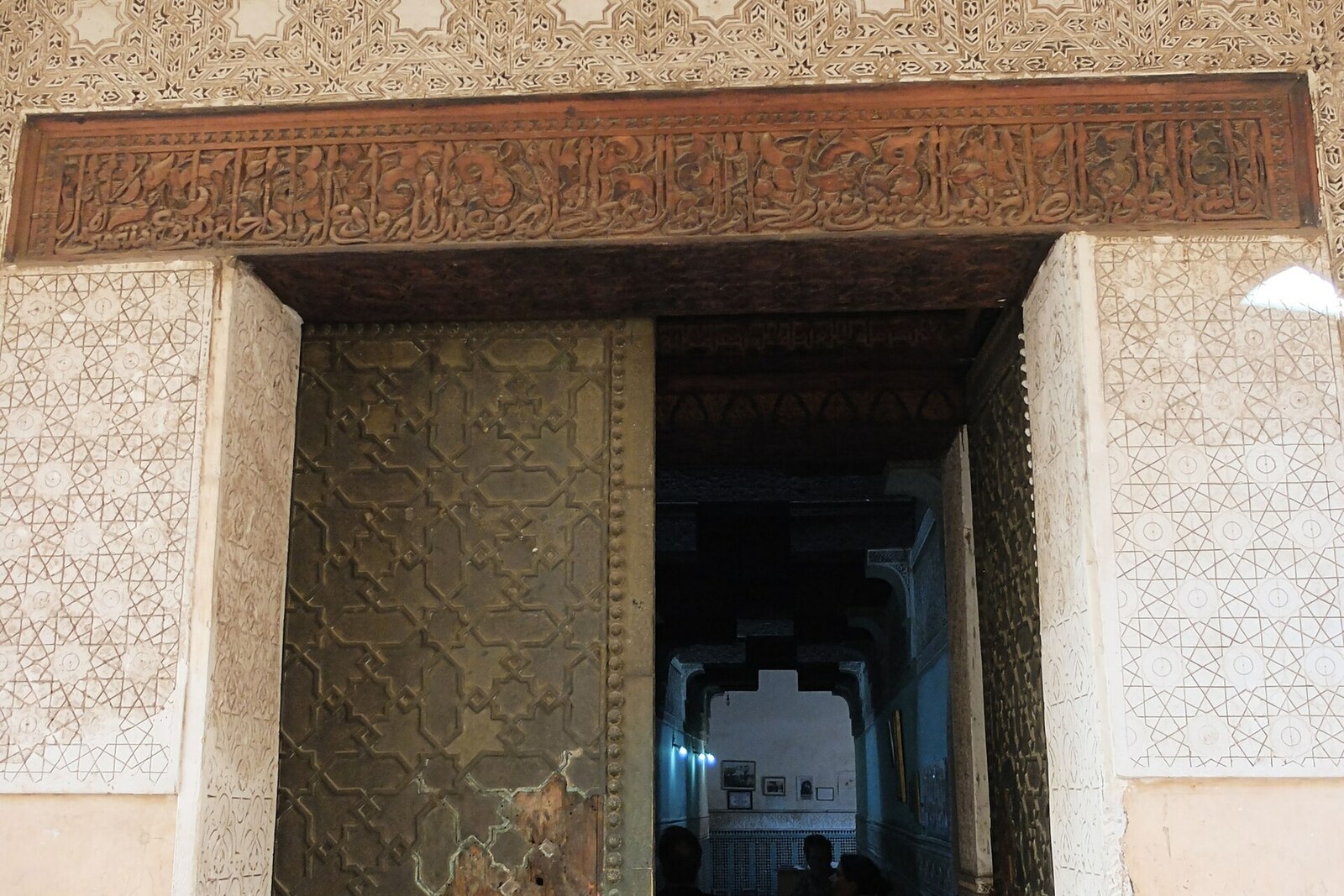
Look around first
What to notice
- The inscription above the entrance
- The tiled frieze of the courtyard
- Small light wells
- Student rooms
The story of the place
At the entrance to Ben Youssef Madrasa, the story begins with a struggle for the throne. In fifteen fifty-seven, Abdallah al-Ghalib took the Saadian throne after his father was murdered by envoys of the Ottoman governor of Algiers. The sultan's three younger brothers, who also had claims to the throne, fled to the Ottomans. Ottoman troops soon entered the Fez Valley. At the same time, Abdallah had to reckon with Fez's theologians and jurists: Morocco's largest center of learning was there, and its teachers did not always support the new Saadian dynasty.
Abdallah needed his own educated judges and experts in religious law in the capital, Marrakesh. A fourteenth-century madrasa already stood here beside the city's main mosque. The sultan ordered it replaced with a much more spacious building. Work was completed by fifteen sixty-five; the patron's name was carved above the entrance, and the year of completion was recorded in the tiled frieze of the inner courtyard.
The main classes were held in the neighboring mosque and in the prayer hall here. The madrasa itself primarily provided lodging for students who had come from elsewhere. About one hundred thirty rooms were arranged over two floors and grouped around small light wells. Students slept in them, kept their books there, and reviewed lessons in Islamic law, Quranic interpretation, and Arabic grammar. By a widely accepted historical estimate, up to eight hundred people could live here at one time. For a young man without family or a home in Marrakesh, a place in such a room made it possible to study for years with the capital's teachers. For almost four centuries, teachers continued to hold classes, while new generations of students filled these rooms.
The madrasa took its name from the mosque for whose students it was built. Ben Youssef is Ali ibn Yusuf, son of Marrakesh's founder, Yusuf ibn Tashfin. In the early twelfth century, Ali ruled the Almoravid realm and ordered the construction here of the city's main Friday mosque, where theologians also taught students. More than two hundred years later, the first residential madrasa appeared beside it, and later still Abdallah al-Ghalib replaced it with the present building. The old mosque's name was retained.
Today, classes are no longer held here. The name on the sign belongs to Ali ibn Yusuf, the inscription above the entrance names Abdallah al-Ghalib, and beyond the decorated courtyard are the students' cramped rooms—the two buildings were placed side by side for the students.
Useful on site
Paid museum site; check current hours and the queue.
Checked: date not specified. Check the official source before visiting.Go into several different cells and compare them with the ceremonial courtyard. In the narrow passageways, do not block other visitors.