 Guide On Map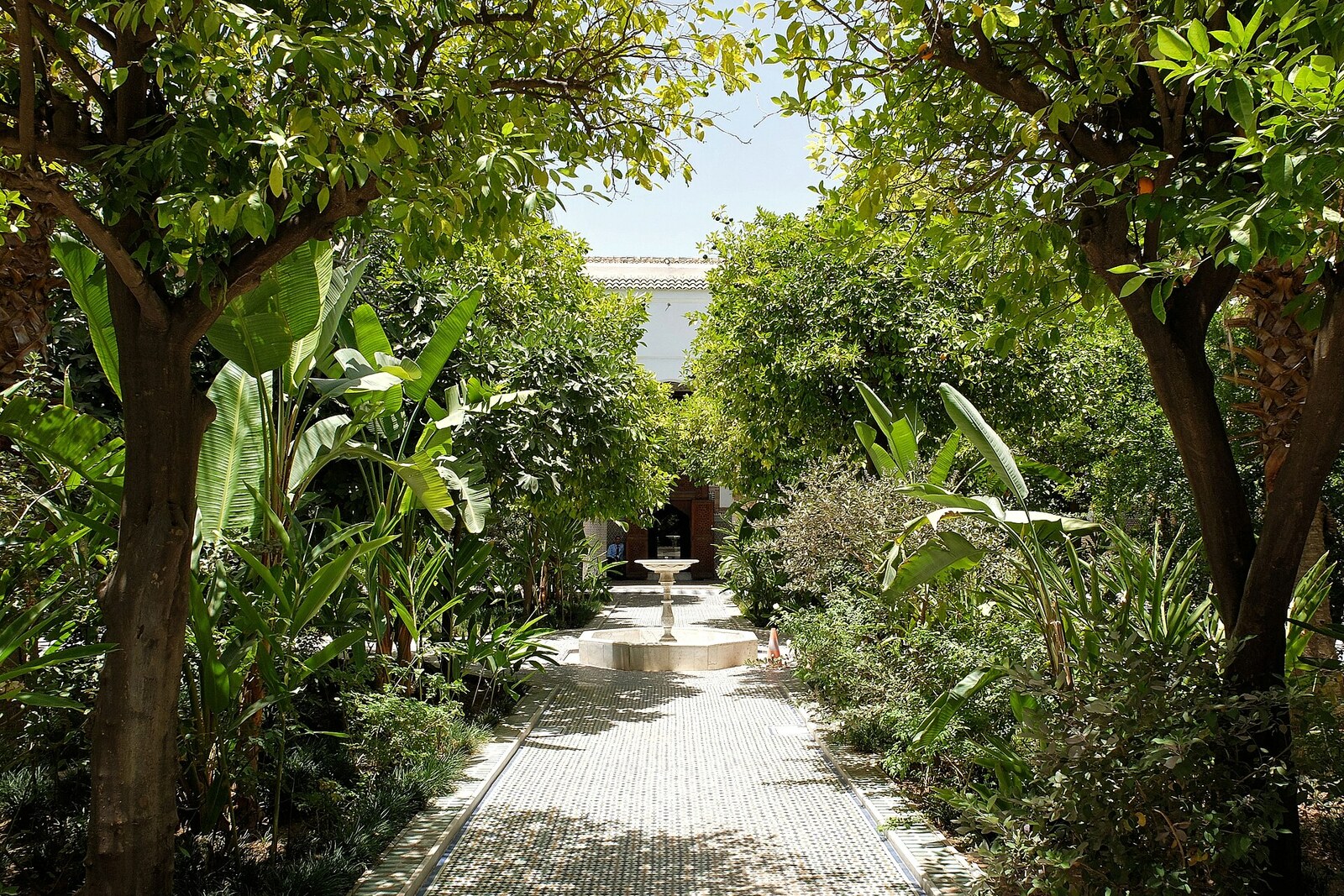
Look around first
What to notice
- Central garden
- Six salons around the garden
- Upper chambers
- Palace gates
The story of the place
In the early twentieth century, the palace was built as the home of the city's governor: it contained family rooms, a reception room, and spaces where city affairs were handled. Six salons open onto a garden in the middle of the palace, with upper chambers arranged above them. After a long period of neglect, the ceremonial part was restored for the Museum of Confluences, with exhibitions on Morocco's religions and cultural ties. The old name Dar El Bacha, the Pasha's House, remained with the site after the palace became a museum.
In August nineteen fifty-three, Thami El Glaoui summoned several thousand supporters to the gardens of his Marrakesh residence. El Glaoui was a pasha—a governor appointed by the Sultan, responsible for governing the city, judging cases, and appointing local officials. Now he was seeking the removal of Sultan Mohammed V himself.
The palace was built for El Glaoui in the early twentieth century. Sultan Moulay Youssef confirmed him as pasha of Marrakesh in nineteen twelve, and the residence came to be called Dar El Bacha—the Pasha's House. It served at once as a family home, a reception room, and an administrative center. In a photograph from nineteen twenty-four, a line of men stands at the palace gates, waiting for the pasha to hear their cases.
El Glaoui lived on income from extensive lands, shares of almond, saffron, and olive harvests, taxes from subject tribes, and investments in French mines and businesses. The French Protectorate in Morocco kept him in office and relied on the caids under his authority—the rulers of rural districts. Mohammed V, by contrast, refused to break with the Istiqlal Party, which demanded Morocco's independence. When the pasha attacked nationalists during an audience with the Sultan, the Sultan ordered him thrown out of the royal palace. After that, El Glaoui began collecting signatures for Mohammed V's removal.
On August sixteenth, nineteen fifty-three, Moulay Ben Arafa waited in one of the upper salons of Dar El Bacha. He was an elderly relative of the Sultan whom El Glaoui intended to put in Mohammed V's place. After four hours of negotiations, an adviser to the pasha's court read an act to those assembled. Ben Arafa was proclaimed imam, meaning a religious leader: in this way, Mohammed V's opponents tried to deprive him of the right to speak in the name of the faithful. El Glaoui signed the document first; after him, the religious authority El Kettani and twelve pashas and caids signed it.
Four days later, French armored vehicles surrounded the royal palace in Rabat. Mohammed V refused to abdicate, and he and his family were sent first to Corsica and then to Madagascar. Ben Arafa was placed on the throne.
El Glaoui's calculation did not work out. The exiled Sultan became a shared symbol of resistance to the protectorate, clashes intensified, and Ben Arafa failed to gain recognition in the country. In the autumn of nineteen fifty-five, the French government agreed to return Mohammed V. El Glaoui declared him the legitimate Sultan, flew to him in France, fell to his knees before him, and asked forgiveness. The Sultan forgave him.
On January twenty-third, nineteen fifty-six, the former pasha died in his Marrakesh palace. His body was placed here on simple bier under a black shroud; several hundred people recited prayers over him. Representatives of the Istiqlal Party also came to pay their respects—the very party whose connection with the Sultan had caused the break.
After a period of neglect, restorers from the National Foundation of Museums restored the ceremonial part of the residence, and in twenty seventeen the Museum of Confluences opened here. Exhibitions in the six salons around the central garden explore the different religions, artistic traditions, and cultural ties that shaped Morocco. The old name was retained in the full name: Dar El Bacha, the Pasha's House.
Useful on site
A museum with separate opening hours and tickets; check the National Foundation of Museums schedule before visiting.
Checked: date not specified. Check the official source before visiting.From the street, the palace's history is almost impossible to read: for this stop, going inside matters. Look not only at the decor, but also at the sequence of rooms.