 Guide On Map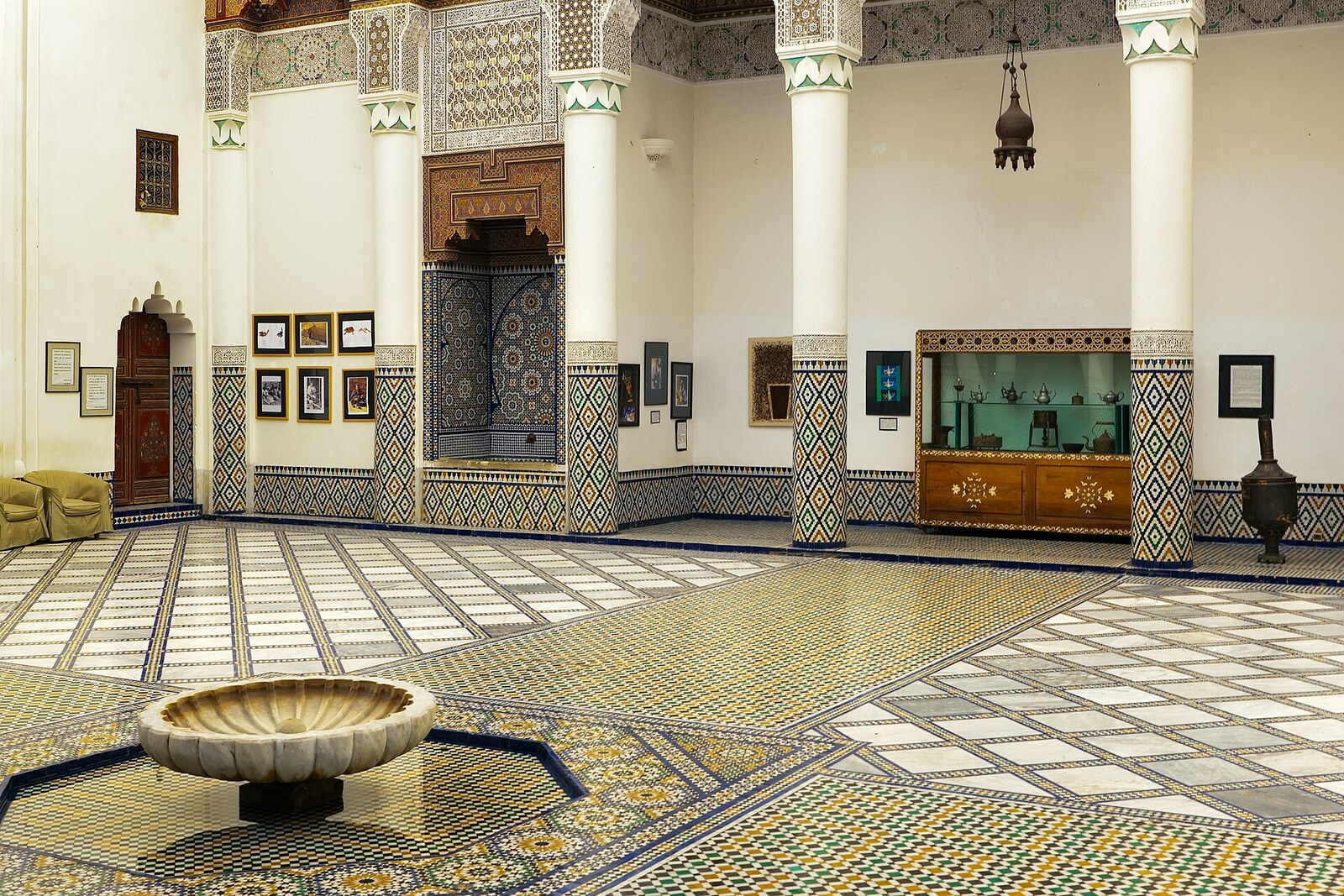
Look around first
What to notice
- Covered courtyard
- Large copper light fixture
- Four salons
- Private hammam
The story of the place
The Museum of Marrakech occupies a former palace with a huge central courtyard. During the restoration, the courtyard, with an area of more than seven hundred square meters, was covered and turned into a hall for exhibitions, concerts, and conferences. A copper light fixture, nearly five meters in diameter and weighing about one thousand two hundred kilograms, hangs beneath the roof. The remaining rooms were given over to the museum collection.
In eighteen ninety-eight, Mehdi el-Menebhi commissioned his own residence here. He was close to the young Sultan Moulay Abdelaziz and soon became his minister of war. The new house matched his position: an open courtyard with fruit trees, four large salons, a separate kitchen for a large household, and a private hammam. The name Dar Menebhi means precisely “the house of Menebhi.”
The owner had to prove his position through military successes. In nineteen oh three, the sultan ordered him to defeat Bou Hmara—a claimant to the throne who had seized Taza and brought part of eastern Morocco under his control. Menebhi first took Taza, but the campaigns that followed brought heavy losses. The sultan removed him from the ministry. The former favorite made a pilgrimage to Mecca, settled in Tangier, and never again returned to live in the palace in Marrakesh. The house retained the surname of the man for whom it was built during the shortest and most successful period of his career.
After Morocco gained independence, the state gave the former residence to the first girls’ school in Marrakesh. The pupils occupied rooms designed for the minister’s family and his receptions. Later, the school moved out, the palace stood empty, and gradually fell into disrepair.
In nineteen ninety-six, Omar Benjelloun took it on—a Casablanca industrialist and collector of ceramics, books, and paintings. He paid for the restoration from his own funds and instructed a foundation he had established to adapt the palace for public display of the collection. As early as March nineteen ninety-seven, the Museum of Marrakech opened here.
For the museum, the restorers altered the main space of the house. Under Menebhi, the courtyard, with an area of more than seven hundred square meters, remained open and was planted with fruit trees. Benjelloun ordered it covered and commissioned a huge copper light fixture: about five meters in diameter and weighing roughly one thousand two hundred kilograms. Exhibitions, concerts, and conferences are now held beneath it; the displays occupy the former salons, while the restored hammam remained in its original place.
Useful on site
Museum site near Place Ben Youssef; check current opening hours and ticket information.
Checked: date not specified. Check the official source before visiting.Do not limit yourself to the display: the building’s layout is no less important here. Compare the ceremonial courtyard with the more restrained rooms around it.