 Guide On Map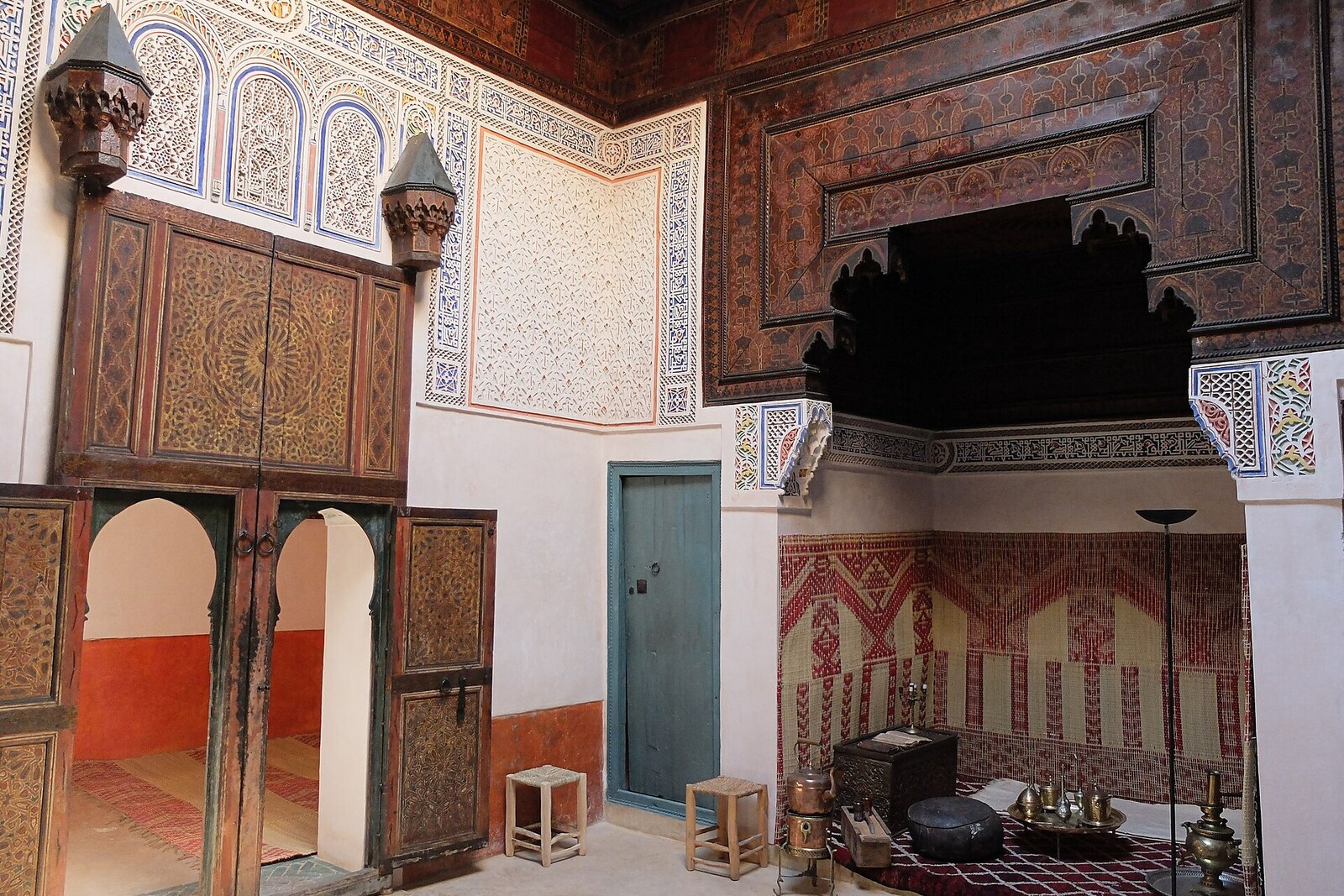
Look around first
What to notice
- Pink carved plaster
- Red, green, and yellow pigments
- Wooden ceilings
- Two seating niches
The story of the place
The upper rooms of this house were separated from the family quarters: here the owners received honored guests and could let them stay overnight. Such rooms were called a douiria; a wealthy family built them in the second half of the sixteenth century, when the neighborhood around Mouassine Mosque was being resettled. At the center, a salon survives with two niches facing one another, wooden ceilings stretching above them, and pink carving and traces of red, green, and yellow paint visible on the walls. These rooms now house a museum where music from Morocco's different traditions can be heard.
In two thousand eleven, Patrick Manac'h and Hamid Mergani, founders of the Marrakesh House of Photography, first went up to these rooms. At the time, a carpenter lived here with his family. The wooden doors and painted ceilings looked old, but the walls were white: several generations of residents had smoothed them with fresh plaster, poured concrete floors, and installed toilets. The roof leaked, and some of the stucco decoration had already been lost. No one knew what remained beneath the white layers.
A year later, Manac'h and Mergani bought the upper part of the house with private funds. It is called a douiria: separate guest quarters above the family dwelling. In the central salon, two seating areas are arranged opposite one another, and doors from it lead to side rooms. The owners could receive honored guests and let them stay overnight without bringing them into the family quarters. A wealthy family built the douiria in the second half of the sixteenth century, when the rebuilt neighborhood around the new Mouassine Mosque was being resettled.
Manac'h suspected that the white walls concealed earlier decoration and invited Xavier Salmon, a curator at the Louvre Museum, to test the idea. Trial cleanings revealed several more layers beneath the later paint and, deeper down, pink gypsum plaster with a carved pattern. Red, green, and yellow pigments survived in the recesses. Later residents covered the old finish, but in doing so protected the paint from constant handling and further alterations.
Manac'h and Mergani decided to remove all the added layers and repaint almost nothing. Two young potters from the Ourika Valley began uncovering the relief with soft brushes; the team then grew to ten craftspeople. Lost areas were filled with plaster from the same valley, its pink tint provided by clay. The workers replaced rotten load-bearing beams, removed cement from the facade, restored ventilation channels, and directed the water away. The original doors, ceilings, and surviving paintwork were left in place. After the restoration, the former dwelling opened as Musée de la Musique – Mouassine Douiria.
Music appeared here before a separate exhibition did. Evenings by Moroccan performers began in the restored douiria. For three years, the concerts drew such large crowds that in December two thousand nineteen, Manac'h and his team turned the entire museum into Musée de la Musique – Mouassine Douiria. The rooms received instruments, photographs, and recordings devoted to Amazigh, Jewish, and Arabo-Andalusian music, the religious brotherhoods of Gnawa, and Dakka Marrakchia, Marrakesh's collective drumming tradition. The museum's creators also began assembling an archive of Moroccan music, so that concerts would not remain the only way to hear it.
Musicians still perform in the central salon. The audience occupies the two niches facing one another, prepared by sixteenth-century builders for guests. Old wooden canopies remain above them, and around them are the same pigments that Patrick Manac'h and Hamid Mergani found beneath the white plaster of the dwelling.
Useful on site
A museum with its own hours and possible concerts; check the program in advance.
Checked: date not specified. Check the official source before visiting.Look closely at the boundaries of the uncovered historic layers. An ordinary visit does not guarantee live music; plan separately around the concert program.