 Guide On Map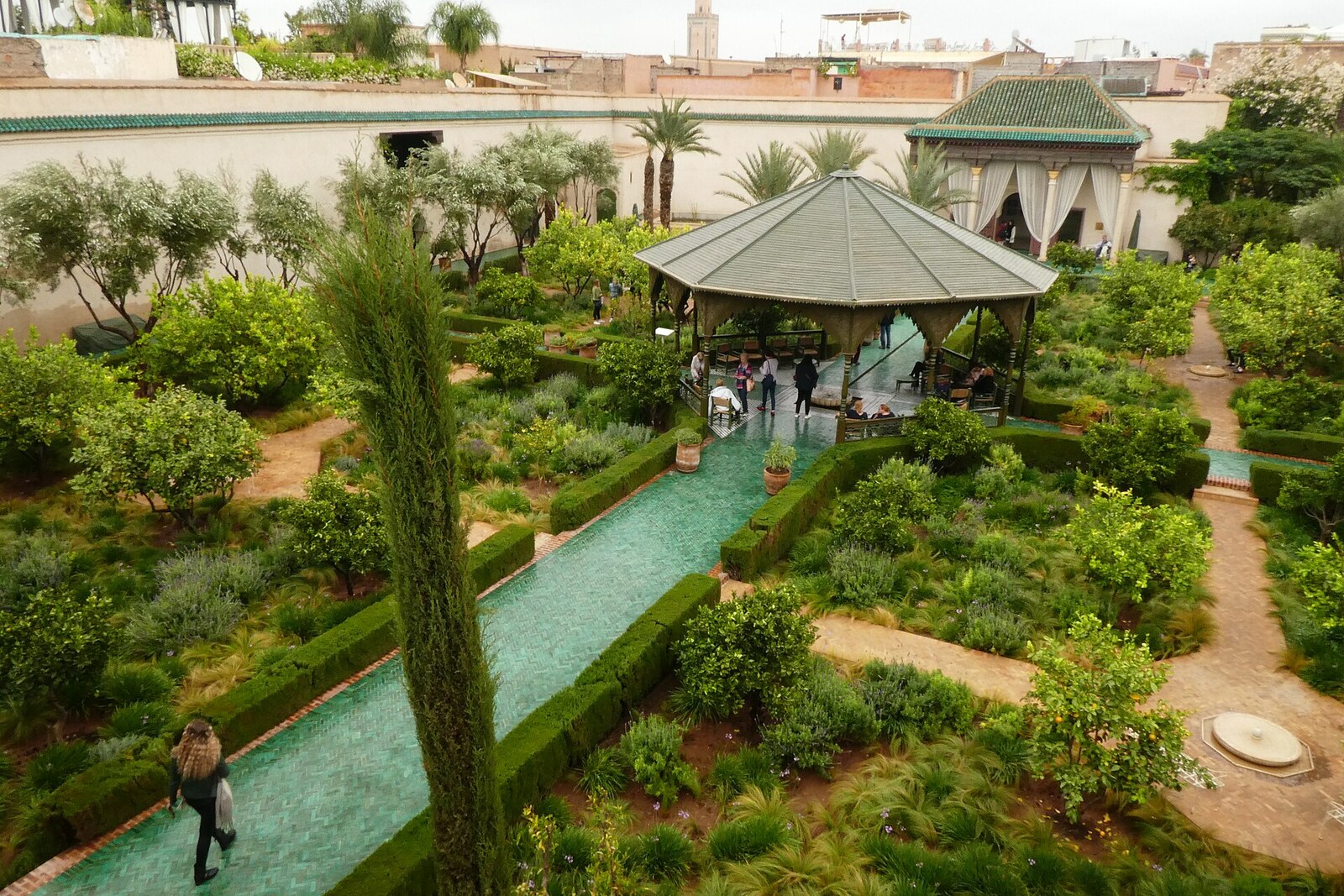
Look around first
What to notice
- Four rectangular sections
- Crisscrossing raised paths
- Marble basin
- Old water channels
The story of the place
A riad within the medina served as a private family home with a garden in its inner courtyard, where outsiders were not admitted. The building from the middle of the nineteenth century occupied a site where a Saadian palace had previously stood. In the large courtyard, paths raised above the plantings converge on a marble basin. The smaller courtyard was planted with plants from different parts of the world; its trees were brought at night on carts pulled by donkeys and horses.
Water once again flows through narrow channels between the four sections of the Islamic garden. During the restoration, the surviving parts of the old water system were put back into operation, and the plants were replanted. That is why the greenery here is younger than the stone layout that waters it.
The last owner to hold the estate as a whole was al-Hajj Muhammad Loukrissi. He lived by the watchmaking trade, became the head and representative of the corporation of Marrakesh watchmakers, and the connections he gained brought him to court. In nineteen oh eight, Loukrissi received the post of chamberlain—a trusted court official of Sultan Moulay Abdelhafid.
His career lasted four years. In nineteen twelve, the Sultan agreed to the French protectorate, abdicated, and went into exile. Loukrissi lost his position at court. He then exchanged his house in Fez for this Marrakesh estate and settled here with three wives and numerous children.
This was a riad—a house arranged around an inner garden. The estate was built in the middle of the nineteenth century on the site of an earlier Saadian palace. The garden lay within the family home, behind blank walls; outsiders were not brought in. Loukrissi lived here until his death in nineteen thirty-four.
After him, the large family brought about a very tangible change. The heirs divided the property into parts. The single riad became numerous plots with different owners, service rooms disappeared, and later buildings appeared in the courtyards. The garden was neglected, and the old water basins filled with rubbish.
In two thousand six, a group of entrepreneurs began buying up these plots. They intended to profit from a large real-estate project in a favorable part of the Medina of Marrakesh, and at first they had only a poor idea of what exactly they were acquiring. Negotiations with the many owners and the lack of clear land-registry documents stretched the process of assembling the land over six years.
When the plots were finally united, the project leader Lauro Milan proposed abandoning the original commercial plan. The owners agreed to restore the estate and open it to visitors. In two thousand thirteen, builders began dismantling the later additions. Beneath them they discovered a private hammam, large pools, old pipes, and the remains of former pavilions. Archaeologists established that beneath the nineteenth-century estate, traces survived of a garden from the Saadian sultanic era, created in the second half of the sixteenth century, when Sultan Moulay Abdallah was rebuilding the Mouassine quarter. Excavations confirmed the old division of the property into two courtyards and showed the route of the water through pools and channels. Restorers incorporated this water system into the present one.
The two gardens were treated differently. For the large courtyard, the landscape architect Tom Stuart-Smith recreated the probable appearance of a nineteenth-century Islamic garden: crisscrossing raised paths, four rectangular plantings, and a marble basin in the center. It proved impossible to determine what the smaller courtyard had looked like. There, Stuart-Smith created a new exotic garden from plants from five continents. The trees were brought through the narrow streets of the Medina of Marrakesh, mostly at night, on carts pulled by donkeys and horses.
The name “Le Jardin Secret”—“The Secret Garden”—appeared only during the restoration: by then, even in Marrakesh, few people knew what was hidden behind these walls. On March twentieth, two thousand sixteen, the former family riad opened to the public for the first time. The word “Secret” remained on the sign.
Useful on site
Paid-entry garden with seasonal hours; the tower may be charged separately.
Checked: date not specified. Check the official source before visiting.It is best to walk through the garden slowly and trace the route of the water between its sections. The underground system is not entirely visible, so compare the individual channels and reservoirs.