 Guide On Map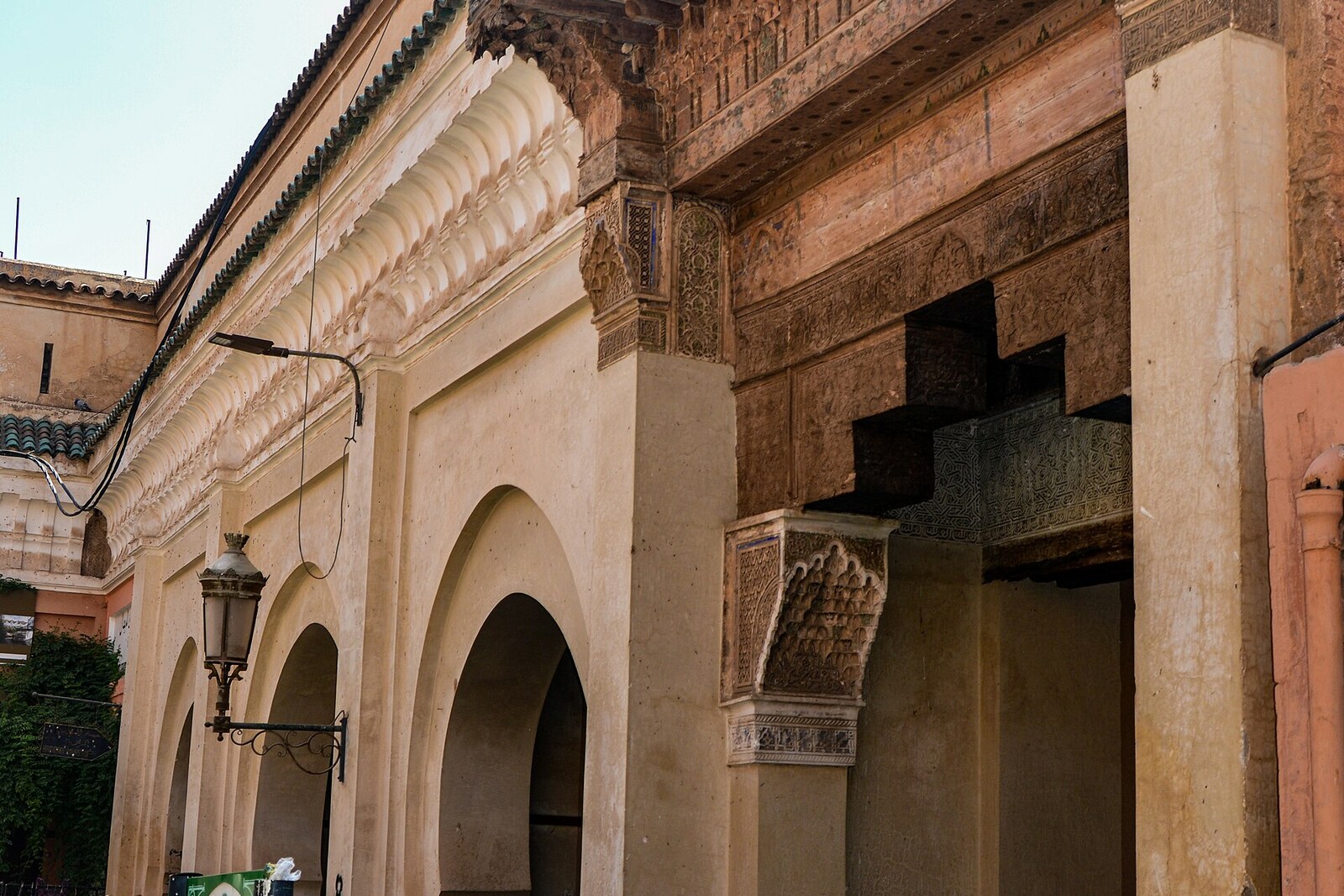
Look around first
What to notice
- Carved cedar brackets
- Lower wooden beam
- Decorated niche
- Arches of the watering troughs
The story of the place
This fountain appeared after an order that forced an entire urban community to change address. In fifteen fifty-seven, the Saadian sultan Abdallah al-Ghalib ascended the throne and began reshaping Marrakesh as the capital of his dynasty. A significant part of what is now Mouassine was then inhabited by Jews, and their cemetery was here as well.
The sultan ordered the Jews resettled closer to the Kasbah of Marrakesh—a fortified palace district. For jewelers, tailors, and merchants, this meant moving their families, shops, and workshops. The new walled quarter was later called the Mellah of Marrakesh. According to Jewish tradition, construction was directed by Rabbi Mordechai ben Attar, a representative of the community being relocated: he had to house the people on the site of the former sultan’s stables. The work was completed around fifteen sixty-three.
On the freed land, Abdallah al-Ghalib ordered the construction of the Friday Mouassine Mosque and at once provided the future neighborhood with everything it needed: a school, a library, a bathhouse, a room for ablutions, and a public water source. The mosque was built over part of the former Jewish cemetery. After the resettlement, some Jews tried not to pass nearby, fearing they might step on graves. One old account claims that for this reason some Muslims also avoided the mosque, but other chronicles do not confirm this.
The fountain was needed for the new neighborhood to be populated at all. In the decorated niche, people filled vessels with water. The neighboring arches led to watering troughs for pack animals; a wooden crossbar kept them from reaching the human basin. This division explains the scale of the structure: residents, merchants, and drovers all obtained water here at the same time. Abdallah al-Ghalib arranged daily water provision as a charitable gift, because giving city residents drinking water was considered an especially honorable donation.
Water arrived through a khettara—an underground tunnel with a slight slope that brought groundwater to the city without pumps. Researchers believe that the Ain al-Mouassine line appeared around the same time as the complex. It supplied about forty fountains in the western Medina of Marrakesh, part of the Kasbah of Marrakesh, and part of the new Mellah of Marrakesh, where the sultan resettled the former residents of Mouassine.
Carved cedar brackets and the lower beam survive from the original construction. The plaster and painted decoration were largely redone during repairs in eighteen sixty-seven. The black inscription that once proclaimed a promise fulfilled and the rising of a star of glory has disappeared; its text is known from an old photograph.
The origin of the name Mouassine remains disputed. A local explanation linked it to a family of sharifs supposedly living nearby, but historians have found no such family in the documents. A more likely version derives the name from the Arabic word for “knifemakers”: before the Saadian rebuilding, blade craftsmen kept workshops along the neighborhood’s main street.
Useful on site
An open street-side stop; keep the passage clear.
Checked: date not specified. Check the official source before visiting.The fountain is viewed from the street. Do not block the narrow passage, and treat the water as part of the historic structure, not as a source of drinking water.