 Guide On Map
From Barra to St. Paul: Old Macau
From A-Ma Temple through the old neighborhoods to the Ruins of St. Paul's
Guide On Map on your phone
Open the walk like a regular app
It takes about 10 seconds to install. No app store needed.
The whole path
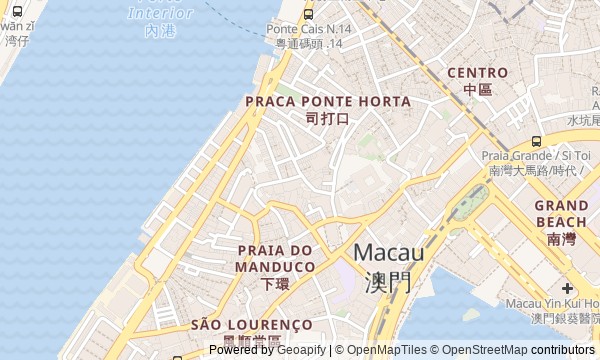
Route map
About the walk
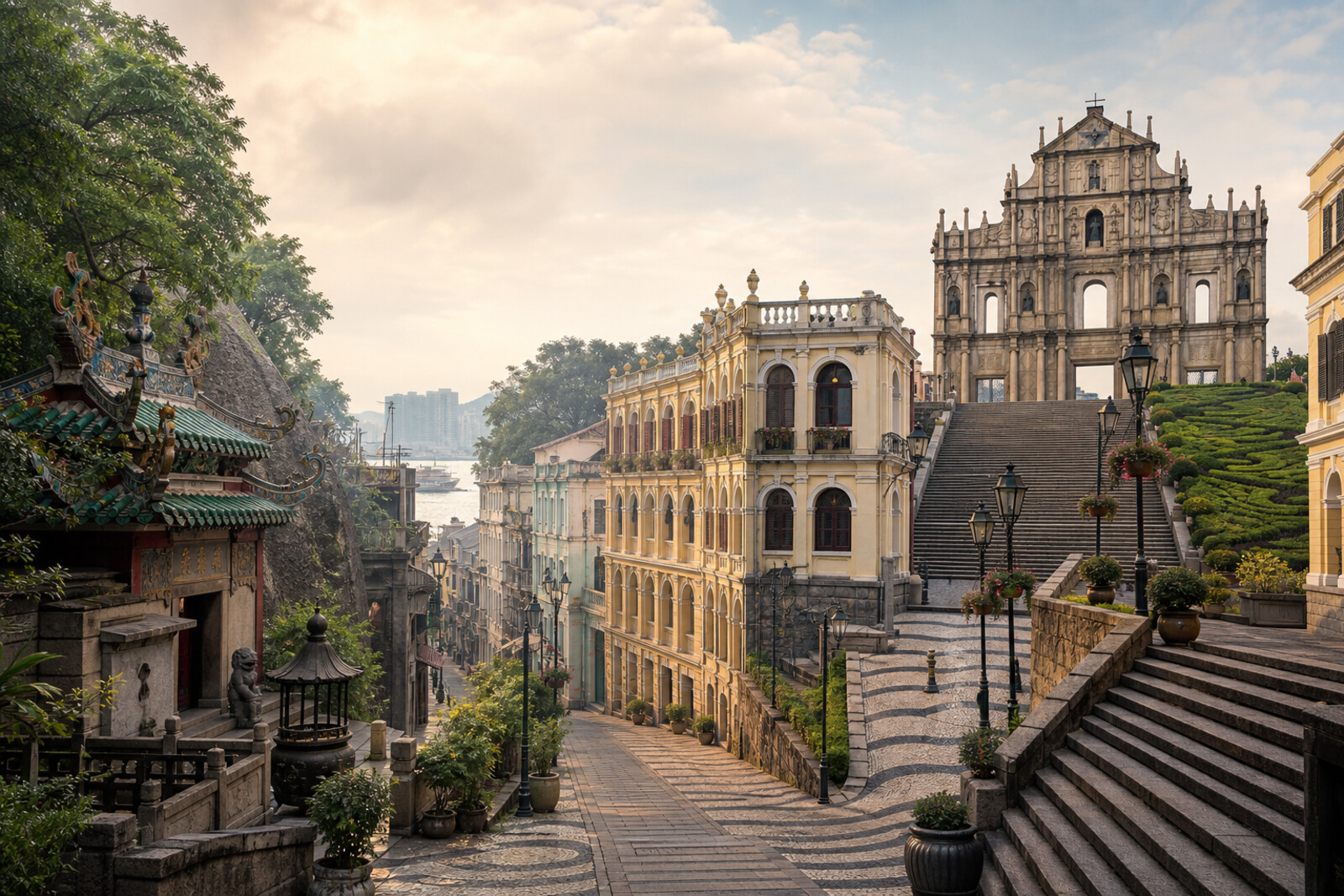
You will walk north from the foot of Barra Hill, through old residential neighborhoods to the main squares and the stone façade of St. Paul. The way climbs from a working Chinese sanctuary past barracks with Indian arches, a former spring, a large family house, and Catholic churches.
Here the sea will surface in stories, then slip out of sight. You will learn why the barracks were called Moorish even though their first residents were recruited in Goa. You will hear why townspeople asked for a canceled procession to be restored, and what members of the senate risked when they chose a king.
The story follows documents and human decisions. A legend remains a legend, and a beautiful later version does not replace what is known for certain.
After the walk, you will read old Macau as a port city where a sanctuary, a spring, a family house, churches, and the senate are joined by one road leading to a granite façade.
Why this order
The route begins at Inner Harbour, because A-Ma Temple explains the city's maritime origins. The climb up the slope brings you straight to the barracks: after the patron goddess of seafarers come the people whom the Portuguese administration brought across the same sea. The road then reaches Lilau—from an official building to the spring around which the neighborhood's everyday life took shape. Mandarin's House stands beside the square, and the water of a private neighborhood gives way to the story of a family, trade, and a book. The street then rises to St. Lawrence's Church: from a merchant's home, the route moves to the church of families waiting for trading ships. St. Augustine's Square continues the church line, but shifts it from private prayer to a procession for the whole city. The descent to Senado Square reveals the next scale: a public political decision made by the entire community. From the square, the final climb leads to St. Paul, where trade money, mission, and urban construction come together in the surviving façade.
Those who want to walk through historic Macau as one continuous route Those who care about the human decisions behind familiar landmarks Those who prefer documents to beautiful urban legends
Those looking for a walk through casinos and modern waterfronts Those who dislike climbs, stairs, and old neighborhood streets Those who only want a quick overview of the best-known façades
Before you go
Bring water and shoes that hold firmly on stone: the distance does not look long, but the route gradually climbs and ends with a long staircase. In temples and churches, you are a guest in active religious places—speak more quietly, do not block passageways, and do not disturb prayer or services. Access to Mandarin's House, the church, the theater, and museum spaces may differ from access to the surrounding streets and squares, so do not build the whole walk around interiors. Headphones work best for the stories: many stops need not volume, but a few calm minutes of observation.
When to go
Set aside 3–4 hours for all eight stops. You can complete the route more quickly, but the stories of Lilau, Mandarin's House, and St. Paul lose their meaning when taken in on the move. You will need extra time if you enter the residential complex, churches, or the museum section of the ruins.
Backup plan
A closed interior does not require changing the order of the walk. At the former barracks, the main story can be read outside in the arcades, verandas, and anchor; at St. Lawrence's Church, the staircase, towers, and position above the former shore still work; St. Augustine's Square is understood through the neighboring church and theater; at St. Paul, the façade itself remains the main object. If Mandarin's House is closed, linger at the entrance and at Lilau, but bear in mind that without its courtyards the route shows Chinese private life less clearly. In rain, shorten stops in open squares and take particular care on wet steps.
Route conditions
Surface. Paved — 927 m (data covers 39% of the route)
Stairs. Flights: 3, 30 m in total
Access. Wheelchair — no; stroller — limited (stairs)
Facilities. Toilets — 9; drinking water — 1
Elevation. Ascent — 55 m; descent — 32 m
OpenStreetMap extract of June 18, 2026: database data, not a check on the ground. Data © OpenStreetMap contributors, ODbL licence
Walk plan
Open in maps ↗- 1
A-Ma Temple
Here, a seafaring legend gives the route its starting point and explains the origin of Macau’s name. - 2
Moorish Barracks
This stop shows how colonial service linked Macau with Goa and left the building with an inaccurate name. - 3
Lilau Square
The former spring reveals what the first residential quarter on a peninsula without rivers or lakes depended on. - 4
Mandarin's House
The family residence connects its owner's commercial experience with a book that reached the imperial offices. - 5
St. Lawrence's Church
Here, the lost sea view explains the church's Chinese name and the custom of families waiting for ships to return. - 6
St. Augustine's Square
This stop will show how a canceled monastic procession became the concern of the whole city. - 7
Senado Square
Here the trading city appears as a community that had to publicly choose a side and accept the consequences. - 8
Ruins of St. Paul's
The finale will bring together maritime trade, missionary work, city fires, and what the residents decided to build again.
Route features
Everything you need stays in the browser
Progress, saves and your trip plan are stored on this device.
Add Guide On Map to your home screen so the walk opens outside the browser.
How we handle sources, maps and corrections: our editorial standards