 Guide On Map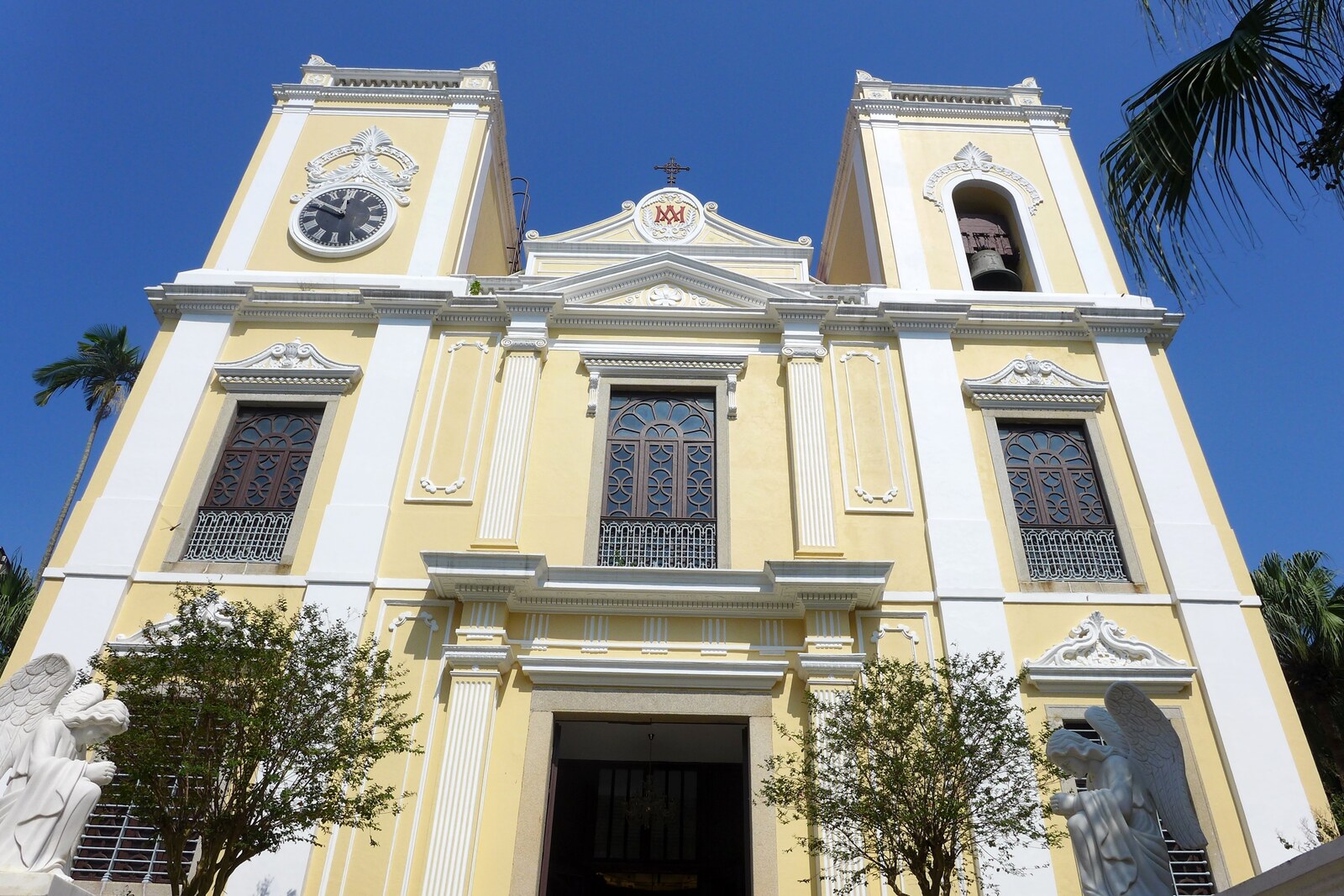
Look around first
What to notice
- The two facade towers
- The broad staircase
- The spacious nave
- The figure above the high altar
The story of the place
Wealthy merchant families from the neighboring quarter attended this parish church, so it acquired a grand and formal appearance. At first, a wooden Jesuit church dedicated to St. Lawrence stood on this site. After typhoons, the building was rebuilt: a broad staircase leads to the facade, two towers rise above it, and a spacious nave stretches inside. Mass is still celebrated here, and above the high altar remains the figure of the saint revered in Macau as the patron saint of seafarers.
In winter, Portuguese merchant seamen left Macau with the northeast monsoon. They expected the return wind in April or May: then the southwest monsoon was supposed to bring the ships home. With the man went the goods and the money on which his family lived. Until the ship appeared off the shore, his wife and children did not know whether both their breadwinner and the fortune invested in the voyage would return to them.
They came here to wait. The high churchyard offered a direct view over Praia Grande Bay. Families gathered on the grand staircase, watched for ships, and prayed for the return of their husbands and sons. A Chinese chronicle from the mid-eighteenth century calls the church the Temple of News of the Wind: after ocean-going ships had departed, those at home waited daily for news and asked here for a favorable wind.
The wind also brought news of danger. A signal mast stood beside the church, where warnings of an approaching typhoon were raised. The Chinese name “Feng Xin Tang,” “Temple of News of the Wind,” sounds similar to “Feng Shun Tang,” “Temple of Favorable Wind.” The second version became attached to the church. It brought together the maritime schedule, the signal mast, and the families' plea to bring the ships back.
The Jesuits built the first wooden church here before fifteen sixty and dedicated it to St. Lawrence. He was a Roman deacon of the third century, responsible for the property of the Christian community and aid to the poor; in two fifty-eight, he was executed during the persecution of Christians. In Macau, Lawrence was revered as the patron saint of seafarers. His figure stands above the high altar, before which seafarers' families prayed.
Trading voyages brought great fortunes to this neighborhood. Wealthy merchant families settled nearby, and their parish church acquired a scale to match. After damage from typhoons, the Macau architect José Tomás de Aquino rebuilt it between eighteen forty-four and eighteen forty-six. His work left the present facade with two towers, the broad staircase, and the spacious nave.
It is now an active Catholic parish church; the bell in one of the towers rings during Mass. You can no longer watch ships returning from the staircase: land reclamation pushed the shore farther away, and urban development blocked the former sea view. The signal mast is gone as well. What remains are the staircase, the saint above the altar, and the name “Feng Shun Tang”—a plea for a favorable wind that no longer requires a view of the sea.
Useful on site
Officially: Monday–Friday 07:00–18:00, Saturday–Sunday 07:00–21:00; services and church events may limit sightseeing.
Checked: June 30, 2026. Check the official source before visiting.During a service, look around the church silently or remain outside. Even without entering, the staircase and facade help explain the place's former connection with the sea.