 Guide On Map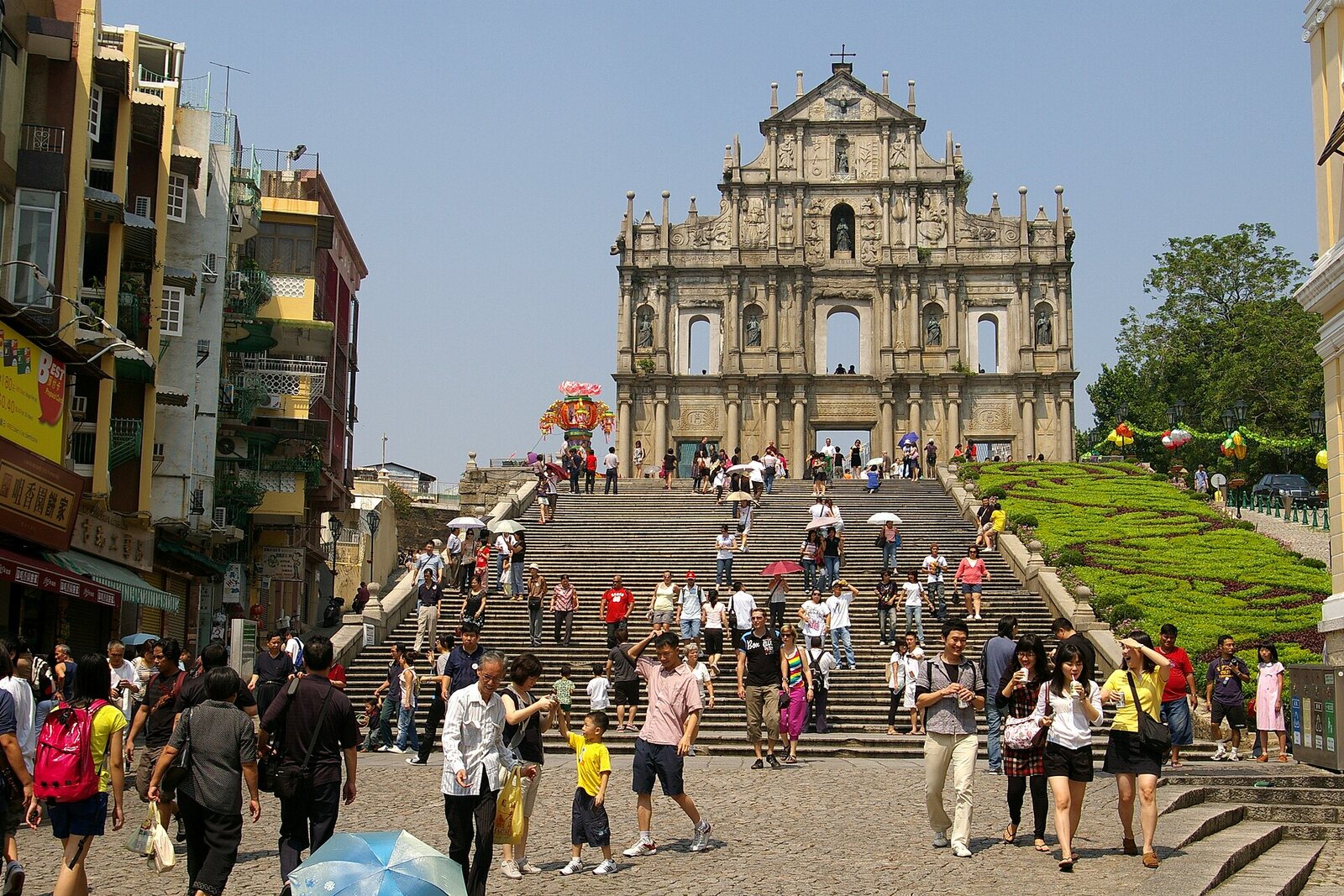
Look around first
What to notice
- Granite facade
- Wide staircase
- Three portals
- Exposed foundations
The story of the place
A wide staircase rises to the granite facade, behind whose three portals remain the building's exposed foundations and the empty space of its former hall. The stone wall was completed over decades: people from Japan worked alongside local craftsmen, so Chinese sayings, chrysanthemums, a lion, and a three-masted ship appeared among the European columns. After the college closed, soldiers occupied its buildings, and of the church only the facade and staircase remained; the foundation stone at the lower left corner still names the city of Macau as the client.
The stone wall at the top of the staircase is the facade of a church that has neither a roof nor naves left. The church itself was dedicated to Mater Dei: above the central entrance, the Latin formula “Mother of God” is still carved. The neighboring College of St. Paul, which trained Catholic preachers for China and Japan, bore the name of Paul, the missionary apostle. The whole complex, and then the ruins themselves, came to be called St. Paul's after the college.
On November twenty-seventh, sixteen oh one, the earlier church caught fire. Manuel Dias, the rector of the college, reported to the head of the order that someone had set it alight from outside. Residents rushed in to fight the fire. Women carried vessels of water from their homes, and female servants passed them to the men. People managed to carry out the tabernacle and two costly altars, but the church burned out, and the fire also damaged the college.
The Jesuits needed a new church, while the city's merchants were awaiting a ship from Japan. Their incomes depended on such a voyage: Chinese silk was taken to Japan, and silver and goods were brought back. At a general meeting, the people of Macau promised to give half a percent of the income from trade with Japan for construction if the missing ship returned. It arrived with a profitable cargo, and the promised money was given to the college.
The same delay in sailings left in Macau a man capable of drawing up the new church. Carlo Spinola, a Jesuit and mathematician, was seeking to be sent as a missionary to Japan, but the annual ship did not depart because of a shortage of silk. While Spinola waited, he was assigned the design of the church. The original drawings have not survived, so the authorship cannot be considered completely proven, although Spinola's early biography and later documents confidently link the design to him.
In July sixteen oh two, Spinola finally left for Japan. He never saw the completed facade. After Christian missions were banned, he remained there secretly, was arrested, spent almost four years in confinement, and was put to death in Nagasaki in sixteen twenty-two.
The new church opened on Christmas Eve, sixteen oh three, but the granite facade continued to be completed for several more decades. People from Japan decorated it alongside local craftsmen; according to church tradition, Christians exiled from their country were among them. That is why Chinese moral inscriptions, a lion, chrysanthemums, and a three-masted merchant ship appeared above the European columns—the very means of travel on which both the missionaries and the people who paid for construction depended.
In seventeen sixty-two, the Jesuit college was closed, and soldiers later occupied its buildings. On January twenty-sixth, eighteen thirty-five, a fire began in the former college kitchen. The fire destroyed the wooden columns, the ceiling, and the entire interior of the church. The granite facade and staircase remained standing.
Exposed foundations now lie behind the three portals, and a foundation stone survives in the lower left corner of the facade. Its inscription states that the city of Macau voluntarily dedicated this church to the Great Mother Virgin in sixteen oh two. The main entrance leads to the empty space of the former nave, but the client is still named in the stone: the city of Macau.
Useful on site
The facade and staircase are accessible around the clock. The Museum of Sacred Art and crypt are usually 09:00–18:00, last entry 17:30, with closing after 14:00 on Tuesdays; the ruins area is usually 09:00–18:00, last entry 17:30.
Checked: June 30, 2026. Check the official source before visiting.The climb is exposed to the sun and requires comfortable shoes. The facade is viewed from outside, while the crypt and museum spaces should be treated as a separate part of the visit, with their own access conditions.