 Guide On Map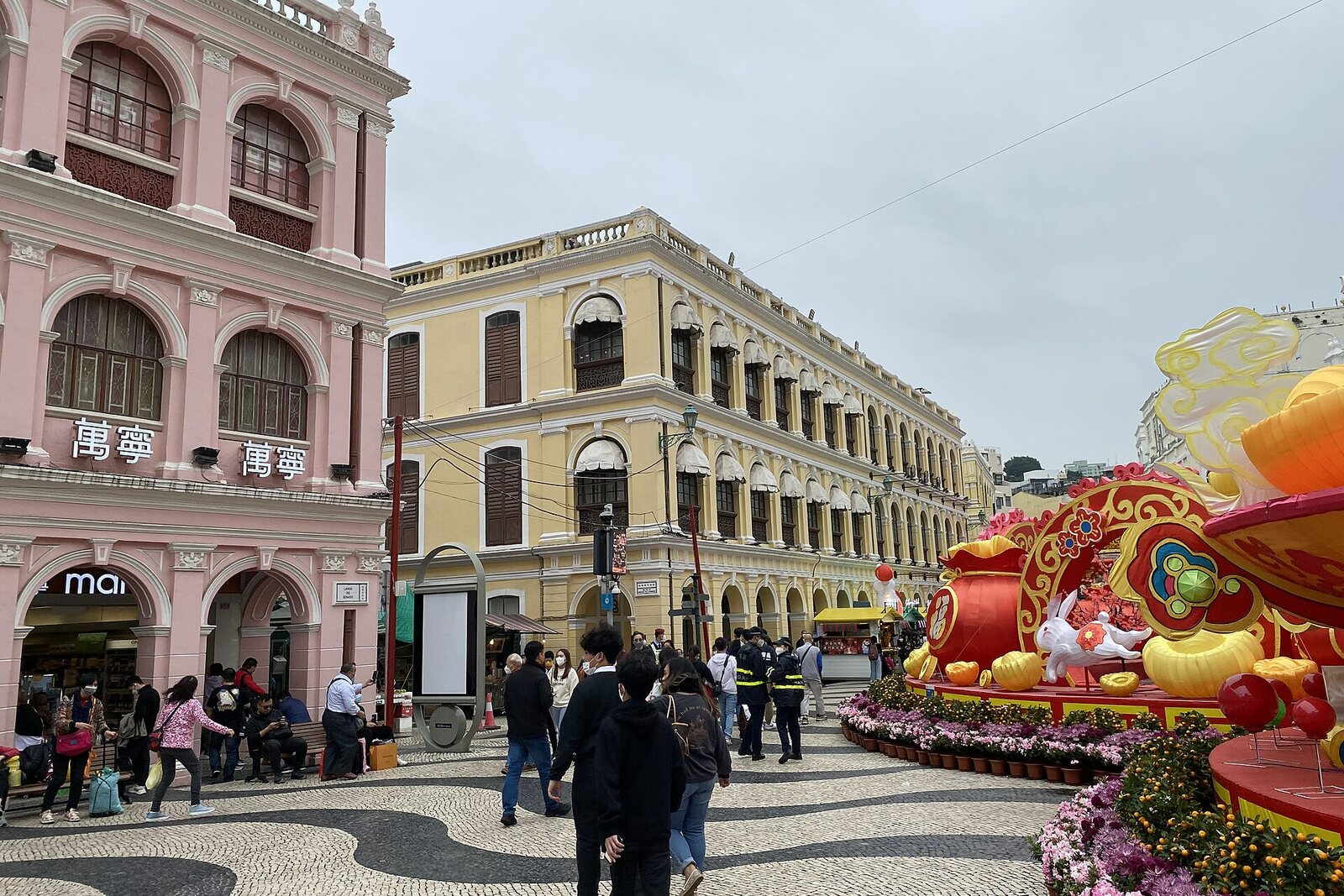
Look around first
What to notice
- White façade
- Green windows
- Arched passage
- Wooden plaque with the royal formula
The story of the place
The white building with green windows at the lower end of the square houses the Municipal Affairs Bureau. The city council—the senate, from which the square takes its name—once met here. Over time, the word “leal,” meaning “loyal,” was added to “senate.” That loyalty had to be proved by a decision that put its members’ trading fortunes at risk.
In sixteen forty, Portuguese aristocrats overthrew the viceroys of the Spanish Habsburgs. For sixty years, the crowns of Spain and Portugal had belonged to one monarch; now the Duke of Braganza was proclaimed Portugal’s King João IV. It took a year and a half for the news to reach Macau. During that time, local merchants continued taking Chinese goods to Spanish Manila and receiving American silver from there. After the Japanese market closed and the Dutch captured Malacca, this trade became the main source of income for many.
The news was brought by António Fialho Ferreira, a wealthy Macau merchant who invested in both Japanese and Philippine voyages. He pressed the residents to recognize João before envoys of the Spanish king Philip IV could arrive from Manila. Fialho paid for the journey himself. In return, he expected to receive the right to open a direct sea route between Macau and Lisbon, command that voyage, and secure rewards for his son.
On the evening of May thirtieth, sixteen forty-two, Fialho met with the city’s leaders in the senate by this square. The argument continued through the night. To recognize João meant risking money already invested in Manila; to remain with Philip meant rejecting Portugal’s separation. The next day, the first act of oath to the new king was drawn up. The unanimity later boasted of in court accounts of the celebration did not exist then: by June twenty-first, three different documents had to be completed, and the signatures on them differed markedly.
On June twentieth, João IV was publicly proclaimed in the square. The council decided to accompany the proclamation with lengthy festivities, so that foreign merchants would understand which side Macau’s Portuguese community had taken. The residents then collected money for the king, along with two hundred bronze cannons cast here. Fialho set off back to Europe with the news that Macau had recognized the new monarch. His account of his own mission was printed in sixteen forty-three: the merchant managed to turn the letters he had delivered into proof of his merits.
The cost of the decision became clear before the king’s gratitude. Already in November, an expedition arrived from Manila with fifty soldiers and Portuguese merchants who had remained in the Philippines. They were to return Macau to Philip IV. In the city, the soldiers were disarmed, and the expedition’s leaders were sent under guard to Goa. Trade with Manila was not abandoned entirely: both sides needed the goods, and it was later continued covertly.
In sixteen fifty-four, João IV granted Macau the formula: “City of the Name of God Macau, There Is None More Loyal.” The present building was erected later, in seventeen eighty-four, but the council transferred the honorary name to it as well. Above the arched passage inside, a wooden plaque with the royal formula still hangs, and the square in front of the former Leal Senado Building remains the city’s main place for public celebrations.
Useful on site
Open square, accessible around the clock; individual buildings around it have their own hours.
Checked: June 30, 2026. Check the official source before visiting.The square often moves to its own brisk rhythm. To listen, step aside to the edge, do not stand in the middle of the flow of people, and take in the ensemble as a whole.