 Guide On Map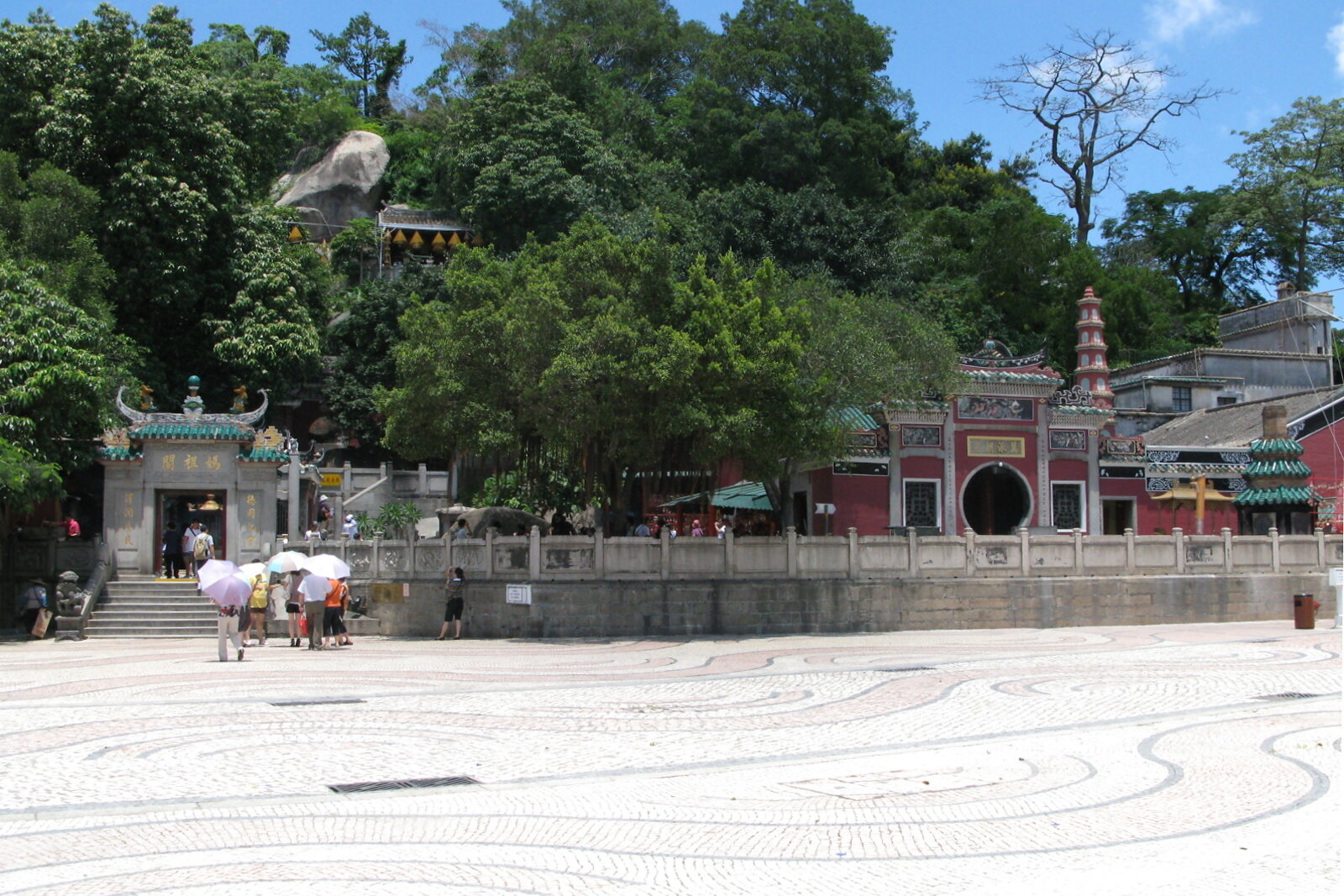
Look around first
What to notice
- Stone gate with Mazu’s name
- Pavilions on the slope
- Prayer hall
- Upper shrine of Guanyin
The story of the place
At the entrance to the Inner Harbour, fishing boats and merchant vessels had met for centuries. Those who put to sea from here had much to ask for: along with their cargo and gear, they staked their own lives. They marked their return with offerings that paid for altars, pavilions, and new images of their heavenly protectress. The stone gate, the prayer hall, and the shrine higher up the slope still draw those who bring incense and ask for safety and good fortune.
Stone pavilions rise one above another along Barra Hill. Nearly all of them honor the same patroness of sailors: Mazu, also known as A-Ma. The upper shrine belongs to Guanyin, the goddess of mercy. This is how the temple grew over several centuries, but local legend begins its story with a single boat that reached this shore.
In a port in Fujian, a poor girl asked to be taken aboard a vessel. She could not pay for a place and offered to work during the voyage. The owners of the junks refused her: each was carrying goods and did not want to feed an extra person. Only a tea merchant agreed.
When the flotilla put out to sea, a storm began. According to the legend, the junks sank one after another. The tea merchant’s boat, which had let the girl aboard, survived. The passenger took the helm and brought the vessel into a sheltered bay by Barra Hill. On shore, she did not wait for thanks: she climbed the slope and disappeared. The sailors decided that Mazu herself had saved them—deified Lin Moniang, whom people along the coast regarded as the protector of fishermen and seafarers. At the landing place, the survivors set up a shrine to her.
This is a legend, not a reliable record of the temple’s construction. The surviving pavilions were built and rebuilt in different years. The earliest part of the complex confirmed by a stone inscription—the prayer hall called the “First Temple of the Sacred Mountain”—dates to sixteen oh five. The temple acquired its present scale after the major reconstruction of eighteen twenty-eight.
The legend accurately conveys why a shrine was needed here. Fishermen lived and merchant vessels stopped at the entrance to the Inner Harbour. People risked their boats, cargo, and their own lives, so they expressed gratitude for returning from the sea in tangible ways: they paid for altars, pavilions, and new images of their patroness.
In the sixteenth century, Portuguese merchant seafarers landed near the temple while looking for a place to trade. The Chinese called this bay A-Ma-Gau—the Bay of A-Ma. The Portuguese applied the name they heard to their settlement; over time, it became “Macau.”
The temple remains an active shrine. People bring incense and offerings here, ask for safety and good fortune, and on the A-Ma Festival—the twenty-third day of the third month of the lunar calendar—offerings and Cantonese opera performances are held in front of the temple. Mazu’s name is still written above the stone gate, and the city’s name preserves the name of the poor passenger for whom, in local legend, one tea merchant made room.
Useful on site
Usually 07:00–18:00; this is an active temple, so some areas may be restricted during ceremonies.
Checked: June 30, 2026. Check the official source before visiting.This is an active temple. Do not disturb people at prayer, do not linger in the passageways, and take care as you climb the stone steps.