 Guide On Map
Opet Road: From Karnak to Luxor Temple
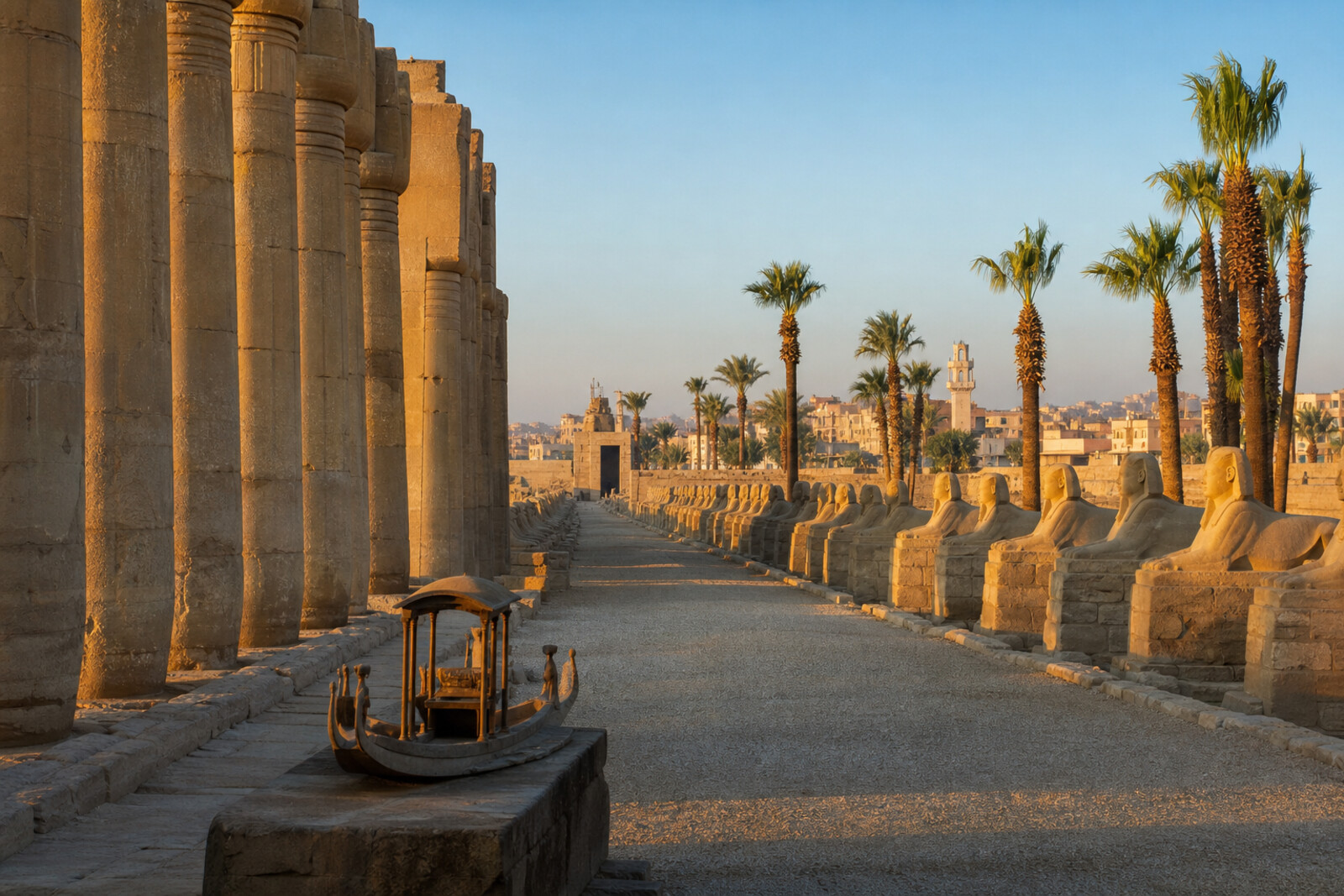
From deep inside Karnak, along the Avenue of Sphinxes to Luxor Temple
Guide On Map on your phone
Open the walk like a regular app
It takes about 10 seconds to install. No app store needed.
The whole path
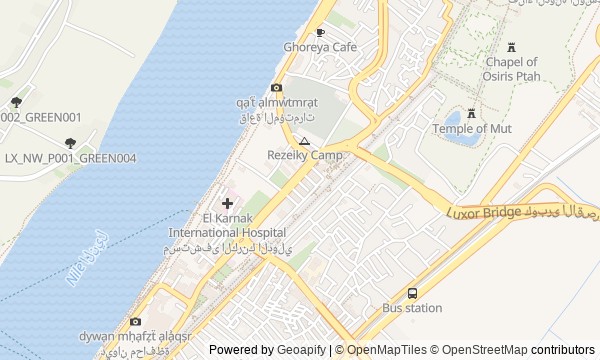
Route map
About the walk
You will begin deep inside Karnak, among the columns beneath which the bark of Amun once passed. Then you will emerge among the sphinxes and head south along Opet Road, the road of the Opet Festival, toward Luxor Temple. Along the way, you will turn into 2 small museums: one gathers together a broken wall, while the other brings an ancient craft down to an experience that can be tested.
This is a walk about rulers, archaeologists, and engineers changing monuments that were already complete. Why will 3 columns end up in the wrong place after restoration? How does a modern duck get into a museum? Where did the second obelisk go? The answers will appear in carvings, empty spaces, and construction seams, without ceremony or invented mystery.
At the end, a working mosque will stand above a pharaonic courtyard. You will carry the Opet route away as a key to Luxor City: a road where power rewrote stone again and again, but could not erase the work that came before.
Why this order
The Great Hypostyle Hall first gives the scale of Amun's public appearance, and the shrine after it shows where the bark was brought out to begin its journey. Returning to the northern sphinxes shifts the story from interior rooms to the ancient landing place; beyond them, the middle section of the Avenue shows how a water-and-temple route became a long overland road. From there, it makes sense to turn to Luxor Museum: the wall assembled there leads back to stones taken out of Karnak. The neighboring Mummification Museum replaces monumental archaeology with a close-up scientific experience before the route returns to vast architecture. At the pylon, the broken paired entrance comes into view; then the colonnade restores the direction of the procession into the temple. Only after that should you return to the Courtyard of Ramesses II: above the processional space stands a working mosque, and the ending shows that clearing an ancient city did not return it to a single era.
Those who want to link Karnak and Luxor Temple through 1 historical route Those interested in archaeological mistakes, reconstructions, and the fates of monuments Those ready to alternate open spaces with museum galleries
Those looking for a short overview of 1 temple complex Those who only want the best-known pharaohs and ceremonial stories Those who do not want to visit museums along the way
Before you go
Bring water, sun protection, and shoes for a long walk over stone and city paving. Do not expect the entire processional axis to be equally accessible on the day of your visit: some sections may be restricted, so leave yourself the option of walking parallel to the avenue and viewing it from the side. Set aside separate time for both museums, and check visiting and photography rules on site. Abu al-Haggag Mosque is a working religious space, not part of a museum display: choose modest clothing, do not disrupt prayer, and follow the attendants' directions.
When to go
Start at Karnak in the cooler part of the day: the first 4 stops require more walking and attention to open facades. The museums work well as a break between the northern and southern halves of the route. Approach Luxor Temple without rushing, leaving enough energy for the colonnade reliefs and the layered ending in the courtyard.
Backup plan
If heat, fatigue, or a closed passage makes it impossible to walk the whole axis, split the route into 2 parts. At Karnak, keep the Great Hypostyle Hall, the Bark Shrine of Amun, and the northern sphinxes, then view the middle section of the avenue only from the accessible city side. Begin the southern half at 1 of the museums and continue to the pylon, colonnade, and courtyard of Luxor Temple. If time is very short, skip the museum pair, but do not change the order of the temple stops: otherwise, the transition from a royal statement to its remaking, and then to the living religious layer, will be lost.
Route conditions
Surface. Paved — 1.1 km; unpaved — 106 m (data covers 26% of the route)
Stairs. Flights: 2, 9 m in total
Access. Wheelchair — no; stroller — limited (stairs)
Facilities. Toilets — 1
Elevation. Ascent — 25 m; descent — 28 m
OpenStreetMap extract of July 9, 2026: database data, not a check on the ground. Data © OpenStreetMap contributors, ODbL licence
Walk plan
Open in maps ↗- 1
Great Hypostyle Hall
Here the processional route takes on an architectural scale, and the route acquires its first trace of a later mistake. - 2
Bark Shrine of Amun
This stop shows how an absent ruler could be included in a living temple ritual. - 3
Northern Sphinxes of Karnak
The row by the quay connects Amun's road with one man's struggle for royal recognition. - 4
Middle Section of the Avenue of Sphinxes
Here the route moves from the old quay to the newly laid-out overland road of the festival. - 5
Luxor Museum
The museum lets you see how archaeologists reassemble a vanished building and where they refuse to guess. - 6
Mummification Museum
A compact exhibition will replace royal monuments with a testable experiment in ancient technique. - 7
Pylon and Obelisk of Luxor Temple
The paired entrance reveals the gap between the ancient temple design and the square’s present appearance. - 8
Great Colonnade of Luxor Temple
The reliefs will take the walk back to the procession itself and show how later kings appropriated its images. - 9
Courtyard of Ramesses the Second and Abu al-Haggag Mosque
The final point brings together a pharaonic courtyard, a medieval shrine, and archaeological clearance in one place.
Route features
Everything you need stays in the browser
Progress, saves and your trip plan are stored on this device.
Add Guide On Map to your home screen so the walk opens outside the browser.
How we handle sources, maps and corrections: our editorial standards