 Guide On Map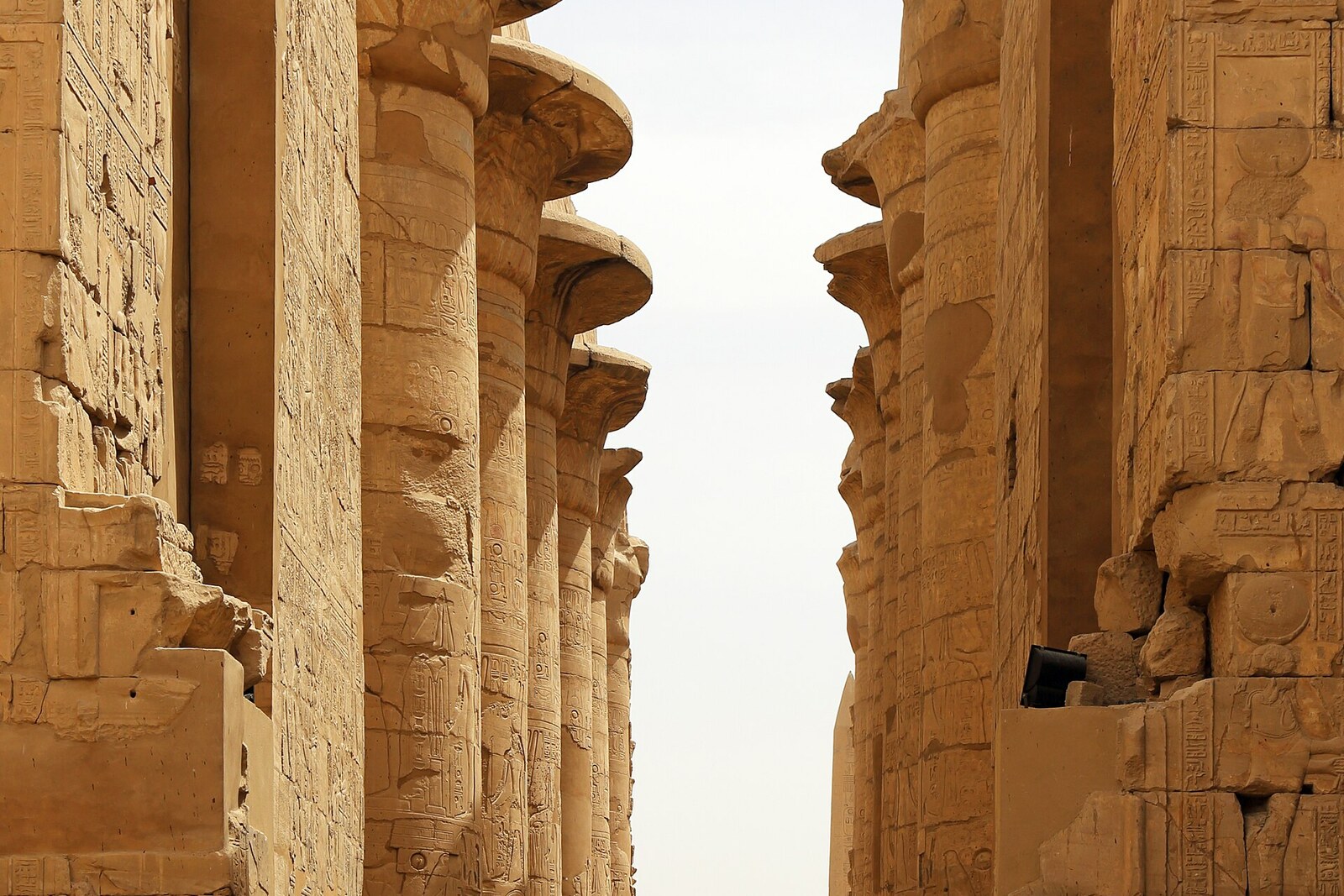
Look around first
What to notice
- Central aisle
- Tall papyrus-shaped columns
- Side rows of columns
- Carvings on stone drums
The story of the place
Stone shafts with blooming papyrus capitals form an entire forest here, and the tall passage in the middle leads deeper into Karnak. During the Opet Festival, priests carried Amun's cult image through the hall in a barque, and on special days some inhabitants of Thebes could stand along the edges of the procession. The pharaoh is shown performing rituals on the columns, and his name was once repeated on the beams overhead as well. Beneath the stone foundations lie small blocks from earlier open temples, dismantled after the restoration of Amun's worship.
The sky is now open above the columns. Under Seti I, a stone roof covered this place. It was supported by one hundred thirty-four columns: the twelve tallest framed the central aisle, while the rest filled the side sections. That is where the modern name comes from: a hypostyle hall is a room whose roof rests on rows of columns.
Seti I, the pharaoh who commissioned the hall, prepared this passage for the ceremonial appearances of Amun, Karnak's chief god. During the Opet Festival, priests carried his cult image from the depths of the temple in a portable shrine made in the form of a barque. The procession moved between the tall central columns. Inscriptions call the hall a place where Amun, Mut, and Khonsu could stop before the procession continued. On special days, some inhabitants of Thebes were allowed in here: they saw the barque and the pharaoh, although the temple's inner rooms remained closed to them.
Seti also intended the hall for his own veneration. Its ancient name can be translated as: “Seti is effective, beloved of Amun, in the estate of Amun.” These words were repeated on the beams beneath the roof. The pharaoh placed his name directly on the god's road, and craftsmen carved scenes on the columns in which Seti performs rituals and receives blessings.
The builders made the foundations for this monument partly from small, uniform blocks that had already once been part of another Karnak. Several decades before Seti, Pharaoh Akhenaten tried to replace the worship of Amun with the cult of the solar Aten. For Aten, he built open temples here from stones convenient for rapid construction. After Akhenaten's death, his successors restored the former cults, dismantled those buildings, and used the blocks in new structures. Images of Akhenaten disappeared from Karnak's surface and ended up beneath the columns of the hall dedicated to Amun and Seti.
That decision had consequences on the third of October, eighteen ninety-nine. Salty groundwater had gradually been destroying the soft sandstone in the foundations. In the northern part, one column pulled down its neighbors; eleven collapsed in a chain. Three more leaned and threatened to continue the collapse.
The task of saving the hall was entrusted to Georges Legrain, a French Egyptologist who served as director of works at Karnak and was responsible for clearing and repairing the entire complex. Karnak was his workplace for twenty-two years. Now he had to prove that columns about fifteen meters high could be assembled again from a heap of multi-ton drums. Legrain himself later admitted that many people considered the idea reckless.
For two years, Legrain and Egyptian workers dismantled the collapse one segment at a time. Each drum had to be extracted, identified, and temporarily stacked so it could later be returned to the right column. The three dangerously leaning supports first had to be dismantled. In the northern wing, workers replaced the weak foundations and raised a substantial part of the masonry again. In the south, they acted even more riskily: they removed the ruined foundation from beneath a standing column and laid fired brick, moving from one support to the next.
Legrain preserved the hall, but he did not restore all of it accurately. Modern researchers compared the carvings on the columns with archival photographs and found that two almost complete columns had been assembled in the wrong places. Another was raised about thirty meters from its original location. In the northern wing, ancient drums stand vertically thanks to people of the early twentieth century, and the arrangement of three columns preserves their mistake.
Useful on site
Karnak is usually open daily from 06:00 to 17:00; the ticket page lists last entries before 16:00. Check the ticket office on the day of your visit.
Checked: date not specified. Check the official source before visiting.Do not try to take in the hall in a single glance. Go up to several columns and compare the depth of the carvings in side light, without touching the surface.