 Guide On Map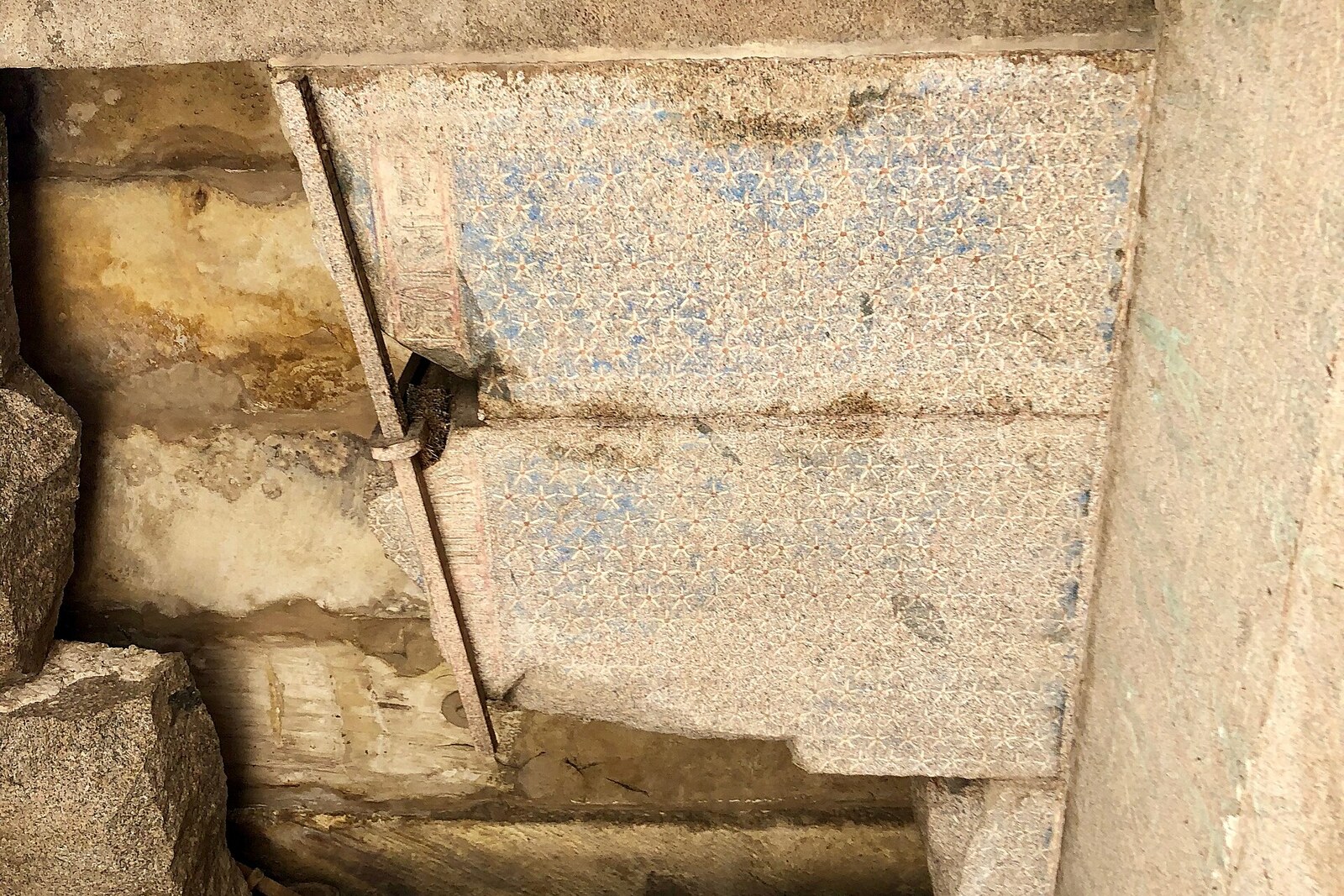
Look around first
What to notice
- Granite walls
- Two registers of reliefs
- Cartouches of Philip III Arrhidaeus
- Images of Amun’s bark
The story of the place
The priests left offerings in the front room, while the portable bark with Amun’s statue was kept farther inside, in the inner room. During the festival, a temple procession with the bark emerged from this small granite shrine. The outer walls are divided into two registers of reliefs, and the royal cartouches on them date the decoration to the time of Macedonian rule.
On the shrine’s outer wall, the king performs a ritual that, in reality, he most likely never performed here. In the upper register, Thoth and Horus purify him, then the gods place the white crown of Upper Egypt on his head. Below, priests carry Amun’s bark, and the king helps them. The hieroglyphs identify him as Philip III Arrhidaeus.
Philip III Arrhidaeus was Macedonian, the half-brother of Alexander the Great. After Alexander’s death in three hundred twenty-three BCE, the army proclaimed him king as Philip III Arrhidaeus: the empire needed an adult heir from the former dynasty. Ancient authors considered Philip III Arrhidaeus unable to rule independently; it is impossible to diagnose him two thousand years later. One thing is certain: he did not command his own armies, and orders were issued by the regents who succeeded one another during his reign.
Egypt then went to Ptolemy I Soter, Alexander’s commander, who was appointed satrap—that is, Philip III Arrhidaeus’s governor. Ptolemy I Soter intended to hold the country, but he could not yet declare himself king. He had to show that he was acting in the name of the legitimate ruler. According to the most convincing theory among researchers, it was Ptolemy I Soter who ordered this shrine to be built, or at least decorated with Philip III Arrhidaeus’s name. Who began the granite masonry remains disputed; the reliefs and royal cartouches unquestionably date from Philip III Arrhidaeus’s time.
The place for such a statement was chosen with great precision. In the outer room, priests presented offerings; in the inner room, they kept the portable bark with Amun’s hidden statue. During the festival, it was carried out of the temple. The relief assigns Philip III Arrhidaeus the royal role in the procession: the gods purify and crown him, and then he accompanies Amun. This is a ritual image, not a record of a royal visit. Philip III Arrhidaeus most likely never made it as far as Karnak.
His wife Eurydice tried to remove the next regent and rule in her husband’s name. Olympias, Alexander’s mother, opposed them, seeking the throne for her grandson. Philip III Arrhidaeus’s Macedonian soldiers went over to her side without a fight. Olympias ordered Thracians to stab the captured king, and forced Eurydice to take her own life. Ptolemy I Soter kept Egypt and later assumed the royal title himself.
Amun’s bark disappeared from the inner room. On the granite wall remained Philip III Arrhidaeus—a crowned pharaoh whom Karnak most likely never saw alive.
Useful on site
Within Karnak Complex hours: usually 06:00–17:00, with earlier last entry according to the ticket page.
Checked: date not specified. Check the official source before visiting.Do not look for a surviving wooden boat: it is more important to imagine the enclosed shrine on poles and the people carrying it according to a prescribed sequence.