 Guide On Map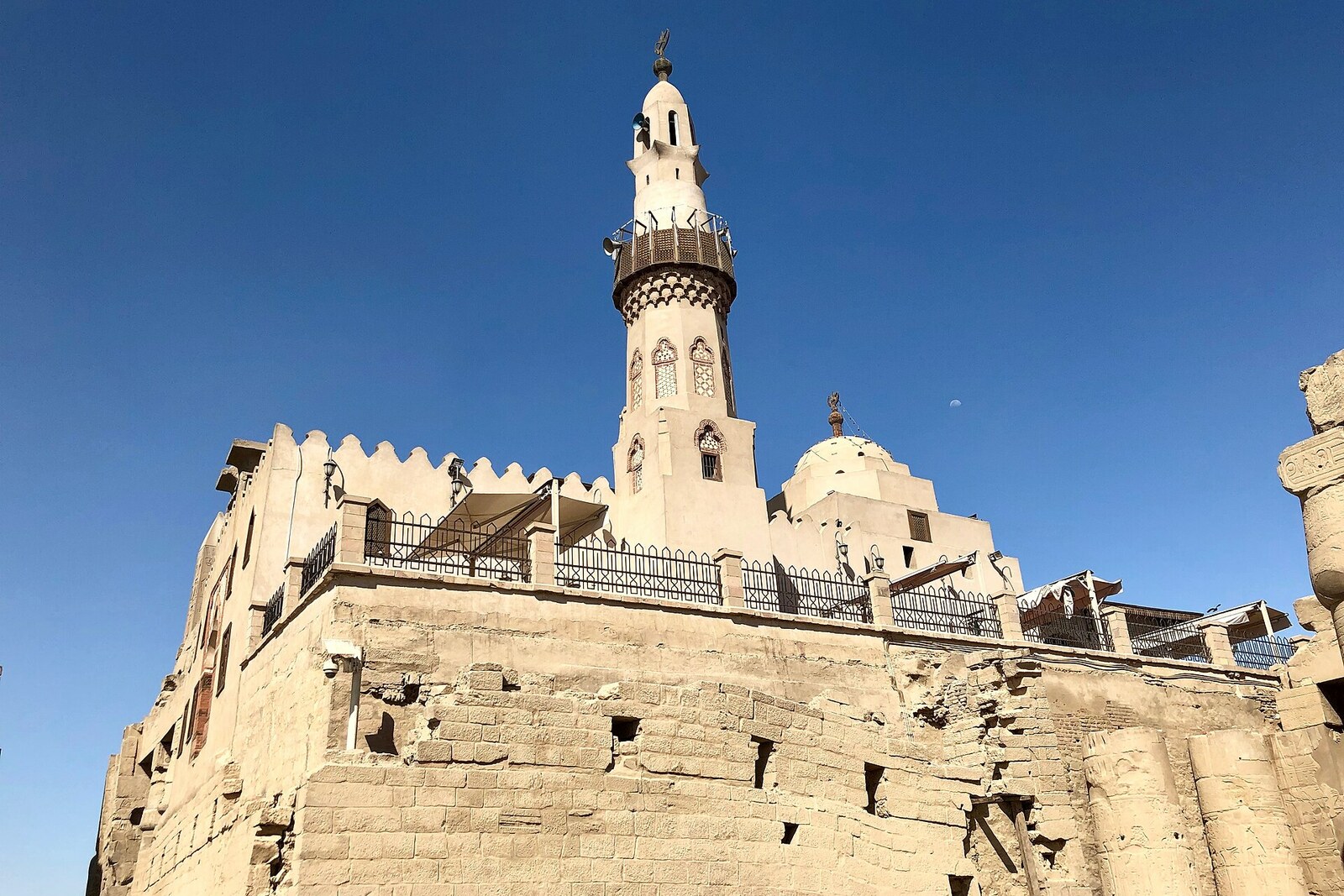
Look around first
What to notice
- White mosque
- Former entrance set high above
- Eastern staircase
- Ancient columns beneath the mosque
The story of the place
The white mosque occupies the northeastern corner of the Courtyard of Ramesses the Second. In the thirteenth century BCE, this pharaoh ordered a large open courtyard with a double row of columns added to the entrance of Luxor Temple. His colossal statues were placed between the columns, and the walls were covered with scenes of his campaigns and offerings to the gods. The courtyard bears his name because Ramesses created a ceremonial entrance to the temple here anew and filled it with his own images.
The mosque appeared above this courtyard not when it lay as an open ruin. By the thirteenth century, the ancient columns and walls were hidden beneath layers accumulated over centuries, while the houses of medieval Luxor stood above them. Yusuf Abu al-Haggag, a Muslim scholar and teacher, came here from Baghdad and probably taught on the grounds of the buried temple. He gained such respect in the city that by his death in twelve forty-four, a large circle of students and followers had already formed around him.
Yusuf was buried here, on the roof of an ancient Christian church that by then had also ended up underground. About ten years later, his son established the early part of the shrine above the tomb. One clarification matters: the oldest minaret may have appeared about a century and a half before Yusuf himself. Therefore, it cannot be stated with confidence that he founded this mosque. The name Abu al-Haggag became attached to it because of his tomb and the veneration continued by his students, townspeople, and descendants.
The mosque remains active today. Prayers are performed here, and during the annual Mawlid—a festival in honor of a saint—the descendants of Abu al-Haggag carry decorated boats around the temple. They explain the boats as a remembrance of Yusuf's journey to Egypt. Their procession truly recalls the ancient Opet Festival, when the sacred barks of Amun, Mut, and Khonsu were brought here. However, an unbroken transmission of the rite from pharaonic times has not been proven: this is a resemblance, not an established kinship between the two ceremonies.
The mosque acquired its present height much later. At the end of the nineteenth century, the Courtyard of Ramesses was still beneath a residential quarter. Houses, storerooms, and dovecotes stood between the ancient walls; for archaeologists, these were later layers, but for families, they were homes and property. Gaston Maspero, director of the Egyptian Antiquities Service, decided to uncover the temple down to its pharaonic floor. There was not enough money to buy out the houses, so he sought funds to compensate their owners and collected donations.
From eighteen eighty-five to eighteen ninety-two, the service cleared the courtyard. The residential buildings disappeared, and their owners left the temple grounds. The mosque and its tomb were left in place. When archaeologists removed the earth around it, its former entrance stood high above the void that had formed, and builders had to create a new facade and staircase on the eastern side.
The upper parts of Ramesses's columns remain beneath the mosque; some ancient columns and architraves were incorporated directly into its walls, and the tomb of Abu al-Haggag lies above the southern row. The staircase rises to the city level where his son lived, while the pharaonic courtyard lies below—where Maspero's clearance lowered it.
Useful on site
The courtyard is accessible during Luxor Temple opening hours; the mosque is active, and visitor access depends on prayer, security, and local rules.
Checked: date not specified. Check the official source before visiting.Visit the mosque as a living place of worship. Do not enter closed areas, keep quiet during prayer, and ask permission before photographing people.