 Guide On Map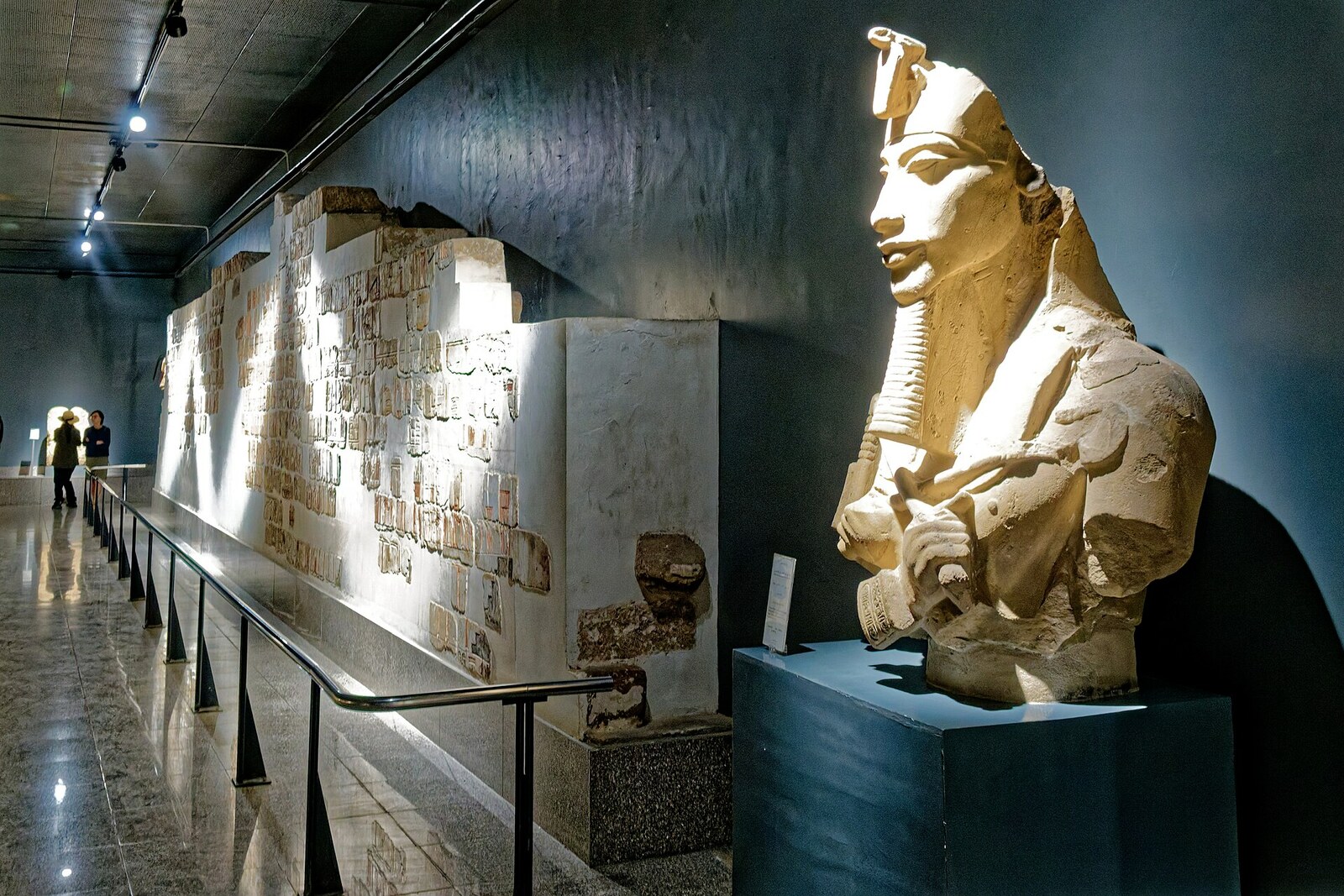
Look around first
What to notice
- A wall of small sandstone blocks
- Empty sections of the reconstruction
- Reliefs with supplies
- Joints between individual talatats
The story of the place
The Egyptian Ministry of Culture planned a museum for archaeological objects from Luxor City and its western bank that had previously remained in storage. The site was chosen between Karnak and Luxor Temple, on land belonging to the Egyptian Antiquities Service opposite the Theban Necropolis across the Nile. On the upper floor, a long wall is assembled from small sandstone blocks; the reliefs show temple storerooms and porters with supplies.
In the mid-nineteen seventies, the architect and archaeologist Jean Lauffray, head of the Franco-Egyptian Centre for the Study of the Temples of Karnak, was assembling in the new museum building a wall that had not existed for three thousand years. His team had hundreds of identical sandstone blocks with fragments of reliefs: a hand, a basket, part of a face, several signs. Incorrectly joined stones would have turned an ancient scene into a modern invention.
These blocks were made in the fourteenth century BCE for Aten temples built by Akhenaten near Karnak. Stonemasons used small standard blocks—talatats. They were easy to carry and quick to lay while the pharaoh erected sanctuaries for the new cult.
After Akhenaten's death, Horemheb, a former military commander who became pharaoh, restored the former cults and worked to erase the Aten structures. His men dismantled the temples and laid the talatats inside the Second Pylon of Karnak, the Ninth Pylon of Karnak, and the Tenth Pylon of Karnak—massive temple gateways. Their relief sides ended up inside the masonry. Akhenaten's sanctuaries vanished from the surface, while their stone supported Horemheb's new structures.
In nineteen sixty-four, the western half of the Ninth Pylon of Karnak threatened to collapse. Staff of the Egyptian Antiquities Service began dismantling it for reinforcement and discovered talatats inside, arranged in thirty-four layers. Archaeologists faced the danger of repeating the work of Horemheb's men: removing the blocks from the masonry and permanently losing the connections between them.
The team changed the order of dismantling. Each layer was cleaned and photographed strictly from above at the same scale. Every decorated stone was numbered before removal, and its number was transferred to the photograph. It emerged that the ancient builders had placed the fragments in the pylon roughly in the sequence in which they had taken them from the walls. Parts of one scene often lay side by side. The records made it possible to retrace the route of the ancient stonemasons in reverse.
Lauffray and his Egyptian-French team joined two hundred eighty-three talatats. The result here was a wall eighteen meters long. Temple storerooms, people with supplies, and details of the sanctuary's everyday work appeared on it again. Large gaps were left empty: the remaining stones needed to continue the scene with confidence were not found.
It was for work like this that the Egyptian Ministry of Culture created Luxor Museum. In nineteen sixty-two, officials commissioned the architect Mahmoud El-Hakim to design a building for finds from Luxor City and western Thebes, which archaeologists had previously kept in storage. The site was chosen on land belonging to the Egyptian Antiquities Service, between Karnak and Luxor Temple, opposite the Theban Necropolis across the Nile. Construction was completed in nineteen sixty-nine; then, for several years, objects were selected and the exhibition was arranged. The museum opened in December nineteen seventy-five.
Those two hundred eighty-three blocks still stand on the upper floor. First they were a wall of an Aten temple, then filling for Horemheb's gateway, and at Luxor Museum they became a wall again. The temple to which it belonged no longer exists anywhere.
Useful on site
The ticket page gives separate hours: in summer 09:00–12:00 and 17:00–19:00; in winter 09:00–13:00 and 17:00–20:00; during Ramadan 09:00–14:00 and 17:00–19:00.
Checked: date not specified. Check the official source before visiting.Choose several key objects and examine them from all sides, if the exhibition allows. Ask on site about photography rules and access to individual galleries.