 Guide On Map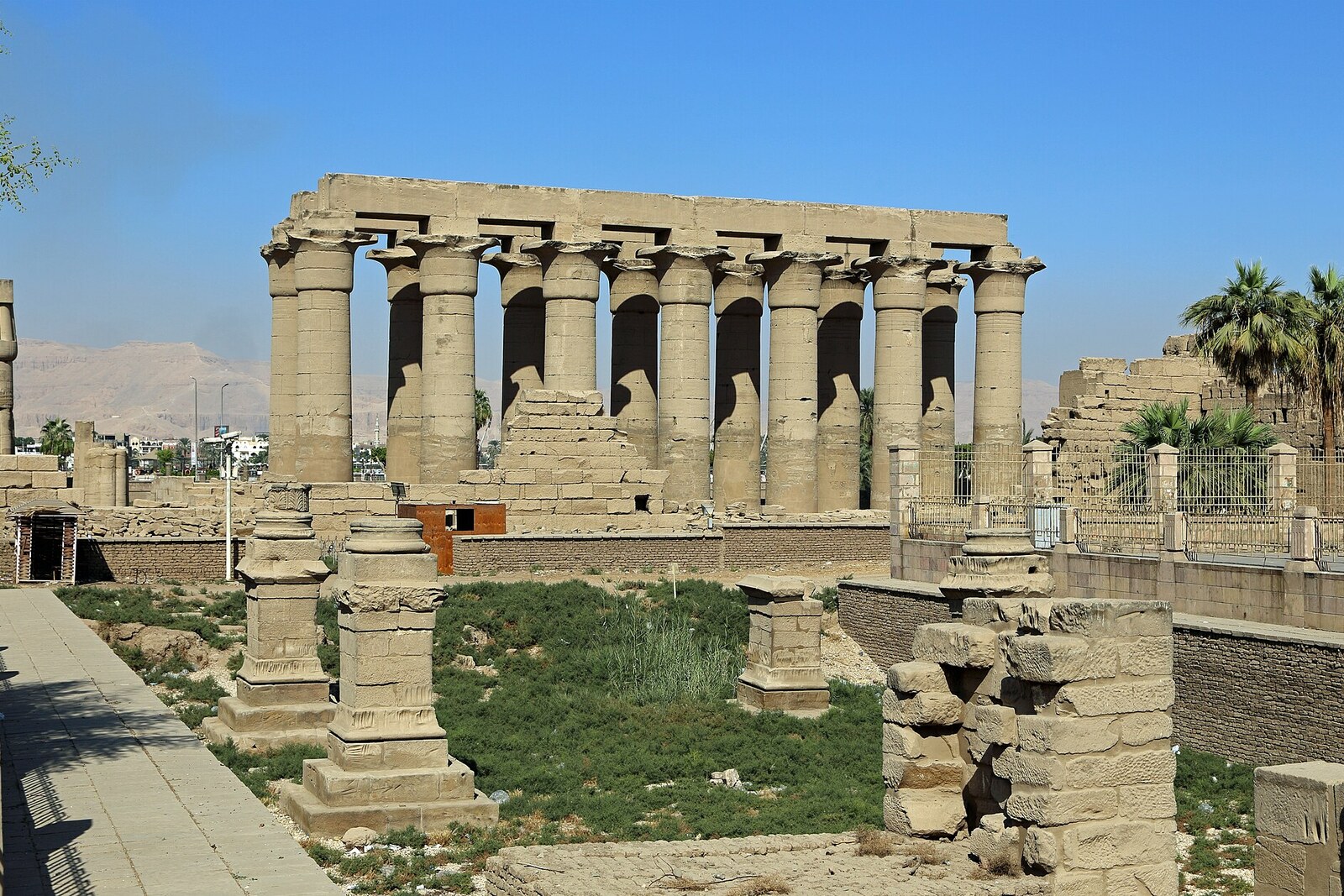
Look around first
What to notice
- Two rows of giant columns
- Open papyrus capitals
- Reliefs of the festival procession
- Cartouches bearing traces of earlier signs
The story of the place
Along the colonnade’s western wall, the festival procession travels from Karnak to Luxor Temple. Along the eastern wall, it returns the other way. The portable barques of Amun, Mut, and Khonsu are loaded onto large vessels, towed upstream on the Nile, received at the temple, and, after the ceremonies, sent downstream. Between the walls stand two rows of giant columns with capitals shaped like open papyrus. Under the ancient roof, they formed a tall, narrow passage: during the Opet Festival, priests carried the barques through here to the temple’s inner rooms, while the images on either side repeated the procession’s entire route.
Tutankhamun ordered the main part of this account carved. He was the young pharaoh who, after Akhenaten’s religious reform, restored the former rites of the temples of Amun. He came to the throne as a child and depended on older courtiers and military commanders. For such a king, the Opet Festival served a very practical purpose: during the ceremonies, Amun confirmed Tutankhamun’s right to remain pharaoh.
Amenhotep III had begun the colonnade, but nearly the entire unified program on its walls was carried out under Tutankhamun. Here, the king offers gifts, accompanies the divine barques, and takes part in rites renewing royal dignity. It was detailed testimony that the former order had been restored and that Amun recognized the new ruler.
Tutankhamun died at about nineteen and did not see the work completed. In the southern part of the hall, only painted preparatory drawings remained; stonecutters carved them under Seti I, about forty years later. After Tutankhamun’s death, Ay, his elderly adviser who took the vacant throne, completed the northern façade.
Horemheb, Tutankhamun’s former commander-in-chief, who did not belong to the royal family, then became pharaoh. Horemheb’s own coronation inscription linked his recognition as king specifically to the Opet Festival and Amun’s decision. Having gained the throne, Horemheb ordered the post-reform predecessors excluded from the official sequence of kings. Tutankhamun’s buildings dedicated to Amun were not destroyed: they remained suitable for worship. Horemheb appropriated them.
In this colonnade, Horemheb’s stonecutters systematically cut away the signs inside the cartouches—oval frames containing a royal name—and placed Horemheb’s name there. The figures, the procession, and most of the inscriptions remained unchanged. The result was that Horemheb himself appeared to accompany the barques and receive confirmation from Amun. On the eastern wall, even the name of Ankhesenamun, Tutankhamun’s wife and a participant in the festival, was rewritten: Mutnedjmet, Horemheb’s wife, was named over it. Another royal couple took the place of the former one within an already completed ceremony.
The traces were covered with plaster and paint, but the coating crumbled away over time. The signs of Tutankhamun now show through in Horemheb’s recessed cartouches; carvers omitted several of Tutankhamun’s lesser names altogether. One survived on the covering of Amun’s portable barque. The depicted king remains Tutankhamun, although the inscription beside him names Horemheb.
Useful on site
Within Luxor Temple hours: usually 06:00–20:00, with final entry before 19:00 according to the ticket page.
Checked: date not specified. Check the official source before visiting.Let your eyes adjust to the intricate reliefs, and read the scenes in sequence along the wall. Do not take today’s open sky for the original appearance—the passage was covered by a roof.