 Guide On Map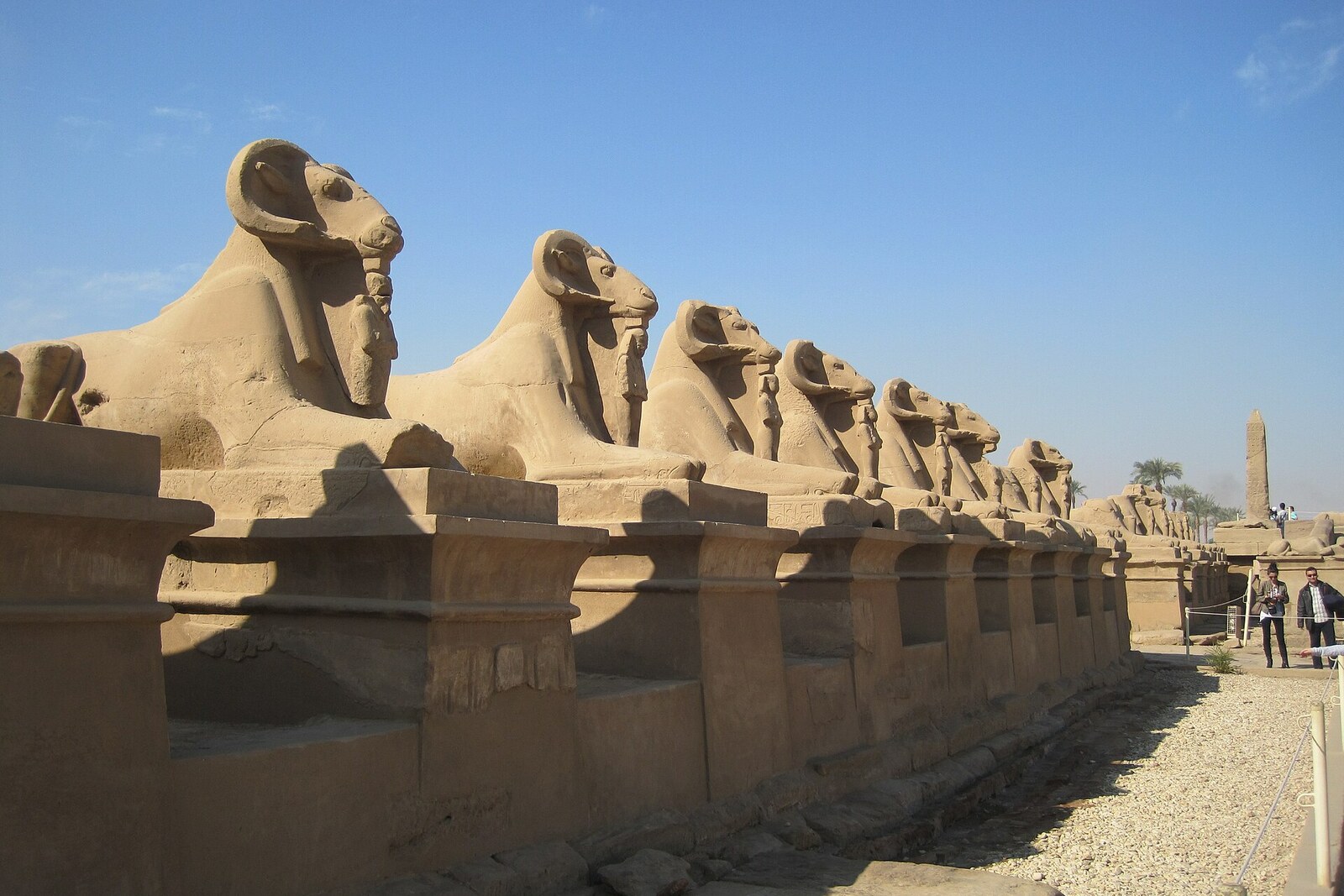
Look around first
What to notice
- Ram's heads of the sphinxes
- Small royal figures between the paws
- Cartouches on the sculptures
- Inscriptions on the bases
The story of the place
This row stands at the northern end of the route between Karnak and Luxor Temple, but the ancient line of these sphinxes points toward the quay at Karnak. When Amun's bark was brought by water, it was carried from here into the temple. That is why the sphinxes have ram's heads: the ram represented Amun himself, while the small royal figure between the front paws showed the ruler under his protection.
These figures served several owners. Researchers allow that they were carved under Thutmose IV or Amenhotep III. Later, Ramesses II appropriated the sphinxes, adding his cartouches to them—oval frames containing a royal name. It is his name that survives on the sculptures, although they had been prepared for another pharaoh.
At the beginning of the eleventh century BCE, Pinedjem I put them to his own use. He was the high priest of Amun—the chief administrator of the cult and Karnak's vast estate—and also commanded the army. Pinedjem ruled southern Egypt, but the recognized pharaohs were in Tanis, the northern capital. He sought to have people regard him as a king.
His position rested on thoroughly material reserves. Grain from the temple estates of Upper Egypt was brought to Thebes; scribes recorded it and stored it in granaries. These supplies fed temple personnel and made it possible to gather people for major works. Pinedjem could order dozens of heavy sandstone statues transported, but bearers alone were not enough. He needed Amun's recognition: without it, he remained a priest serving a pharaoh seated in the north.
Pinedjem ordered about one hundred old sphinxes, probably once standing by Luxor Temple, moved to Karnak. In his time, the present First Pylon did not yet exist, and the row stretched for about two hundred meters from the gates of that time, today's Second Pylon of Karnak, to the quay. Whenever Amun's bark was carried between the temple and the water, the procession passed the monuments newly inscribed by Pinedjem.
He did not stop at a single name. Praise for what Pinedjem had done for Karnak is repeated along the sides of the bases. The front inscriptions on the sphinxes differ: each names a deity, the place where it was worshipped, and the benefit that god grants Pinedjem. On the worn stones, at least twenty-three deities have been identified. Fragments of scenes also survive in which Pinedjem kneels before Amun. The old royal statues became a long list of those who seemed to support his claim.
Later, Pinedjem added royal names to his titulary and began to depict himself as a pharaoh. He did not remove Ramesses II from the stone: the sphinxes retained the name of the earlier appropriator, while Pinedjem's name appeared on the bases.
Today, ninety-three ram-headed sphinxes stand here. Their present arrangement was created by the archaeologist Georges Legrain during the reconstruction from eighteen ninety-six to nineteen oh nine; under Pinedjem, the row looked different and led directly to the main temple road. His calculation can still be read on these bases: borrowed sphinxes, Ramesses's cartouche, and dozens of gods promising benefits to a high priest who wanted to become king.
Useful on site
Visiting the Avenue of Sphinxes is linked in the official price list to tickets for Karnak and Luxor Temple; access to individual sections may be regulated by guards.
Checked: date not specified. Check the official source before visiting.Look at the row not only from the front, but also along its axis: the repetition of the figures best conveys the rhythm designed for a moving procession.