 Guide On Map
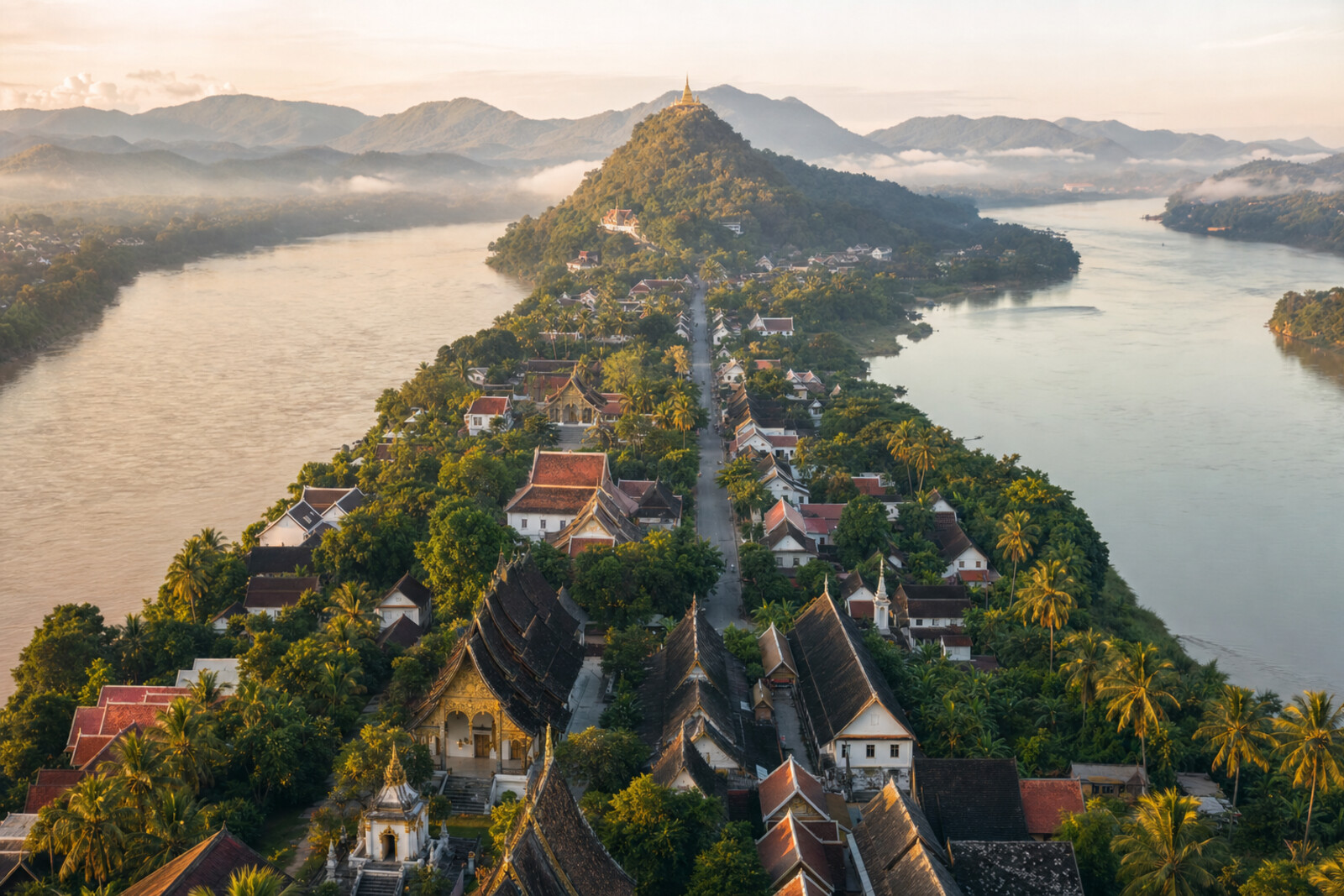
The Sacred Peninsula of Luang Prabang
From the Royal Palace (Haw Kham), across Mount Phousi, to where the Nam Khan meets the Mekong
Guide On Map on your phone
Open the walk like a regular app
It takes about 10 seconds to install. No app store needed.
The whole path
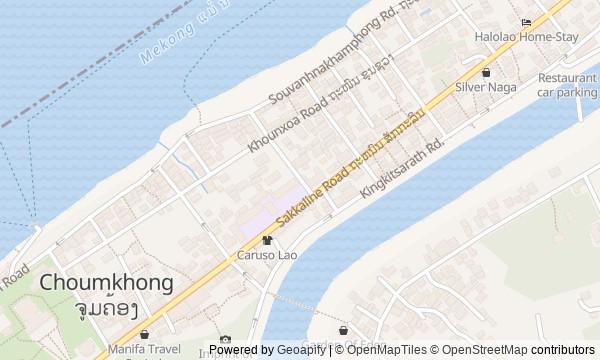
Route map
About the walk
You will cross the peninsula from end to end: from the former Royal Palace (Haw Kham), past the foot and summit of Mount Phousi, then along Sakkaline Road to old monasteries and the mouth of the Nam Khan. First come the palace halls, the temple of the city's sacred image, and a small prayer hall with no monastic community. After the climb, the route returns to houses where you will see how a brick commercial ground floor was joined to a wooden residential upper story, then continues beneath the low roofs of Wat Xieng Thong toward the 2 rivers.
The stories follow people's decisions rather than a roll call of dynasties. Why will a deposed king have to be restored? Who will carry a heavy statue out of a doomed temple? Why will a man who promised a monastery 1 year never return to his family's trade? Legend will be told as legend, alongside what is known for certain.
By the end, you will be able to explain Luang Prabang through the journey of a single statue, the different reasons its temples survived, and a white boat that must win.
Why this order
The Royal Palace (Haw Kham) and Wat Mai Suwannaphumaham stand together because the Pha Bang was moved between them: after the story of royal power, the role of the sacred image that confirmed a rightful ruler becomes clear. Across the road, Wat Pa Huak shows the cost of a different decision by those in power—the community was displaced, but the hall and its murals remained. Its courtyard begins the physical climb up Mount Phousi, where a Buddhist stupa rose above the place of the city's spirit. The descent to Sakkaline Road shifts the route from the sacred summit to a street reshaped by state construction, trade, and visiting craftsmen. On the same street, Wat Sensoukharam shows how 1 abbot changed monastic architecture in the twentieth century. Farther on, Wat Xieng Thong returns to the attack of 1887—not through a rescued statue, but through a surviving sim. The final walk to the river mouth places a monastery, a trading landing, and the site of a river ritual side by side: the peninsula ends where the Nam Khan enters the Mekong.
Those who want to understand the link between the royal court and the monasteries Those who care about human decisions rather than a list of dates Those ready to climb Mount Phousi and walk the peninsula to its end
Those looking for a walk without a stair climb Those who only want a brief overview of the main temples Those who prefer separate sights without a shared historical thread
Before you go
Choose clothing that covers your shoulders and knees; remove your shoes and headwear before entering prayer halls. Bring water and protection from sun or rain: Mount Phousi has 328 steps, and part of the route passes without long indoor stops. Check the current opening hours of the National Museum of Luang Prabang and the temples in advance, but do not build the walk around seeing every interior: small shrines may be closed. In active monasteries, speak quietly, do not block passageways, and do not turn monks or ceremonies into a photo shoot.
When to go
Allow about 4 hours. Morning is the easiest time to set out, so you can take the palace-and-temple section at an unhurried pace and climb Mount Phousi before the heat grows strong; at the summit, leave time not only for photos but for reading the shape of the city.
Backup plan
If the museum or an individual prayer hall is closed, continue the route: the palace's orientation toward the river, the facade of Wat Mai Suwannaphumaham, the roof of Wat Pa Huak, and the layout of monastic courtyards can all be read from outside. In rain, or if 328 steps are not for you, skip the summit and go around Mount Phousi toward Sakkaline Road. The peninsula's overall pattern will still emerge at the end, where the Nam Khan enters the Mekong. Do not try to make up for a missed interior by rushing: spend longer looking at the details that are accessible and keep an easy pace.
Route conditions
Surface. Paved — 1.2 km (data covers 48% of the route)
Stairs. Flights: 8, 624 m in total
Access. Wheelchair — no; stroller — limited (stairs)
Facilities. Toilets — 5
Elevation. Ascent — 58 m; descent — 70 m
OpenStreetMap extract of July 3, 2026: database data, not a check on the ground. Data © OpenStreetMap contributors, ODbL licence
Walk plan
Open in maps ↗- 1
Royal Palace — National Museum of Luang Prabang
House arrest will show how quickly a symbol of power can turn into a necessary political instrument. - 2
Wat Mai
The story of the rescued statue will explain why this monastery became the venue for citywide ceremonies. - 3
Wat Pa Huak
The community’s removal provides a key to the murals, which were left without an active monastery. - 4
Mount Phousi and That Chomsi
Here, the king’s right to the city meets a legend of a punishment that became an office. - 5
Sakkaline Road
The facades will reveal who joined together shop, dwelling, brick, and wood, and why. - 6
Wat Sensoukharam
His failed return to trade will explain the appearance of the sim and the abbot's long tenure. - 7
Wat Xieng Thong
The failed expedition will show why the central sim did not share the fate of many of the city's wooden buildings. - 8
Wat Pak Khan and the confluence of the Nam Khan and the Mekong
The ceremony before the races will conclude the route with the story of a family brought together for one day at two rivers.
Route features
Everything you need stays in the browser
Progress, saves and your trip plan are stored on this device.
Add Guide On Map to your home screen so the walk opens outside the browser.
How we handle sources, maps and corrections: our editorial standards