 Guide On Map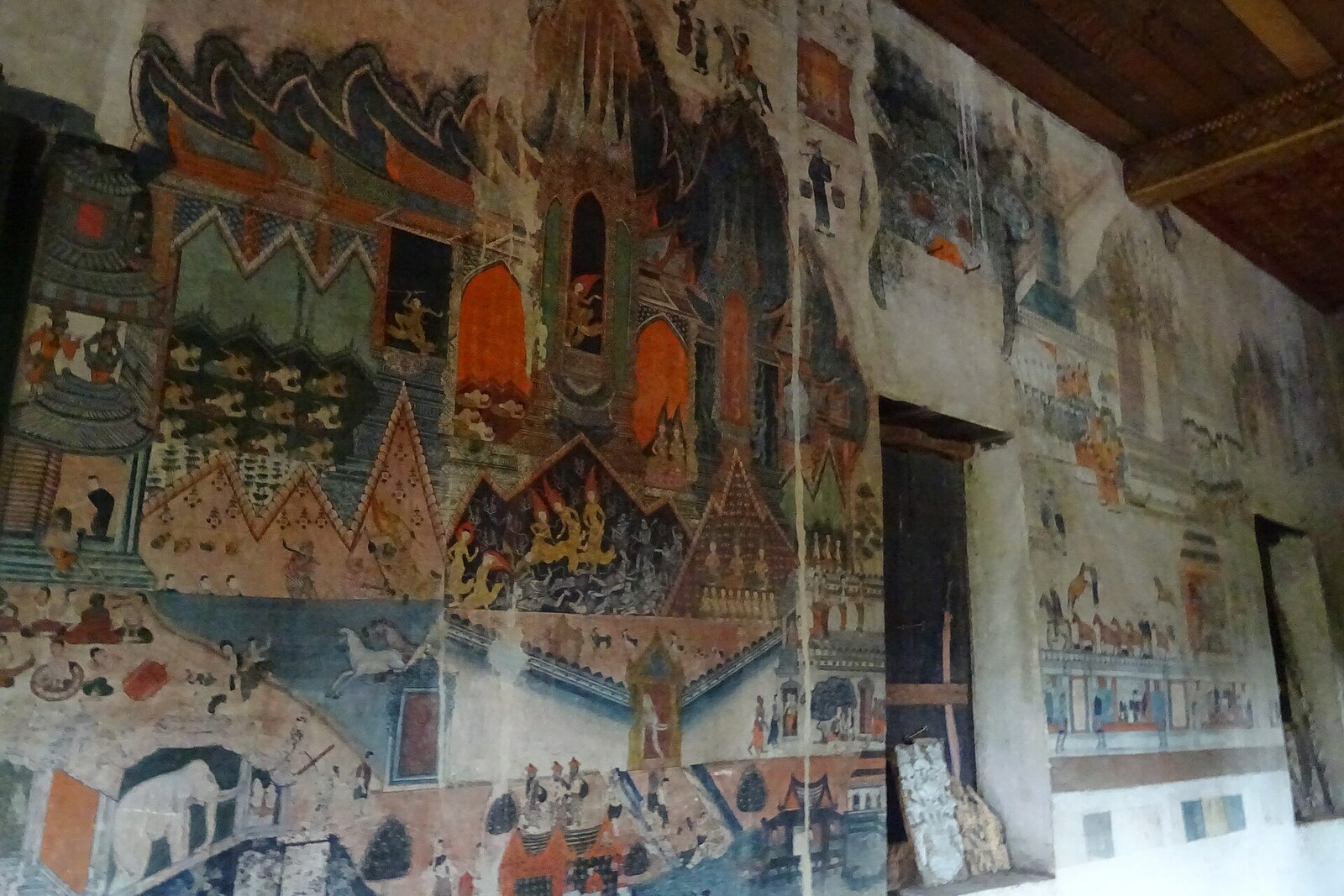
Look around first
What to notice
- Separate prayer hall
- Stupa
- Darkened wall murals
- Figures of townspeople in the murals
The story of the place
Wat Pa Huak was built on the site of a bamboo grove on the slope of Phousi, as a monastery courtyard with residential buildings, a main prayer hall, and a stupa. Of the whole complex, only the hall and stupa can now be seen; the community gathered in the hall for prayer. Its inner walls were covered with a cycle about King Jambupati, but Lao masters placed musicians, craftsmen, lovers, and foreigners from the city they knew beside the mythical palaces. The faded figures on the walls preserve a rare picture of everyday life in Luang Prabang in the mid-nineteenth century.
In nineteen forty-two, the Lao Ministry of Religious Affairs ordered all monks and nuns to be resettled from here. The monastery’s old residential buildings were demolished: officials considered them unattractive opposite the royal palace. The community lost its home, and Wat Pa Huak ceased to be a place of permanent monastic life.
Before that, an entire complex stood here. It was founded in eighteen sixty-one by Phaya Si Maha Nam under King Chantharath. The name Wat Pa Huak means “the monastery of the bamboo grove”: it preserves the memory of what grew on this slope of Phousi before the temple courtyard appeared.
Phaya Si Maha Nam commissioned murals for the main prayer hall. Their subject is the Southeast Asian legend of King Jambupati. The proud ruler was preparing to conquer the kingdom of Bimbisara, but Buddha appeared before him in the guise of a universal monarch, surpassing him in wealth and grandeur. Jambupati acknowledged defeat, renounced his claims, and became a monk.
Lao artists used similar murals in Siamese temples as their model. This was only natural: Luang Prabang then depended on Siam, and members of the royal family spent long periods living and studying in Bangkok. Yet the masters did not limit themselves to the legend. Among palaces and celestial beings, they painted crafts, musicians, lovers, and foreigners whom they saw in Luang Prabang. So a commission about the humility of a mythical king left on the walls a rare depiction of everyday life in the city in the mid-nineteenth century.
After the community was removed, the main hall was not demolished. Buddhist manuscripts were stored in it for some time. Now there are no permanent monks here, and the temple is opened mainly on religious holidays. Of the former monastery courtyard, a separate prayer hall, a stupa, and the name of the vanished bamboo grove remain; inside the hall, darkened figures of townspeople survived the removal, placed beside King Jambupati by anonymous artists.
Useful on site
There is no reliable daily schedule; according to a local cultural source, the inner hall is opened only on certain sacred days
Checked: date not specified. Check the official source before visiting.The murals are fragile: do not touch the walls and refrain from using flash. Access inside may be irregular; if the doors are closed, examine the mixed architectural details from outside.