 Guide On Map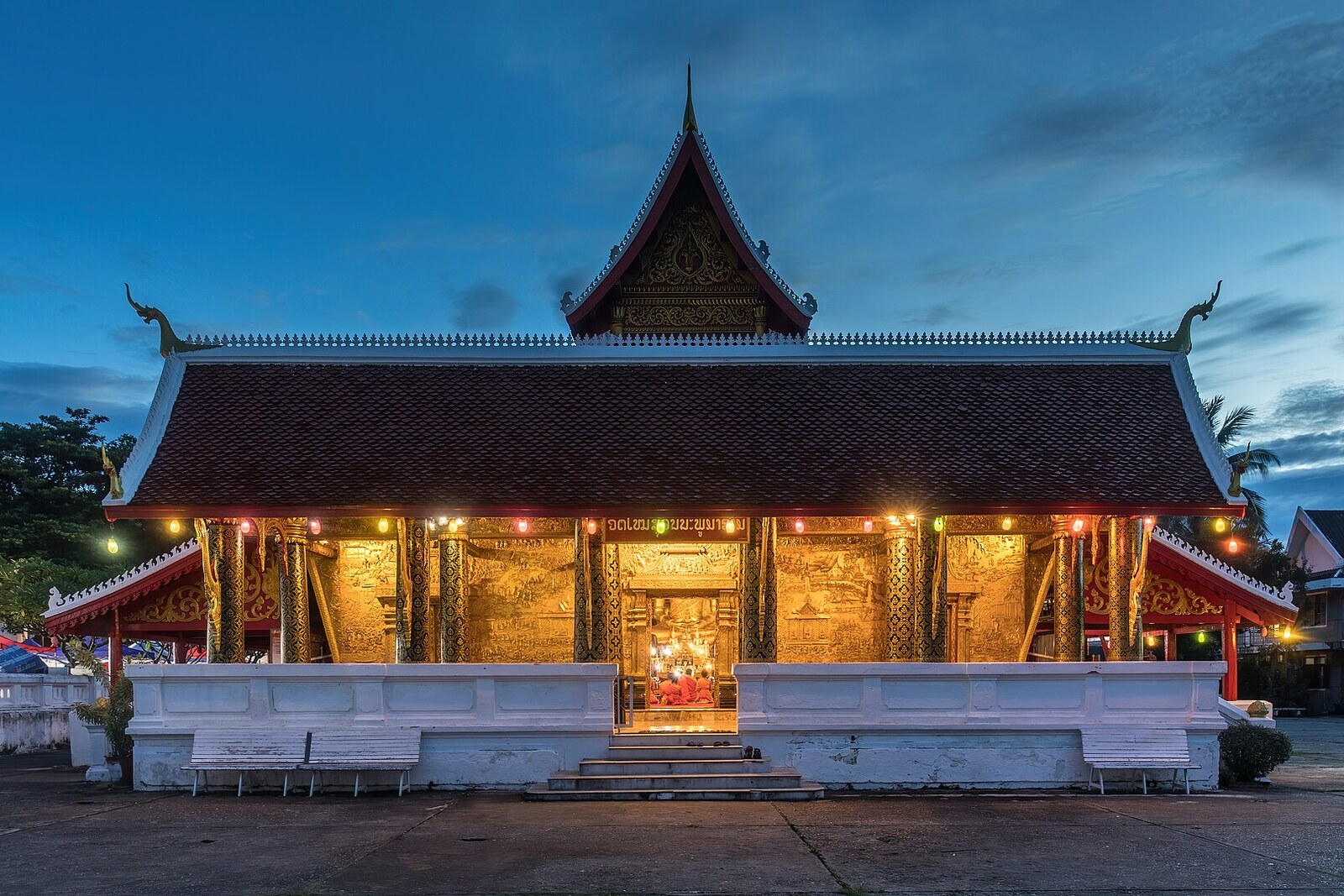
Look around first
What to notice
- Wooden sim
- Front colonnade
- Rear colonnade
The story of the place
Wat Mai means “New Monastery.” The first temple here was built by King Anourat in seventeen ninety-six. A quarter of a century later, his son, King Manthathurat, ordered the wooden sim—the main ceremonial hall—to be rebuilt and front and rear colonnades added. After this reconstruction, the monastery received its present name. Its full name, Wat Mai Suwannaphumaham, is translated as “New Monastery of the Golden Land.”
The main story of this courtyard began with people whose names have not been preserved. In eighteen eighty-seven, armed Ho detachments arriving from the north entered Luang Prabang. At another city monastery, Wat Visun, there was then Pha Bang—a standing statue of Buddha, eighty-three centimeters high and weighing more than fifty kilograms. The city bears its name. For the royal court, Pha Bang served as a protective image and a sign of the rightful ruler; Siamese troops had already carried it away twice as a war trophy.
Before the attack, the guardians took the heavy statue out of Wat Visun and hid it. The Ho detachments burned and looted the temple itself, and many other Buddha images disappeared. Pha Bang survived. Wat Mai was also among the few monasteries that did not burn down.
King Sakkalin, who was rebuilding Luang Prabang after the devastation, ordered the rescued Pha Bang moved here in eighteen ninety-four. At the same time, he appointed the monk Thana Tissapanya as the first supreme patriarch of Luang Prabang—the head of the local Buddhist community—and housed him at Wat Mai. Thus the royal sacred image came under the care of the most senior monk, beside the king’s residence. Wat Mai became the venue for citywide ceremonies and remained the residence of the supreme patriarch for almost the entire twentieth century.
Later, Pha Bang was moved to the palace complex. For most of the year, the statue is there, in the separate Haw Pha Bang pavilion. But on the third day of Lao New Year, senior monks, city authorities, and residents carry it back to Wat Mai on a palanquin. Here Pha Bang is placed in the sim, and for three days people perform ritual bathing with water.
Long ago, unnamed guardians carried the heavy statue out of a burning monastery. Now its annual return ends precisely at the surviving temple that King Sakkalin chose for it after the fire.
Useful on site
Daily 08:00–17:00
Checked: date not specified. Check the official source before visiting.The main account is presented on the facade, so the stop remains meaningful even without entering the hall. Inside, observe temple etiquette and do not disturb prayer.