 Guide On Map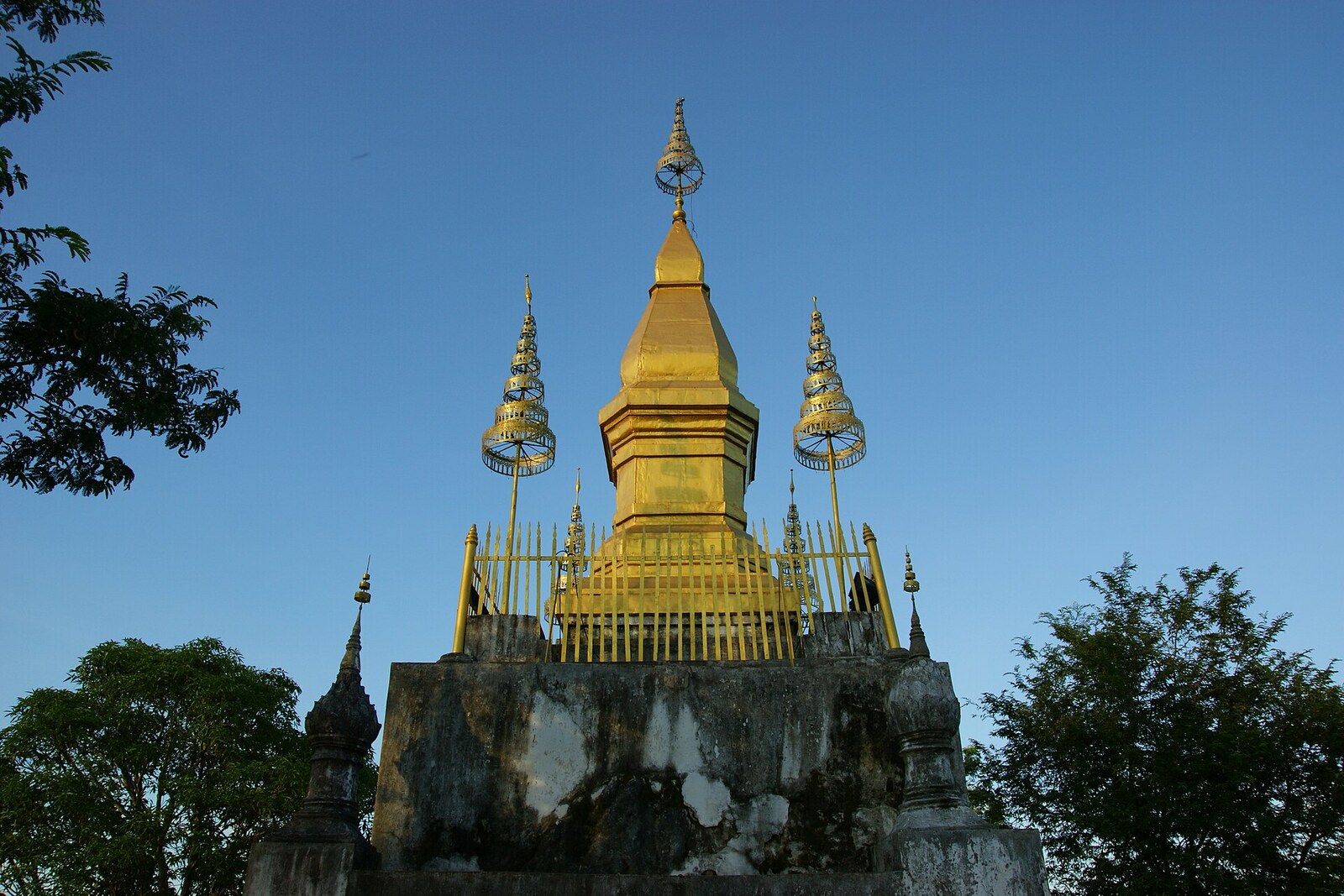
Look around first
What to notice
- The golden That Chomsi stupa
- The drum pavilion
- The three-tiered base
- Bronze umbrellas
The story of the place
North of the golden That Chomsi stupa stands a separate drum pavilion; only the appointed drummer may enter it. He beats the time and gives signals on Buddhist holidays, for announcements, and in emergencies. This stupa contains relics of Buddha, and beside it rises another one, twenty-one meters high: its base has three tiers, lotuses are placed at the corners, and four seven-tiered bronze umbrellas stand at the top.
King Anourat of Luang Prabang ordered construction on this summit after being taken captive twice. His crown depended on Siam—the name Thailand bore until nineteen thirty-nine. In seventeen eighty-eight, the Siamese took Anourat and other members of the dynasty to Bangkok as hostages. Four years later, he was allowed to return and take the throne. Almost immediately, the ruler of neighboring Vientiane accused him of secret ties with Burma, captured Luang Prabang, and again sent the king and his family to Bangkok. Only diplomatic intervention from China helped Anourat return in seventeen ninety-six.
Eight years later, he ordered That Chomsi built here and the first staircase laid to the summit. A that is a Buddhist reliquary stupa; this one contains relics of Buddha. For a ruler who had twice received his own kingdom back with foreign permission, the choice of site was exact. Local people had long considered Phousi the dwelling place of the city’s guardian spirit and called the mountain a likeness of a lak mueang—a sacred pillar that anchors a city to the earth. No written explanation by Anourat survives, but researchers link the construction of Buddhist reliquaries on such summits with the assertion of a king’s right to this territory.
Anourat kept the throne, handed rule to his eldest son in old age, and died in eighteen nineteen. His stupa became the summit’s main shrine, but residents continued to appeal to the mountain’s earlier guardians.
A local tale is connected with this: a deep pit supposedly ran from here to the center of the earth. This is a legend. Villagers helped a monk descend into the pit, where he found a treasure. They took the find, sealed the exit, and left the monk to die underground. He escaped with the help of magical amulets, overcoming seven guardians of the treasure. Learning of the attempted murder, an unnamed king required the culprits to take turns beating a drum, a gong, and cymbals every three hours: it was believed that this would keep the dragons beneath the mountain from disturbing people. The punishment became a city office.
North of That Chomsi, a separate drum pavilion still stands. Only the appointed drummer is allowed inside; the beats are sounded at set times, on Buddhist holidays, for announcements, and in emergencies. Beside it rises Anourat’s twenty-one-meter stupa: three tiers at its base, four lotus-shaped markers at the corners, and four seven-tiered bronze umbrellas. The golden reliquary dates from eighteen oh four, and local people trace the duty in the neighboring pavilion back to the time when people were still seeking an entrance underground in the summit.
Useful on site
Daily 06:00–18:00; the official source warns of seasonal changes
Checked: date not specified. Check the official source before visiting.The climb includes 328 steps. Wear comfortable shoes, take breaks, and be especially careful after rain; leave clear space for worship at the stupa.